


The Abridged version:
- Certified music practitioners perform for hospice care patients in traditional medical settings, adding ease for those toward the end of life.
- Some research points to health benefits of music when involved with treatment for some conditions, but much remains unclear about the effect on patients.
- “It has helped me to become more comfortable with end of life because I know that’s where we’re all headed,” Ann Roach said. “And it’s helped me have very open conversations with my family, my children where death is just a part of the conversation.”
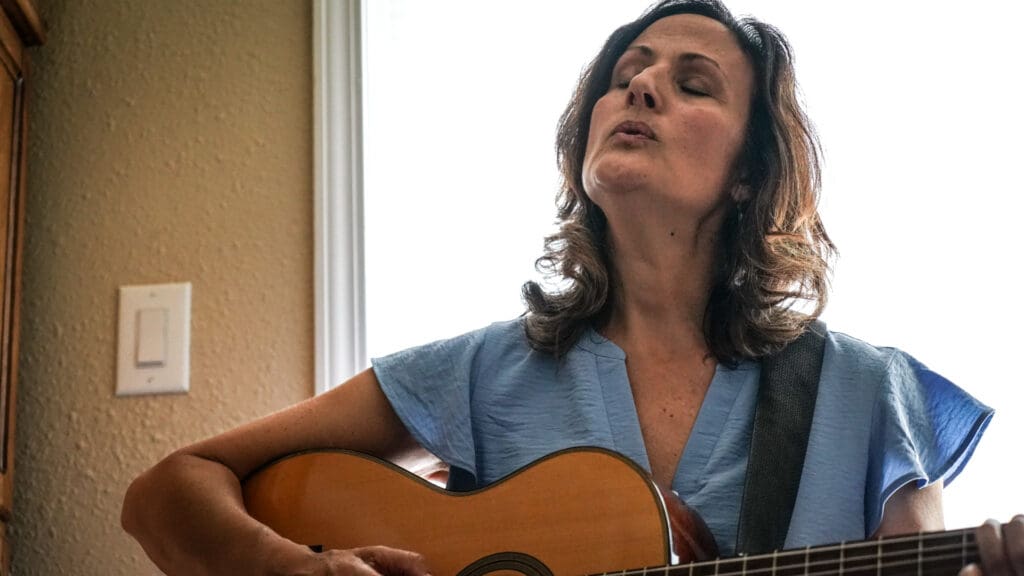
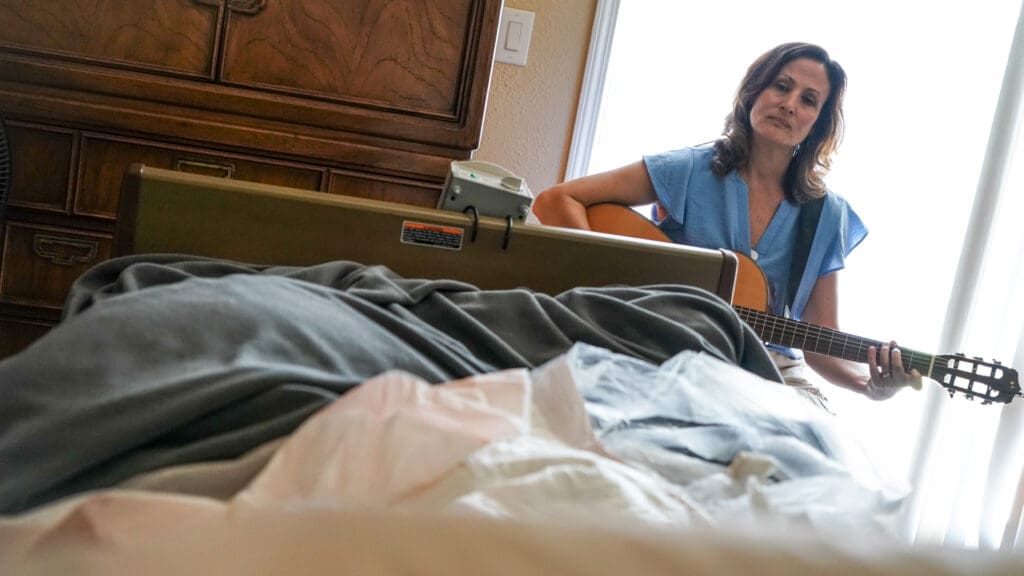
Ann Roach stepped into a darkened room in a residential care home with her guitar.
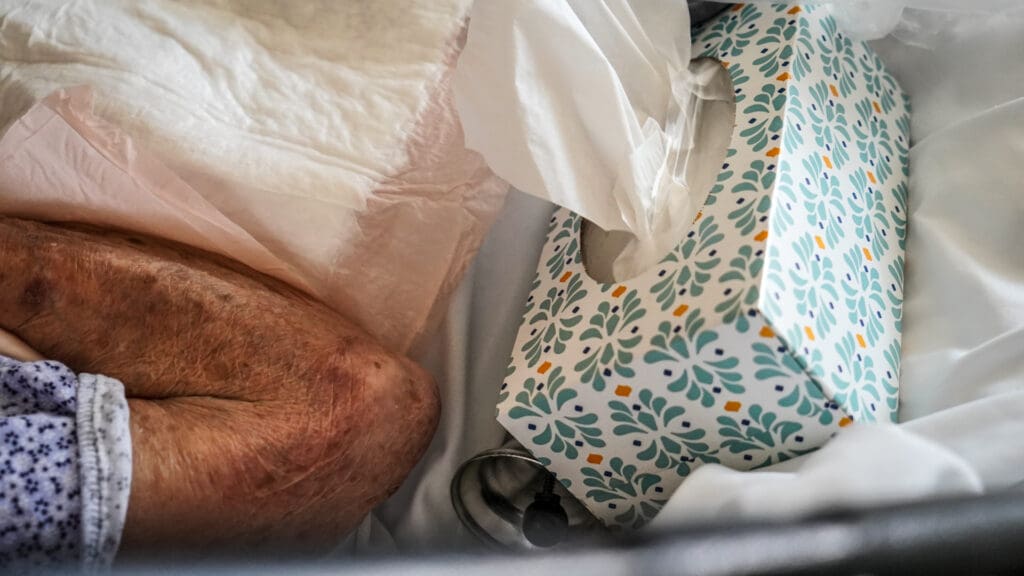
The room’s resident, more than 90 years old, was alert and communicative and greeted Roach from her hospice bed in a Roseville facility. As Roach began strumming and singing, the patient smiled and melted into rest.
Spending time with hospice patients can be a sensitive experience. Roach, 52 and a longtime musician, sees it as a time of vulnerability and service.
“It is the most incredible thing to know the service that you’re giving has a value, and that it’s actually really helping,” she said.
Healing with music
As a certified music practitioner, Roach creates a space of comfort for people at the end of life.
“We meet the patient where they are, and then we move them, through music, to where they can be more comfortable, where we can help with their breathing, with their pain level, with the dying process,” she said. “It’s a science-based art form.”
Carol Spears, CEO of the Music for Healing & Transition Program, pointed to scientific evidence behind the healing effects of music.
The combination of music and training can “alleviate physical pain, emotional suffering and anxiety; promote much-needed relaxation and sleep; stabilize vital signs; elicit memories in cognitively impaired patients, and ease the dying process,” she said in an email.
“The ‘how does it do that?’ question is not yet fully answered, but the outcomes are measured and observed.”
The method is based in science, but the setting requires sensitivity. The effect comes down to the condition of the patient, Roach said, and the practitioner’s ability to connect.
“The magic happens one-on-one, where you are there in service to that individual and taking the cues from them, and they’re not distracted,” Roach said.
A background in music
Roach has been singing in spiritual communities for more than two decades. That involvement, which she refers to as her music ministry, led to her understanding of music as healing.
“I started to realize that music has the ability to really, really touch and affect people,” Roach said. “I would have people tell me, ‘I needed a release today, you helped give me that release.’”
The inspiration to begin formal study came from the 2014 documentary “Alive Inside: A Story of Music and Memory,” which showed the power of music when treating people with dementia and other cognitive ailments.
“They would become themselves again,” she said. “And I just was like, ‘This is it. This is my next step.’”
Roach studied voice at a Colorado music academy for six years, starting in high school. To meet her new goal, she attended the Music for Healing & Transition Program with a practicum at UC Davis Medical Center. She was certified in 2018.
What started with one day a week turned into a full-time gig at the Med Center, treating hospital patients of all kinds, not only those in hospice care.
“That was kind of my pride and joy,” Roach said. “I felt like I helped pioneer that, and that was really special.”
The music program expanded as various departments saw the difference music could make in their patients’ progress.
Case in point: An ICU patient who was very agitated. Medical staff tried what they could. Then they called in Ann, whose music calmed the anxious patient.
“And all of a sudden, his oxygen goes up, his heart rate starts coming down, and you can see it. The coolest thing on the ICU floor is you can actually see it happening,” she said. “So you have the evidence right in front of your face.”
After the program lost its funding, Roach worked through Music Partners in Healthcare, a placement service for certified music practitioners in the Sacramento region. She secured a position with First Call Hospice and now visits patients in their own homes or in care facilities.
A wide range of services
Music practitioners are trained for a wide variety of health conditions and hospital departments. Roach has felt the impact of her practice on her personal life.
“It has helped me to become more comfortable with end of life because I know that’s where we’re all headed,” Roach said. “And it’s helped me have very open conversations with my family, my children, where death is just a part of the conversation.
“I’ve had the frustration of, you know, talking to aging parents who don’t want to talk about it. And yet, it’s what I get to do every day. Be with people that are going to transition.”
Peace for families, too
Paul Milkey and Christina Nicholson heard Roach play when their mother, Beverly Milkey, was in hospice.
“Anne’s music provided a bright moment that we could all share together,” Milkey said. “It made me feel like my mom‘s life was important because someone very talented was willing to spend time with her (and us).”
A musical background is just one of the qualities of a certified music practitioner. Roach said her work with hospice patients requires a different set of tools than public performance.
“Compassion is a really important element. Just to be a presence in that space,” she said. “That’s where it starts. Having an open heart.”
Jean Ann Walth is a harpist and team member at First Call. She noted a successful music practitioner should be gentle, calming and attentive, with a combination of training, experience and an empathetic heart. She has observed Roach’s talent for the work.
“Her patients relax, often transcending their pain and finding comfort,” Walth said.
Roach added one more prerequisite for the job: finding out what works for each patient.
“You start at a point, and you see how they respond,” she said. “You’re using music as a tool. But you’ve got to find them first.”
Donna Apidone is a regular contributor, writing Coming of Age for Abridged.