

The Abridged version:
- Author Reyna Grande’s eighth book, “Migrant Heart: Essays About Things I Can’t Forget,” covers her life, from immigrating to the U.S. to watching her children grow and move out.
- The Sacramento-area author and her husband are moving from Woodland to travel and explore the world.
- Grande has been a staple of the local literary scene and influenced writers and readers with her work.
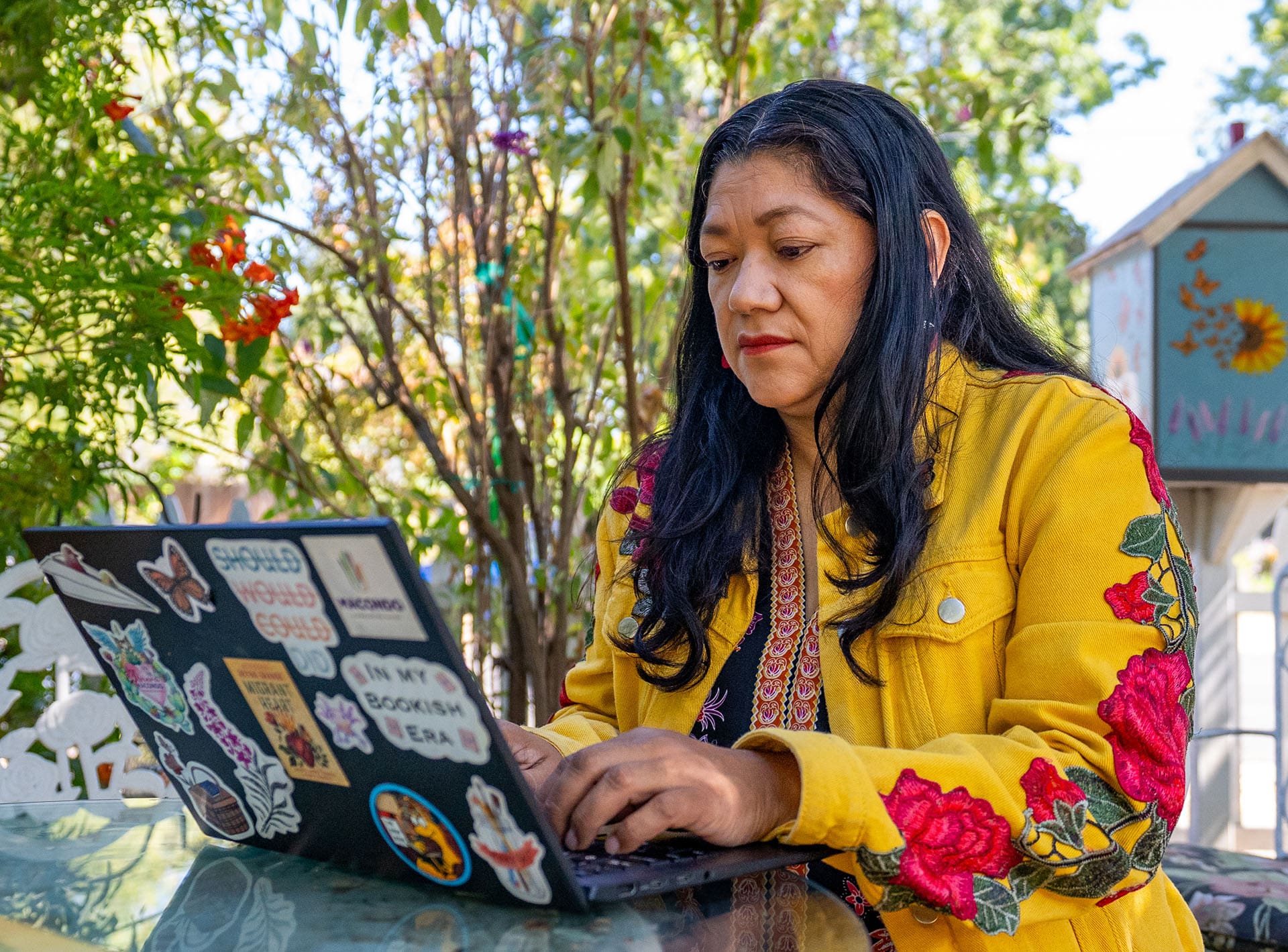
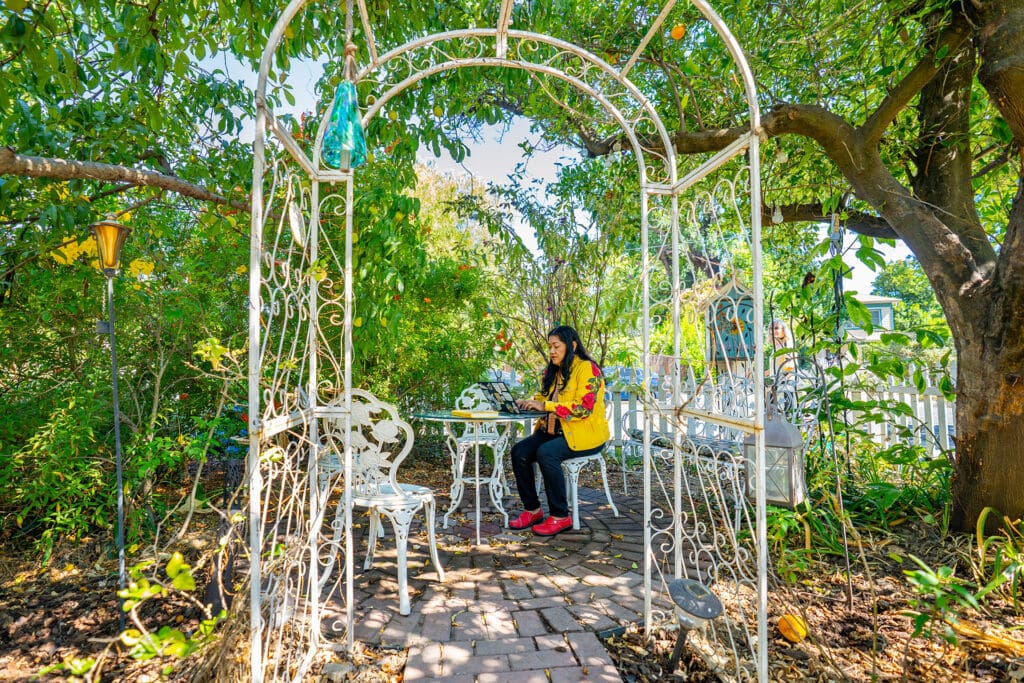
Reyna Grande stands in her garden, wearing a jacket that matches the cover of her latest book. She made it herself.
“Nice jacket!” a passerby on a bicycle shouts.
The jacket, bright yellow with appliqued red roses and dark green leaves, represents her accomplishments. The wearable art also speaks to the author’s journey.
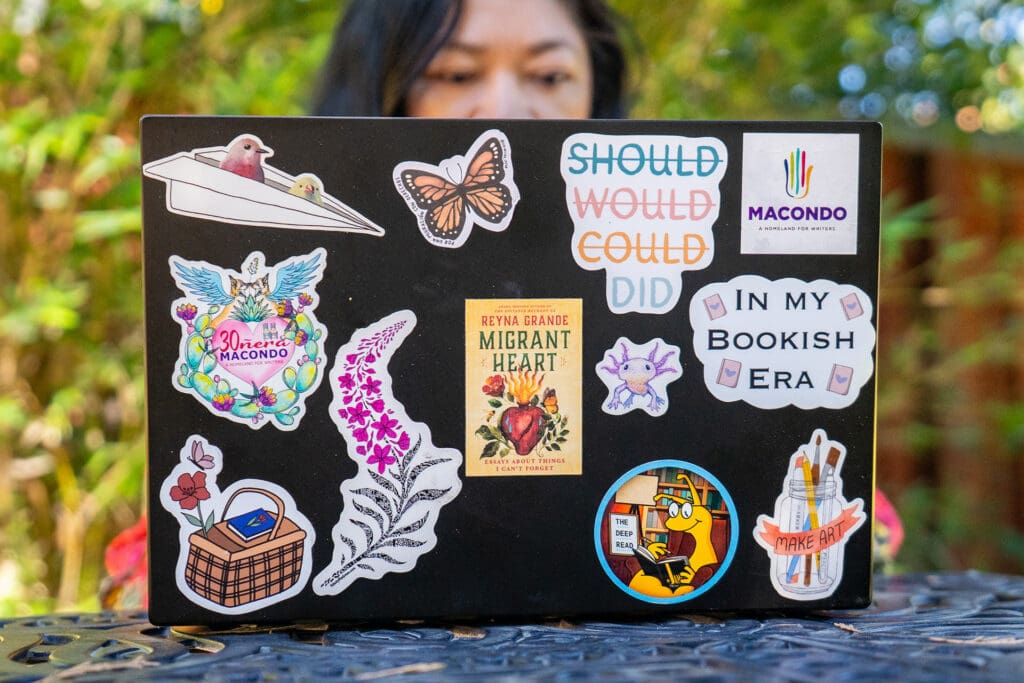
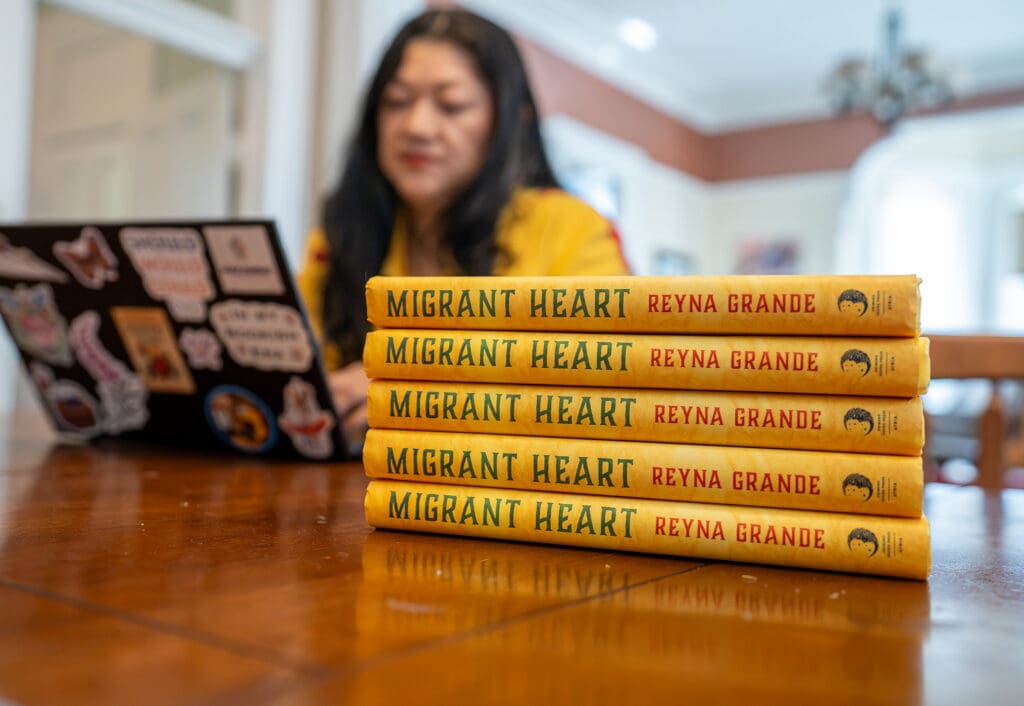
“Migrant Heart: Essays About Things I Can’t Forget” is Grande’s eighth book. The subtitle gives us a clue that she delves into all eras of her life, from the trauma of immigration from Mexico in her early childhood to watching her children leave the nest.
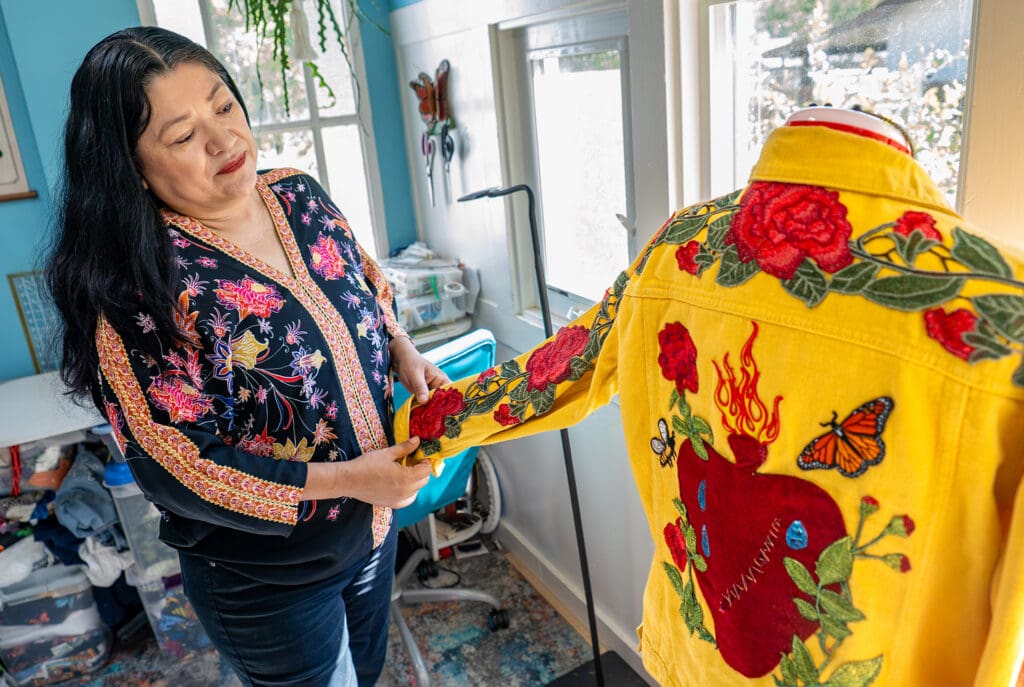
The heart milagro on the book’s cover is a religious icon, popular in Mexico and other Latin American countries, that represents a source of divine love. It also signifies hope and healing.
Like the rest of her work, Grande opens her heart in this book. She shares emotional pain as well as joy. Writing is how she processes her trauma and her celebration.
“It took me a long time,” she said, “because my conditioning as a child was instability. Even though I craved peace, I would intentionally disrupt it. Like, this is not what I’m used to.”
Sign Up for the Morning Newsletter
The Abridged morning newsletter lands in your inbox every weekday morning with the latest news from the Sacramento region.
She saw a pattern she wanted to change. Writing is the tool she used to accomplish that growth.
“As we get older, we learn to appreciate stability, you know?” she said. “We learn to appreciate, like, just not having any drama anymore, but just having peace.”
For most of her adult life, peace has meant a quiet house with a lovely garden. Now, with kids moving out of the house, Grande and her husband have decided to sell their home in Woodland, travel the world and experience other cultures.
Baring the heart
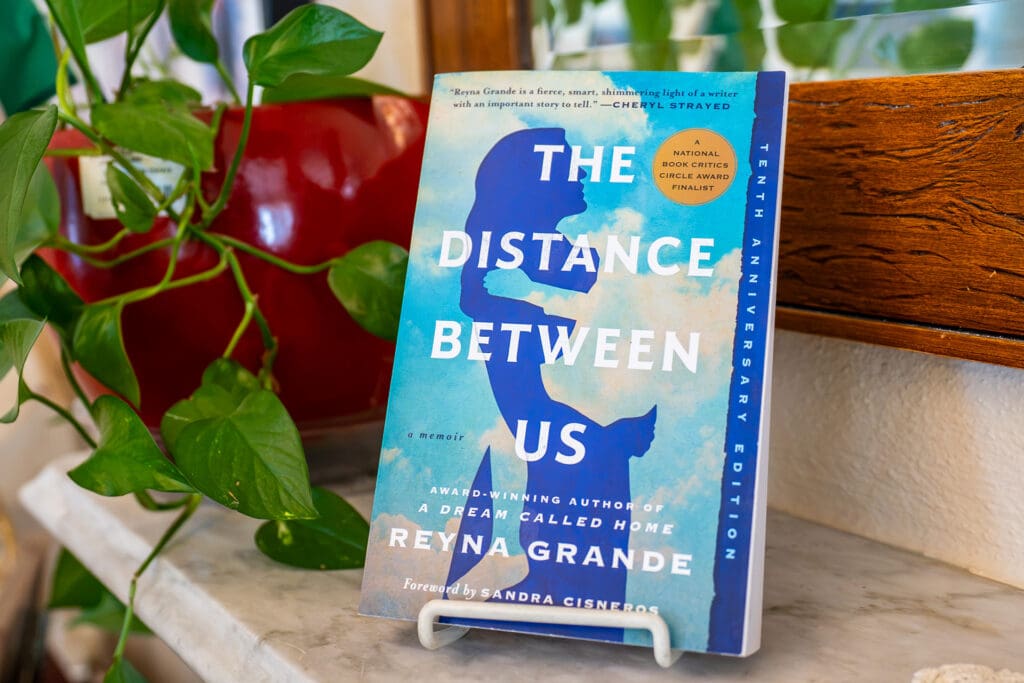
In earlier books, especially “The Distance Between Us,” Grande, 50, lays out the story of her youth. She felt abandoned when her parents left her with grandparents and moved from Mexico to Southern California. She experienced the anxiety of crossing the border with her siblings several years later.
Her story is not only appreciated by immigrants. The emotions of a lonely child resonate with a lot of people who experienced trauma in their youth. Adults who experienced abuse also relate to her story. “The Distance Between Us” was also published in a young adult version in Spanish and English, helping young readers to realize they are not alone.
The author, who has long called the Sacramento Valley home, has shared her work around the country and in Europe. She has been a staple of the local literary scene, speaking and reading her work throughout the region. That tradition continued in May with the release of “Migrant Heart.”
Tim Gaffaney is the casting director for Stories on Stage Davis, which has presented two readings of Grande’s work.
“It’s not just her choice of topics, but the way she constructed her narrative,” he said.
Author Leslie Priscilla, who has shared the stage with Grande at book readings, agrees.
“Reading her words feels like she’s holding your hand through the story, and that’s warm, generous, and transformative,” she said.
Between cultures
One of the topics Grande explores in “Migrant Heart” is the irony of not being fully engaged in a single culture.
“The struggle has been, here in this country, we are made to feel ashamed of being Mexican, of our skin color, of speaking Spanish,” she said. “But then, on the other side, is a Mexican community that then criticizes because we don’t speak Spanish well enough, or we’re too Americanized.”
Going home to Mexico doesn’t always feel welcoming.
“I show up there, super liberal, feminist, and I’m behaving a certain way that my female cousins over there wouldn’t behave, and so I can see that I am different,” she said.
The rules of immigration are different now than when Grande crossed, but the separation of families is much the same.
“The impact was the distance that was created in our family that, to this day, continues to affect us, you know? Because there’s so much trauma,” she said.
“And understanding that has helped me to understand my parents and why they were also dealing with so much trauma themselves that then prevented them from being better parents. They were dealing with their own things, and so that is something that I feel we don’t talk enough about when we talk about immigration.”
In understanding her own family, Grande is helping other families to understand. Through her public appearances and her books, Grande has reached the hearts of a generation of people born in the U.S. She is proud of that.
“When they read my work, it really helps them to understand what their parents went through, what their grandparents went through,” she said. “That’s what’s important when I talk to young people. That has enormous value.”
The hope
Bonnie Hearn Hill is a novelist and essayist in Fresno. At a recent bookstore event, she met members of a book club that reads Grande’s work and travels to hear her talks.
“She’s a voice for people who have lacked a voice,” Hearn Hill said. “When you write the really hard stuff, there is a healing that takes place.”
Priscilla thinks of Grande as more than a voice.
“She’s not just an author to me and the community, she’s truly an hada madrina (fairy godmother) to a whole generation of writers coming up behind her, myself included,” she said.
Grande always combined her love of storytelling with her training as a teacher. Now she mentors writing students at Antioch University in Los Angeles.
Grande was Hearn Hill’s thesis advisor for her Master of Fine Arts at Antioch University.
“Creative nonfiction, which is what this is, reflects our culture,” Hearn Hill said.
“Writing is an art and a craft. You’re born with a certain amount of one, and you can learn everything you have to know about the other. And I believe ‘Migrant Heart’ is both art and craft.”
As a young teacher, Grande would stay up late to write her first novels. It took some time before she could make writing her full-time career.
“So then you recognize it as success. Not as a wild dream you have,” Grande said. “I’m grateful for that, because I know that a lot of writers don’t get to have that, you know? They need to have a day job to support their art.”
“Once your livelihood depends on your art, then you’re not just creating for the sake of creation, the joy of creation.”
Used to the stress
The younger of Grande’s two children, Eva, just graduated high school and has already proven herself to be a talented writer. The two enjoyed presenting a book reading together at Stories on Stage Davis in 2024.
Grande said Eva is realistic about writing as a career.
“There’s this constant stress and anxiety to make enough money to pay my bills through my art, and that’s something my daughter has picked up on,” Grande said. “She’s like, ‘I don’t think I want that, you know? It’s so stressful.’”
Well into her career, Grande is used to the stress. She is celebrating the 20th anniversary and second publication of her first novel. She does most of her own marketing, putting together a schedule of public speaking and book signings.
When she comes home, she spends as much time as she can in the beautiful gardens that surround her Victorian house in Woodland.
And she sews. That’s where the jacket comes in.
Grande found a bright yellow jacket on sale, created fabric appliques of the heart, flowers and leaves on her book cover, and attached them to cascade from the shoulders.
Her yellow jacket, like her latest book, is a perfect representation of a heart that has felt immense pain in the past, but now blooms as it expresses hope and healing.
Donna Apidone is a regular contributor, writing Coming of Age for Abridged.