

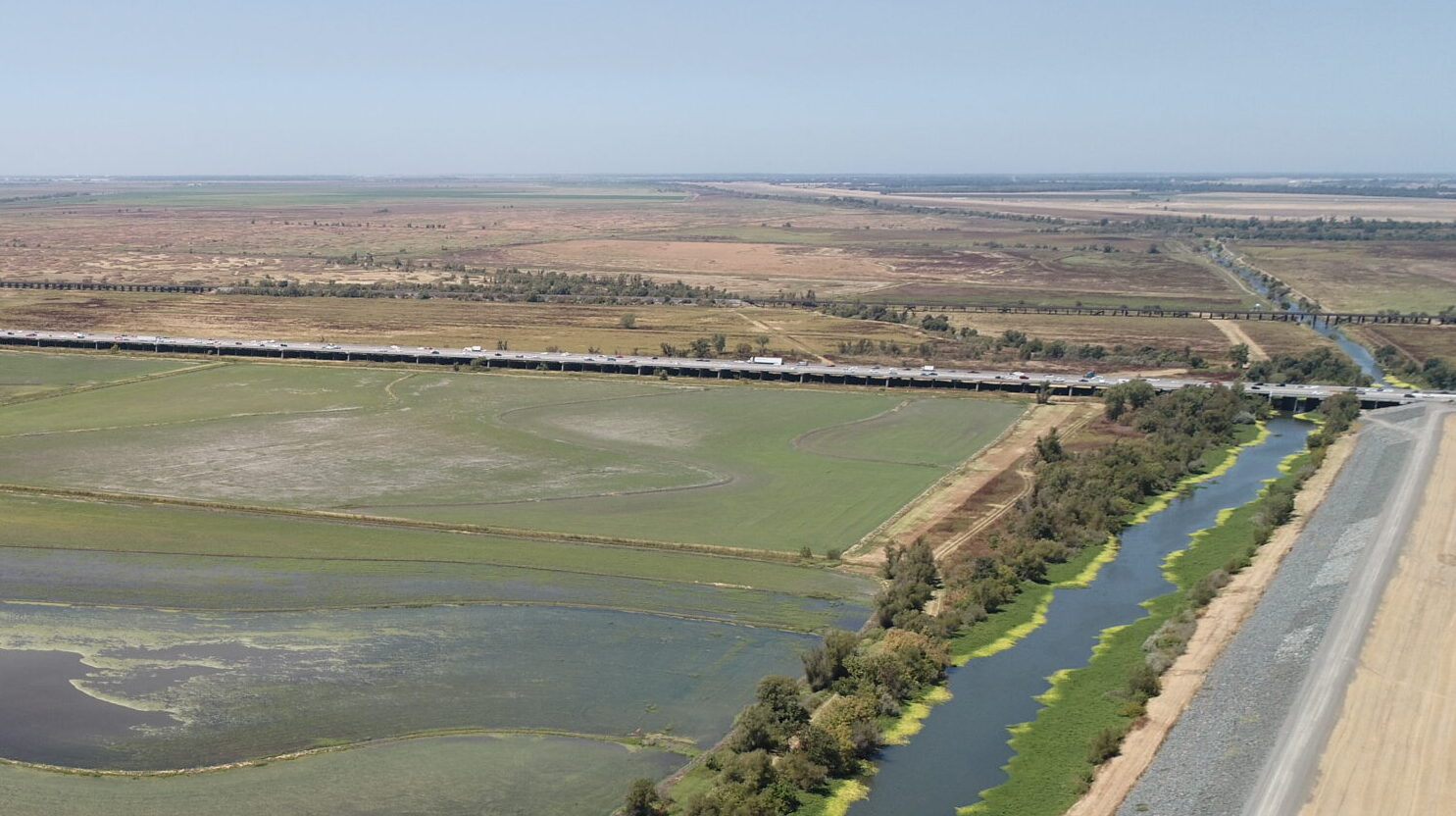
The Abridged version:
- Caltrans said it is nearing completion on a major construction project on Interstate 80 in Yolo County. The project, which has constrained traffic through Davis and on the Yolo Causeway, will add a bus and carpool lane.
- Caltrans officials said they aim to have all lanes open by the fall.
- The goal of the project is to reduce congestion in a notoriously traffic-filled section of freeway, but some experts question whether adding lanes accomplishes that goal in the long term.
Being stuck in a traffic jam on the Yolo Causeway can be a helpless experience. Suspended above the bypass with no escape, drivers frequently find themselves in stop-and-go traffic, completely at the mercy of the flickering red brake lights in front of them.
With narrow lanes, no shoulders and ongoing construction, the stretch of Interstate 80 that connects Davis and West Sacramento has long been plagued by congestion.
In an effort to alleviate some of that traffic, Caltrans embarked on a projected $465 million lane widening and traffic alleviation project in 2019.
When completed, the project will add a new tolled express lane going in each direction to the section of I-80 that runs through Davis to Sacramento.
Most of the construction will be done by the fall, said Caltrans spokesperson Dennis Keaton.
“A lot of it has already been completed,” he said. “The fall is when it’s supposed to be finished and all done.”
Officials hope the added lane will reduce congestion, but some experts question that logic.
“There is lots of evidence that shows if you add a lane, there is more driving, and within a few years you are back to the same level of congestion as you were before you added the lane,” said Susan Handy, UC Davis professor and director of the National Center for Sustainable Transportation.
Caltrans sees it differently.
“We still believe in the bus/carpool system,” Keaton said.
Managed lanes for congestion
Managed lanes like tolled express lanes are increasingly popular traffic tools that are being employed in the region and across the state.
“Any new lanes that are being put in in metropolitan areas of California are some kind of managed lane at this point,” Handy said.
The idea behind managed lanes, Handy said, is to encourage people not to drive alone and to maximize the capacity of each individual lane.
With carpool and bus lanes, people can bypass usual rush hour congestion, creating more of an incentive to use transit.
On top of that, express lanes allow individual drivers to buy their way into emptier lanes, allowing people in a rush to avoid traffic while paying for facilities.
While that can help some drivers, Handy said managed lanes are not a long-term solution to overall congestion relief.
“Adding lanes to the freeway only temporarily helps,” she said. “When you add a lane, what you are doing is enabling more driving, and maybe that’s the purpose, but you are not solving congestions except in the very short term.”
Handy said that remains true, even when the lane is managed as a carpool or express lane.
“The evidence we have suggests that a managed lane has the exact same effect,” she said. “They are being sold as a strategy for reducing congestion and they are certainly not a long-term solution to congestion.”
“My personal, professional opinion is that these projects are being mis-sold to the public,” she said.
Keaton said that Caltrans bases its decisions on studies that show that managed lanes work.
“Carpool lanes do make a difference,” he said.