
The Abridged version:
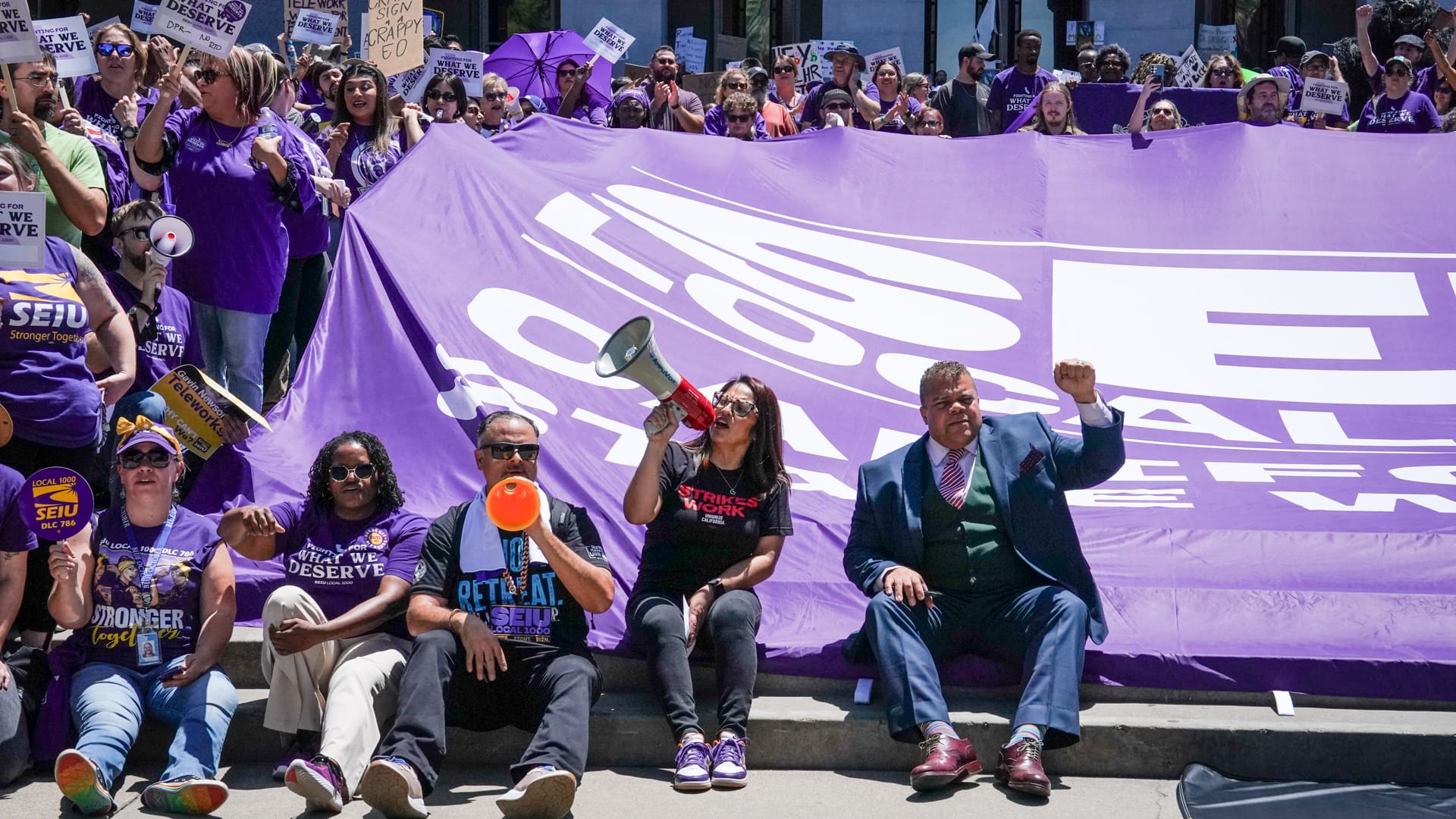
- SEIU Local 1000 announced its membership will vote on whether to authorize a strike over what the union calls unfair bargaining practices by the Newsom administration.
- If state workers covered by the union do strike, it could disrupt a diverse array of state services, from the DMV to California’s prison authority.
- The vote results and what the union will do next will be announced in October, union leaders said.
After California’s largest public employee union announced they’re holding a vote on whether to authorize a strike, the Sacramento region is confronting what life would look like if more than 100,000 state employees walked off the job.
For some who work alongside members of Service Employees International Union Local 1000 — which represents nurses, office workers, librarians, custodians, food servers and more, and announced the strike authorization vote Monday — a Local 1000 strike is hard to fathom.
“This is like asking, where do we drive if (Highway) 99 and (Interstate) 5 disappear,” said Carl Miller, president of AFSCME Local 2620 and a therapist who works alongside Local 1000 nurses at the California Health Care Facility, a prison hospital near Stockton.
“The alternative is just chaos.”
Sign Up for the Morning Newsletter
The Abridged morning newsletter lands in your inbox every weekday morning with the latest news from the Sacramento region.
It’s not the first time the Sacramento region — and communities across the state — is staring down this scenario. Local 1000 also voted a decade ago to authorize a strike, which it called off after an last-minute deal with then-Gov. Jerry Brown’s administration.
Whatever the precise impact, it would be sweeping: Local 1000 represents workers across multiple government agencies, from the department that handles unemployment to the DMV.
And its 100,000-plus workers represented, many of whom work in the Sacramento region, are equivalent to about 37% of the Sacramento-Roseville-Folsom area’s total government workforce.
Below, we dig into some of your biggest questions about a possible strike.
Why now?
The strike authorization vote will follow Local 1000’s July claims that Gov. Gavin Newsom’s administration has used unfair bargaining tactics in negotiations over the union’s next three-year labor contract.
But more broadly, the vote likely also represents a message to Democratic gubernatorial candidate Xavier Becerra, who polling shows has a strong edge over Republican Steve Hilton headed into the November election.
“I think it’s clearly a signal more to Becerra than it is to Newsom, because part of the resolution with the union will involve the state budget,” said Wesley Hussey, a political science professor and California politics expert at Sacramento State.
When a new governor takes office in January, he will have little influence over how the state’s planned budget for the next fiscal year will look, Hussey said. That’s because the outgoing governor will have had to already design the budget proposal to meet the January deadline, he said.
There’s more opportunity for change during what’s known as the May Revise — but by that point, the governor is often juggling a slew of other requested changes.
SEIU may hope Newsom will work with Becerra to address the union’s demands sooner than later, Hussey said.
“Democrat-to-Democrat transitions, there’s more likely to be that kind of positive passing of the baton,” he said.
The strike authorization vote may also represent Local 1000 flexing its muscle as Becerra enters campaign season’s final stretch.
“They’re kind of saying, we can be a strong ally, or we can just be a cordial ally,” Hussey said.
How likely is the union to approve a strike?
When asked if Local 1000 has data suggesting the strike authorization vote will pass, President Anica Walls said in a statement, “Since no strike has been called yet, it’s too early to speculate about the size, scope or operational effects of any action.”
The last vote passed with overwhelming support, with 92% of union members who participated voting “yes.”
Anecdotally, state workers have proven willing to strike more recently, too. State scientists with California Association of Professional Scientists UAW went on strike in 2023.
How would a strike affect you?
Local 1000 workers include some in public-facing roles who help Sacramento-area residents — and Californians in general — access state services.
They include DMV workers, employment program specialists with the Employment Development Department, nurses and more. Those employees would be absent during a strike.
But state business could also be affected in ways less obvious to the public, as Local 1000 members also include office assistants, secretaries and data entry staff across multiple offices, according to SEIU’s website.
State employees working alongside Local 1000 members would also feel their absence, Miller, the state prison therapist, said.
In his case, nurses wouldn’t be present to administer the medication Miller prescribes his patients, some of whom have serious mental health conditions, he said.
“I have no idea” what a strike would look like, he said. “I want SEIU to get a contract and get paid, right? But it obviously creates an untenable situation.”
How would state workers be affected financially?
If Local 1000 goes on strike, its members won’t be eligible to receive pay, leave or unemployment, according to SEIU.
The union has a strike fund, but it’s not enough to replace workers’ wages.
“The strike fund is not intended to replace workers’ wages during a strike,” the local’s website states.
“Going on strike is a financial sacrifice, and members should think about that and plan ahead.”
Correction: This story was updated at noon Friday, Sept. 11, 2026, to clarify that 100,000-plus workers are represented by SEIU Local 1000, not all of whom are union members. This story was updated Sept. 17, 2026, to remove reference to a category of worker that SEIU Local 1000 no longer represents.