

The Abridged version:
- Neonatal medicine has achieved remarkable progress since the mid-20th century, meaning babies born prematurely have a much better chance at surviving — and thriving.
- The limit of viability for a preterm baby in the 1970s was around 28 weeks. Now some NICUs take care of babies born at 22 weeks; UC Davis had survival rates of 42.9% for babies born at 22 weeks in 2025.
- The Sacramento region’s Sutter Health, UC Davis, Kaiser Permanente and Dignity Health all have NICUs, with Kaiser set to open another unit in 2029.
Editor’s note: November is Prematurity Awareness Month. This is the first of three stories exploring NICU access in Sacramento and personal stories of parents in our region. Sign up for the free Abridged by PBS KVIE Morning Newsletter to receive the next part in your email inbox.
Angie first experienced contractions at 26 weeks pregnant. She spent a couple of days in the hospital and was released only to wake up one morning having them again. She arrived at a hospital where she was told they do not deliver babies at 27 weeks’ gestation, put in an ambulance and rushed to a birth center in Sacramento.
Angie asked nurses to Skype her then-partner, a member of the U.S. Air Force stationed in South Korea at the time. She called her parents to catch the first flight out of Missouri. Angie’s best friend stood by her side in the operating room as she underwent an emergency C-section to deliver her daughter.
“I just remember … me asking, ‘Is she alive? Is she alive? Is she alive?’” Angie recalled.
Her daughter was alive, but born nearly three months early. She weighed 1 pound, 15 ounces.
“I never saw her because she was immediately hustled away and she was not OK,” said Angie, who is going by her first name to protect the privacy of her daughter, who is now 9 years old. “I never heard her cry and then they took her straight up to the NICU. My girlfriend saw her before I did because I said, ‘Go with her.’”
Sign Up for the Morning Newsletter
The Abridged morning newsletter lands in your inbox every weekday morning with the latest news from the Sacramento region.
Not all that long ago, a baby born “extremely preterm” at under 28 weeks would likely have died. Those born “very preterm” between 28 and 32 weeks faced significant medical complications, including the risk of death.
Now, some neonatal intensive care units, or NICUs, including in the Sacramento area, can care for “micro-preemies” born as early as 22 weeks and weighing about 1 pound, the very edge of human life’s viability. Local NICUs throughout the area are part of the push to continue improving services and care for preterm babies and their parents.
“No family goes into a pregnancy thinking they’re going to have a baby born prematurely,” said Dr. Timothy Sanders, medical director of the Sutter Sacramento NICU. “So it’s a journey.”

NICUs close to home
The Sacramento region is served by several NICUs operated by UC Davis Children’s Hospital in Sacramento, Kaiser Permanente facilities in South Sacramento and Roseville, Sutter Health facilities in Midtown Sacramento and Roseville, and Dignity Health in South Sacramento and Carmichael.
UC Davis Children’s Hospital has 40 NICU beds and is a Level IV NICU, the highest designation from the American Academy of Pediatrics. The facility is equipped to take care of “any problem that a newborn baby would have,” which includes complications from early birth at 22 weeks and infant surgical or congenital issues, said Dr. Steven McElroy, chief of neonatology at the hospital.
In 2024, UC Davis opened its Small Baby Unit for babies born under 27 weeks or weighing under 2.2 pounds, as a standardized way of caring for this specialized patient population.
Dignity Health’s Mercy San Juan Medical Center in Carmichael operates a Level III NICU that can care for 40 babies. This state-of-the-art facility opened in November 2020 “to meet the needs of the community into the future,” which means the number of beds and services provided meet projected needs, said spokesperson William Hodges. Dignity’s Methodist Hospital of Sacramento, near Elk Grove, has a Level II NICU with 12 beds.
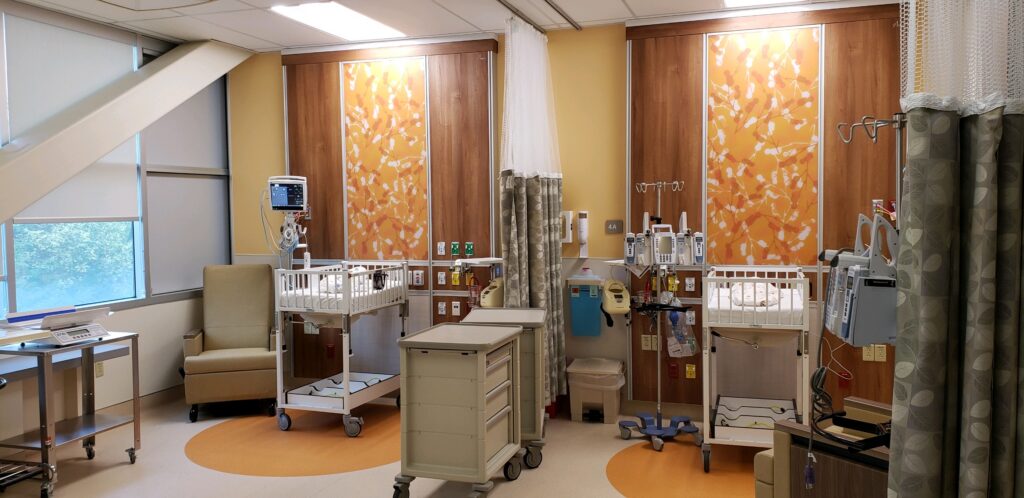
The NICU at Sutter Medical Center in Sacramento is also a Level IV and has 61 beds, making it Northern California’s largest unit. Some NICUs, including at Sutter Sacramento and UC Davis, can transport babies from across the region who lack easy access to a NICU or need more advanced care than their local hospital can handle.
UC Davis’ transport team, for example, transfers infants from within a 33-county service area in inland Northern California that encompasses as far north as Oregon, as far east as Nevada and as far south as Fresno County. McElroy said that the closure of maternity wards across the country is creating maternity deserts and could lead to higher rates of prematurity in the future and a greater need for transports.
Roughly 700 hospitals shuttered their maternity wards between 2010 and 2024 — nearly half of all hospitals now lack obstetrics. Of California’s 355 hospitals during this time frame, 17.5% of them lost obstetric services.
“It’s not unheard of for moms to have to drive an hour-plus to deliver their baby,” McElroy said.
As some places lose these services, the Sacramento region is expanding them. Scheduled to open in 2029, Kaiser’s Railyards Medical Center in Sacramento will include an eight-bed Level II NICU that will specialize in care for newborns born at “33 weeks gestation and greater who require additional monitoring, support or treatment,” said Dr. Rick Vitangcol, physician in chief for Kaiser Permanente Sacramento, in an email.
“Families will benefit from having their babies cared for closer to home by a dedicated neonatal care team,” Vitangcol said. “This NICU will be the 16th for Kaiser Permanente in Northern California.”

One advancement after another
Until around the mid-20th century, a baby born many weeks premature was hopeless. In the decades that followed, the outlook for these babies slowly improved.
When Angie’s daughter was born in 2017, nurses performed a test to determine her Apgar score, which assessed her overall health at 1 minute and 5 minutes after birth. Her daughter’s scores were dismal.
Physician Virginia Apgar developed the scoring system in 1952. While the U.S. infant mortality rate — death within the first year of life — had been decreasing, infant deaths within the first 24 hours after birth had not improved. The Apgar score, still used worldwide today, helps nurses and doctors identify babies who need immediate resuscitation or treatment.
“When Virginia Apgar came up with her scoring system that was a move forward,” said McElroy, of UC Davis Children’s Hospital. “That probably wasn’t the big one.”
The big one of that era, he said, was thermoregulation. A baby cannot regulate its own body temperature until around 36 or 37 gestational weeks because the infant lacks fat to act as insulation and the nervous system is underdeveloped. Thermoregulation balances heat production and loss to stabilize a baby’s temperature.

The idea of thermoregulation was planted in the late 1870s, when an obstetrician Étienne Stéphane Tarnier visited the Paris Zoo. During this time, France faced significant population decline from the Franco-Prussian War and famine. The country needed to have more babies — and keep them alive. The doctor saw poultry-warming chambers where chicks are raised the first several weeks of life. He designed similar incubators for premature babies, which then became standard practice in the U.S. around the 1950s.
In 1960, Yale’s Dr. Louis Gluck opened the first modern NICU in Connecticut. A key figure of neonatology, Gluck also spearheaded more advancements, including the protocol that people in the NICU must wash their hands before handling a baby to prevent the spread of infection.
The development of pulmonary surfactant therapy in the 1980s marked another crowning medical achievement as it greatly reduced the likelihood that preterm infants would die from respiratory distress syndrome, a breathing disorder. Surfactant coats the inside of air sacs in the lungs and allows for normal breathing.
“In the 1960s is when President (John F.) Kennedy’s son died, and he was born at 34 weeks, and he died essentially because of the lack of surfactant in his lungs,” McElroy said. “Since that time, we’ve developed a deeper understanding of what surfactant is, how it works. We’ve developed commercialized surfactant that we can give to the babies and that has really moved the needle.”
Sanders, of Sutter Health, also identifies continuous positive airway pressure, or CPAP, treatment as having “had substantial impacts on survival.” CPAP treatment provides pressurized air through a tube into the baby’s nose to keep a baby’s airway open. High-frequency ventilators are also now used, which are gentler than mechanical ones on a preemie’s fragile lungs.
Even before birth, doctors can help the health of a fetus. Magnesium sulfate can be administered intravenously to mothers when preterm birth is imminent to protect the fetal brain. Additionally, antenatal steroids given to the mother can fast-track the baby’s lung development.
UC Davis is continuing to advance neonatal medicine. UC Davis does research on infant resuscitation and several of its faculty have active National Institutes of Health-funded research programs in that area, according to McElroy.
By the late 1970s, the limit of viability for a preterm baby was around 28 weeks. Now some NICUs take care of babies born at 22 weeks; the survival rate nationally for this gestational age was 25.3% for babies born in 2025, according to a UC Davis spokesperson. UC Davis had survival rates of 42.9% for babies born at 22 weeks.
Why babies come early
The progress of neonatal care for premature babies is considered a remarkable health achievement, according to local doctors. At the same time, prematurity is not going away.
The preterm birth rate in the U.S. has increased since 2014 and stays stubbornly stuck at 10.4% of babies born at least three weeks early, according to March of Dimes, a national organization that works to improve maternal health and end preterm birth and infant death. This represents about 380,000 babies; Black women experience 50% higher rates of preterm birth than white and Hispanic women.
Babies arrive early for many reasons. Women who get pregnant at an older age are at higher risk of a complicated pregnancy and early birth. The use of IVF carries a higher risk for pregnancy complications and preterm birth. Pregnant women with gestational diabetes and high blood pressure can also be at greater risk.
An issue with the placenta or uterus can contribute to a premature delivery. In some cases, a baby might not be growing well or there are signs of infection. Racial, ethnic and socioeconomic factors play a role in preterm births; if a woman receives inadequate prenatal care because she is poor or a woman of color, she is more at risk for giving birth early.
“As we continue to really not put focus on maternal care and infant care,” McElroy said, “I think it’s going to be hard to move the needle on (preventing preterm births).”
And preventing prematurity in the first place remains an important goal. Because the NICU, for all its impressive medical advancements, gentle and nurturing care, and deep commitment of nurses and doctors, can also represent a harsh reality of trauma, logistical nightmares, financial burden and grief for those parents along this journey.

Part 2 coming soon: Local mom gives a look inside her daughter’s stay in Roseville NICU