
The Abridged version:
- Hundreds of thousands of bats call the Sacramento region home.
- Mexican free-tailed, Yuma and big brown bats are the three most common species in the area.
- Opportunities to see bats in nature exist at the Yolo Basin Wildlife Area and Cosumnes River Preserve.
This story was reported by a member of the Abridged by PBS KVIE Community Reporters program. The Community Reporters program empowers local residents to report stories with guidance and support from the Abridged editorial staff.
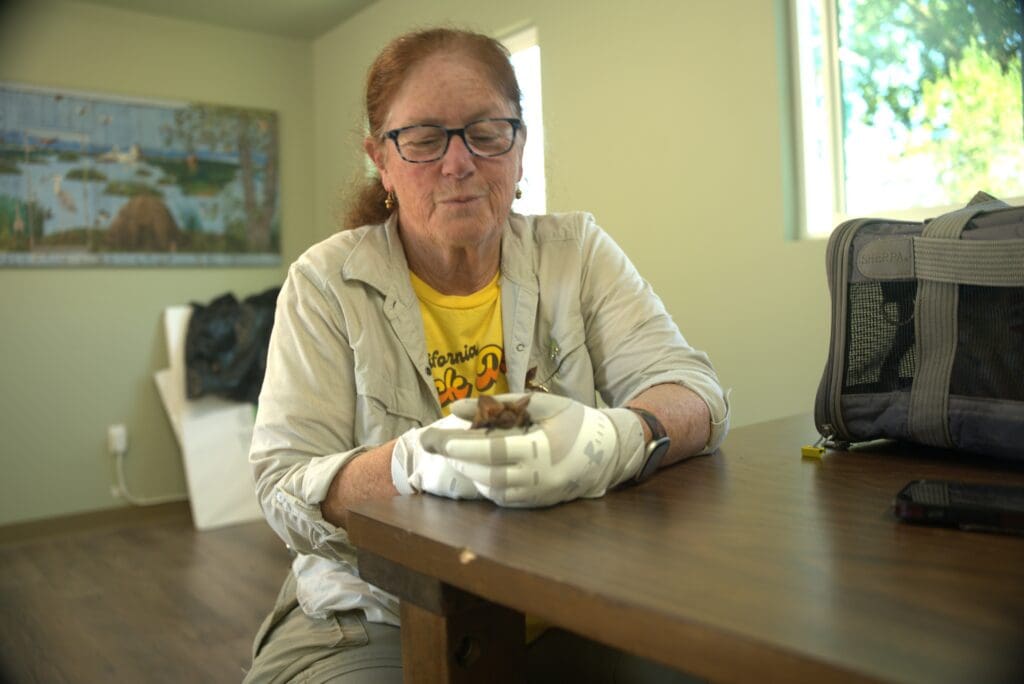
“Birds are just great, and bugs are fun, but bats have always been my favorite,” said Mary Jean “Corky” Quirk. She’s in a classroom at the Yolo Basin Foundation Visitor Center, a building off of I-80 that can be missed in a blink.
Quirk is an educator. That becomes obvious as she delivers rapid-fire facts during a show-and-tell with her winged exhibit bats, permitted by the state and federal government.
“They’re not flying rats or rodents,” she asserted. “They’re actually closer to hedgehogs and shrews.”
She explained that their wings are actually webbed hands, and that they’re the only flying mammal.
Quirk is one of only a handful of California experts to be permitted to rehabilitate and show off the winged animals.
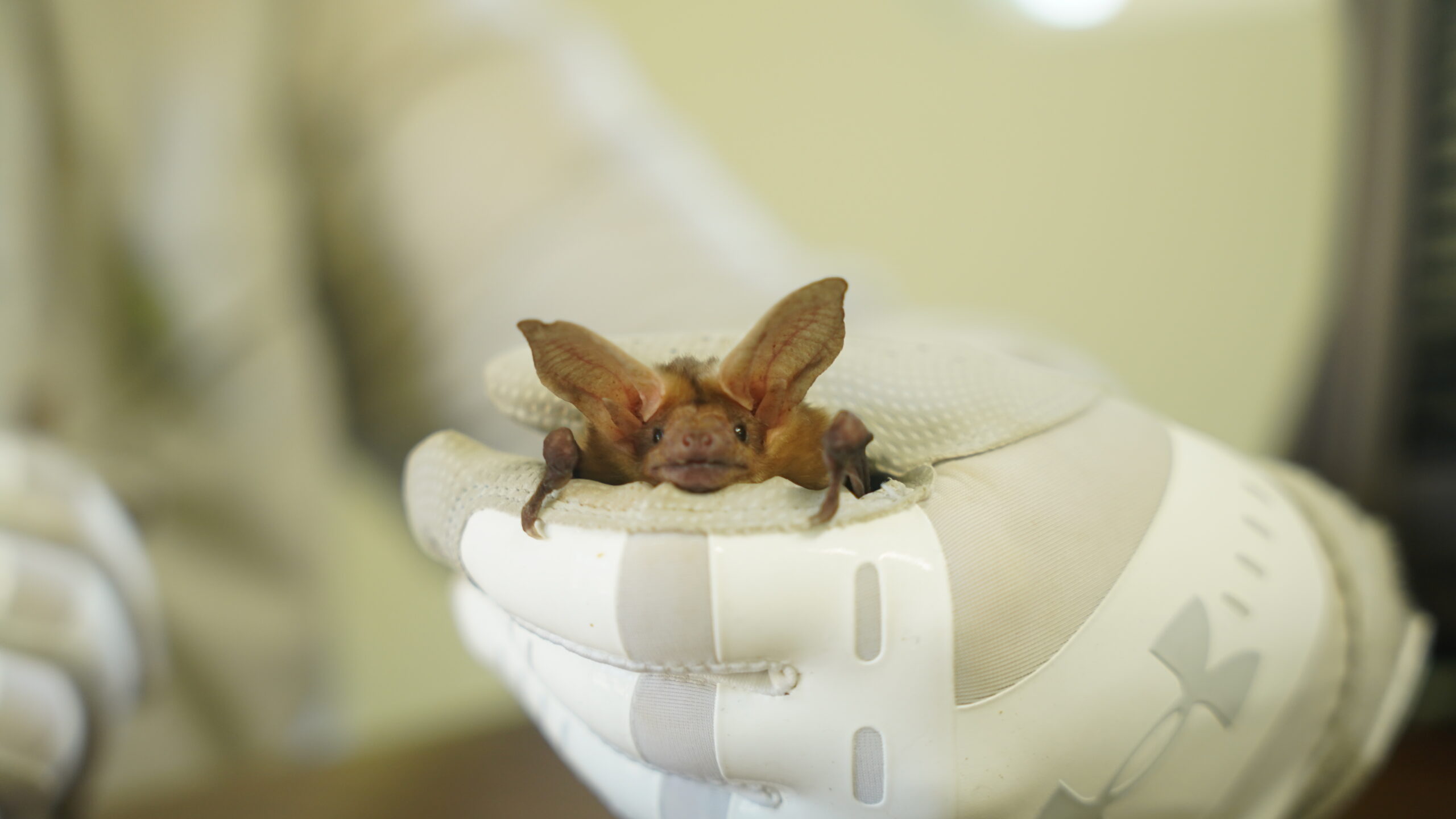
Reaching into a yellow bag with heavily gloved hands, she held a tiny, wriggling, squeaking fabric pouch and revealed its contents. A puppy-faced Mexican free-tailed bat emerged, sporting round ears and a zigzag, spiky grin. Quirk says that this bat’s a female.
“You see that mouth going up, down, up, down?” Quirk asked. “Yeah, she’s putting out her sonar to check you out.”
Permit process is lengthy
Getting a permit to exhibit or rehabilitate bats is not easy.
“There are different kinds of permits in working with wildlife,” Quirk explained. “I have a permit with the California Department of Fish and Wildlife for rehabilitation.” That process involves training and working under guidance of another permit holder. Exhibiting the bats requires a permit from the USDA under a similar process.
Both agencies inspect the caging, records and care.
Quirk is one of only a handful of people in the state who have the proper permits for the handling and care of what she calls “exhibiting bats,” which are rehabilitated bats that are quarantined and checked for disease for safe handling.
Nature’s underdogs
As an educator with the Discover the Flyway wetlands program for the Yolo Basin Foundation, Quirk has spent two decades rescuing bats and teaching locals about California’s nocturnal flying neighbors.
Of the 26 bat species native to California, 17 reside in the northern half of the state, Quirk said. She’s dedicated her life to protecting them.
“I’ve always liked the underdog. And bats are so incredibly misunderstood.”
As the founder of the nonprofit organization NorCal Bats, Quirk’s calendar is packed with local show-and-tell events. Much of her job involves undoing centuries of misconceptions.
“There’s a lot of myths out there,” she says, “bats don’t nest in human hair.”
It’s no wives’ tale that bats can carry rabies, but it’s been overblown.
“Rabies is very rare in roosting populations,” Quirk said, noting that bats on the ground or around humans have a one in ten chance of carrying the virus.
Three main species roost near the Yolo Causeway: the Mexican free-tailed, the big brown, and the pallid bat.
By far, the largest local bat population are Mexican free-tailed bats. Second in number, Quirk said, are big brown and Yuma bats.
Although they’re called Mexican, they’re native to half of the United States. They’re difficult to track, so nobody really knows where they go, Quirk explained.
“The Yolo Causeway bridge holds somewhere around a quarter-million bats alone,” she said. “The Franklin Boulevard bridge is probably another almost 200,000. That’s half a million bats right there.”
That population estimate is in line with past research published in the journal California Agriculture.
These massive numbers translate directly into dollars and cents, she said. Bats act as nature’s pest control and vastly reduce the need for chemical pesticides, saving farmers money.
Researchers estimate that a single Mexican free-tailed bat can gobble up 3,000-5,000 insects in a single night. That means the region’s bat population could consume around 2 billion bugs each night. Nationally, scientists estimate that bats save U.S. farmers roughly $3.7 billion each year.
The mammals also produce guano; a rich organic fertilizer that’s a gardener’s gold.
Sacramento’s rocky relationship with bats
Despite the good they do, Sacramento’s winged allies are facing a quiet local crisis. The immediate threat comes from losing habitat through urban development and a structural practice known as exclusion, or keeping the creatures from returning to their roosting sites after migration.
The word sounds humane, but it still displaces and disrupts bat colonies, advocates maintain. Habitat loss is the number one threat to bats in California.
“You lose your home, you lose your food, you don’t reproduce. And if you don’t reproduce, the next generation doesn’t come,” Quirk said. And unlike quick, litter-producing rodents, bats have one baby once a year, “and not every year,” she added.
In 2019, a specialized contractor was hired by the city to install exclusion barriers to keep bats out of the downtown garage near Macy’s. The netting-like material was installed right before pup season and baby bats emerged and were trapped. According to Quirk, the barriers were cut “either by vandals or by rescue people trying to free the babies.”
Following those disastrous optics, the city conducted a more recent bat exclusion project at the Tower Bridge parking garage in Old Sacramento, where huge colonies lived in small cracks in the structure’s walls and were a nuisance and potential health hazard to commuters parking their cars.
Gabby Miller, who handles press for the Department of Public Works, confirmed that the city initiated the bat exclusion project in October 2025. The city hired a licensed wildlife remediation contractor that placed the barrier during the legally allowed seasonal window, within state wildlife guidelines.
Although the city handled the situation professionally and humanely, dead and orphan bats began showing up nonetheless. The contractor teamed up with NorCal Bats to open a section of the barrier to remediate the situation.
Quirk applauded their efforts but is still concerned about the bats’ safety now.
“I get it,” she said. “If people get sick, the city has a problem. But if we lose colonies, farmers are going to have to use more pesticides,” she said.
“When a colony is displaced, it is very, very hard to ever recover.”
Where to see them
In spite of the loss of numbers, there are still plenty of local bats for enthusiasts to watch.
From May to September, 60,000-100,000 bats bolt from the Cosumnes River Preserve and head to the Franklin Boulevard bridge at sunset. Guided boat tours are also available on the river with Sunset Flyout Paddles during the season.
Just over the Yolo County line, the Yolo Bypass Wildlife Area offers guided bat-watching tours from late June through September. The visitor center sits on I-80 midway between Sacramento and Davis, near the Chiles Avenue exit.
Many bat watchers flock a half mile from the center on County Road 32B to a spot on the levee, which at this time has been tolerated by local police.
A field trip comes up dry
No story about bats is complete without a field trip. To see them, we visited the steep levee, finding local regular Charles Henderson in his white pickup, waiting for the night’s display.
He rolled down a tinted window to say hello.
“Looking for bats?” he asked. “They’re down there.”
He pointed to the I-80 bridge with its concrete pillars, spotlights, and a constant whine of heavy traffic above. Henderson frequents this spot to shoot photos of wildlife, and his mother Norma Thompson is with him.
We waited as it grew darker.
Chano Clark from Benicia slid his F-150 up the gravel hill, making a cloud of dust.
“My wife and I come up here just to watch them,” he said. “There are so damn many.” His eyes didn’t leave the sky.
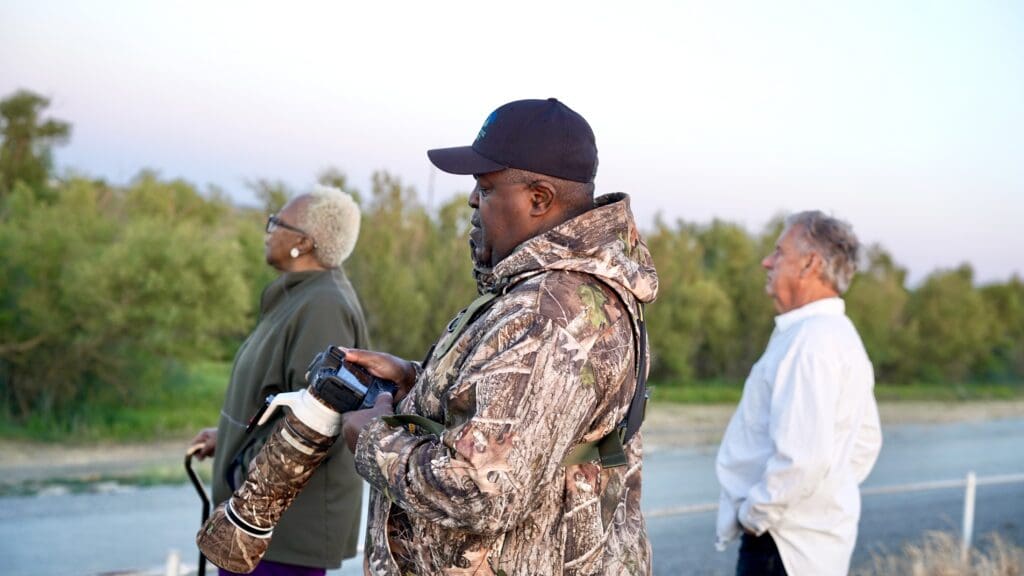
“You only have a short window to photograph them,” Henderson added.
“Sometimes they come in droves,” he said. “Sometimes none at all.”
In the center of the chilly Delta Breeze, we were all getting cold. We stayed close. It got darker.
Finally, the words. “Not tonight,” Clark said.
As anticlimactic as that may sound, there was a lesson: Wild animals don’t act on schedule.
Back on the moonlit levee, the bat-watchers climbed down the slippery incline side by side. Clark grabbed Thompson’s unsteady elbow as she bravely navigated the wind. Henderson thanked Clark for his kindness. A huddle of former strangers swooped in a single flock down the hill in perfect formation as their red headlights dimmed into the dusk.
James Smith is a member of the Abridged Community Reporters program. A retired nurse investigator for the state of California, James studies French and bikes along the American River Parkway in his free time. He lives in Midtown with his husband of 26 years.