The Abridged version:
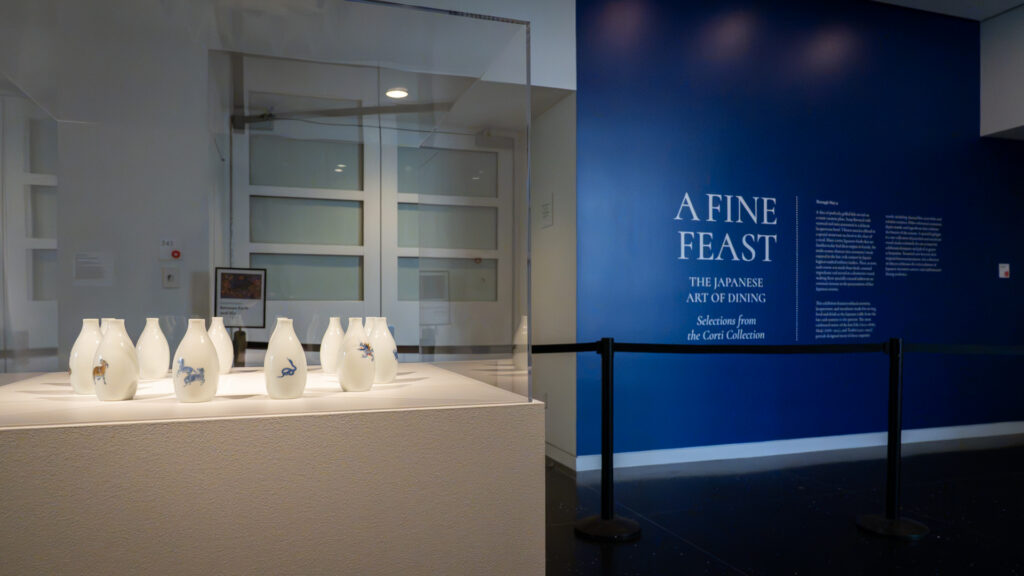
- Through 79 objects, the Crocker Art Museum exhibit “A Fine Feast” shows the variety, freshness, and artistry of the Japanese culinary arts.
- The exhibit draws from East Sacramento grocer Darrell Corti’s personal collection.
- “A Fine Feast,” with objects dating from the late Edo period (1615-1868) to the present, opened over the weekend and continues until May 9.
Japanese cuisine is celebrated for its variety, intricacy, brightness and freshness. Those aesthetics also apply to the platters, plates, bowls, cups and other tableware with which the food is served.
That’s a takeaway from a sweeping new exhibit of Japanese culinary traditions that opens Sunday at the Crocker Art Museum and continues through May 9.
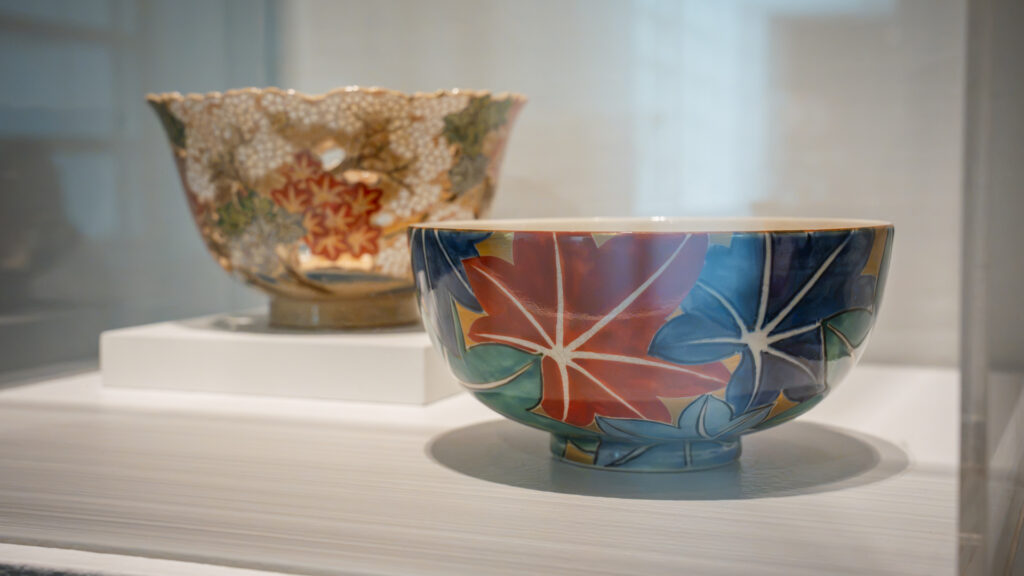
The 79 ancient and artful culinary objects that form “A Fine Feast” were assembled from a collection gathered by Darrell Corti, the vaunted owner of East Sacramento grocery store Corti Brothers, over the past four decades. They include ceramics, metalware and lacquerware, notable for their diversity, refinement and range of applications, from sweets bowls to incense holders.
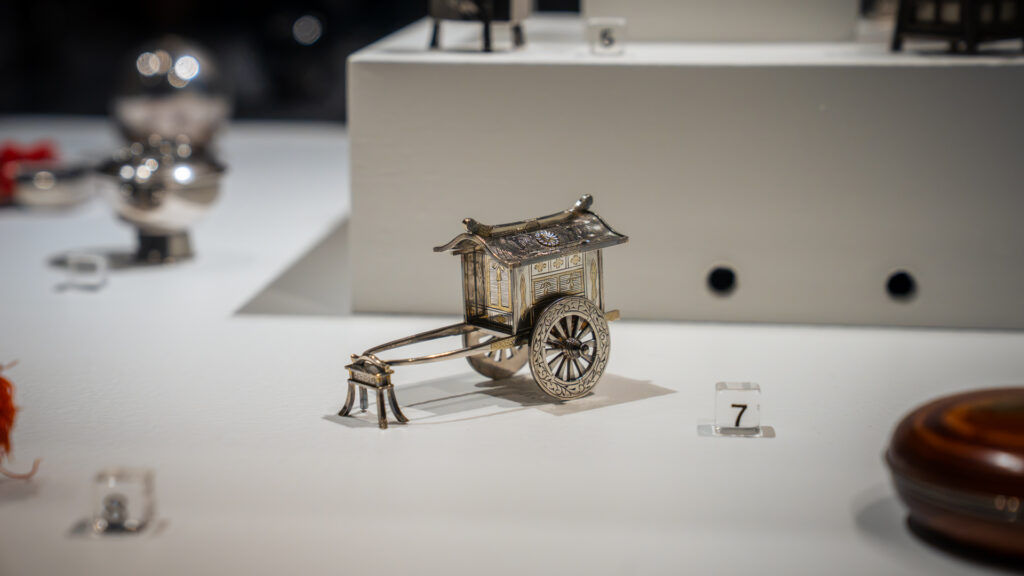
One case apt to draw visitor attention and admiration is given over to bonbonnières, little fancy boxes filled with candies. The concept is French in origin, gifts for guests at noble banquets, but the Japanese have a long and affectionate relationship with them.
Much more than bonbonnières constitute the exhibit, but they stand out for their number and their exquisite craftsmanship. In 1889, Japan’s imperial family started to hand them out to guests as a farewell remembrance at the end of a feast.
The Japanese royal family spotted and adopted the practice while touring Europe in the late 19th century. The Crocker exhibit shows with detail and imagination how they made them their own.
The items are small, generally metal, etched with intricate and symbolic designs. One is a small cart, ready to be hitched to an ox, crowned with the imperial crest, a gift for guests who attended a farewell lunch for the English Duke of Gloucester in 1929. Another is a mirror-shaped box engraved with stylistic phoenixes, auspicious symbols of prosperity, given guests at 1915 banquets to commemorate the enthronement of Emperor Taishō.
Beautiful pieces, meant to be used
Amelia Kit-Yiu Chau, the Crocker’s adjunct curator of Asian art, assembled the exhibit, starting two years ago by combing through Corti’s collection. Given Corti’s high standing in food and wine circles, she selected items to reflect his culinary grounding while also illustrating the significant and symbolic roles played by ceramic, metalware and lacquerware vessels in Japanese dining traditions.
In the Japanese approach to creating tableware, there is no dividing line between the artistic and the utilitarian, she said. No matter how rare and refined the piece, “they were originally meant to be used, and they were used,” she said.
Several pieces are big, bold and sturdy, charged with brilliant and dynamic artwork. Others are delicate, looking so fragile it is a small wonder they survived decades, especially considering that many would be passed from guest to guest during dinner.
Freshness, seasonality, and whimsy thread their way through the exhibit. Nature is a frequent motif, including, curiously, grapes and vines, though Japan until recently has not been seen as much of a wine-drinking culture.
Chau said she wanted to include objects with grapes to acknowledge Corti’s long role in studying and promoting wine. But grapevines have also had a presence in Japanese art since the 7th century because of trade with China, where the motif was prevalent. Grapevines have also long been used in Japan to represent the continuity of family, Chau noted.
One piece with a grape motif is a stoneware plate executed by the Kitaōji Rosanjin, a pseudonym for Kitaōji Fusajirō, a celebrated calligrapher, ceramicist, painter and restaurateur who made his own tableware.
Rosanjin is credited with a phrase variously translated as “dishes are the kimonos of food” and “tableware is the kimono of cuisine,” meaning that bowls, plates and the like should harmonize and enhance the food they hold. A 1923 Tokyo earthquake destroyed many of his ceramics, but by 1954, he had made enough new pieces for a solo exhibition at New York City’s Museum of Modern Art.
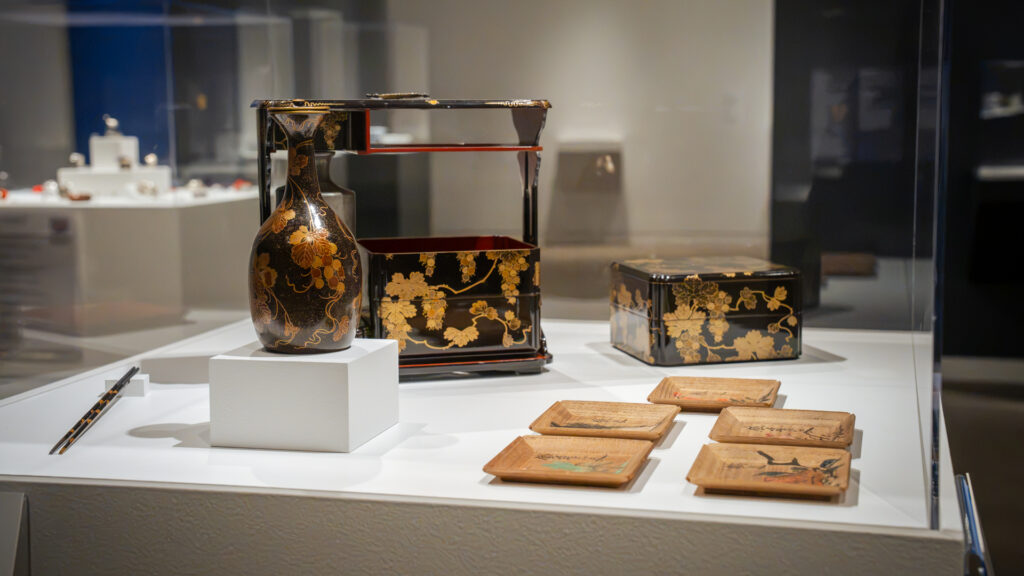
Another piece highlighting grapes also represents the patience and precision that went into several of the works, an elegant pear-shaped sake bottle executed for the 16th-century feudal lord Toyotomi Hideyoshi. The vines that twist in lively realism up the flask were added with the labor-intensive “maki-e” process, a technique whereby flecks of precious metals, commonly gold or silver, were sprinkled onto lacquer before it hardened.
Artists for many of the works are unknown, as with this flask. But other artists had such lofty reputations they were anointed “Imperial Household Artists” by the Japanese government.
Eye-catching fun and engineering marvels
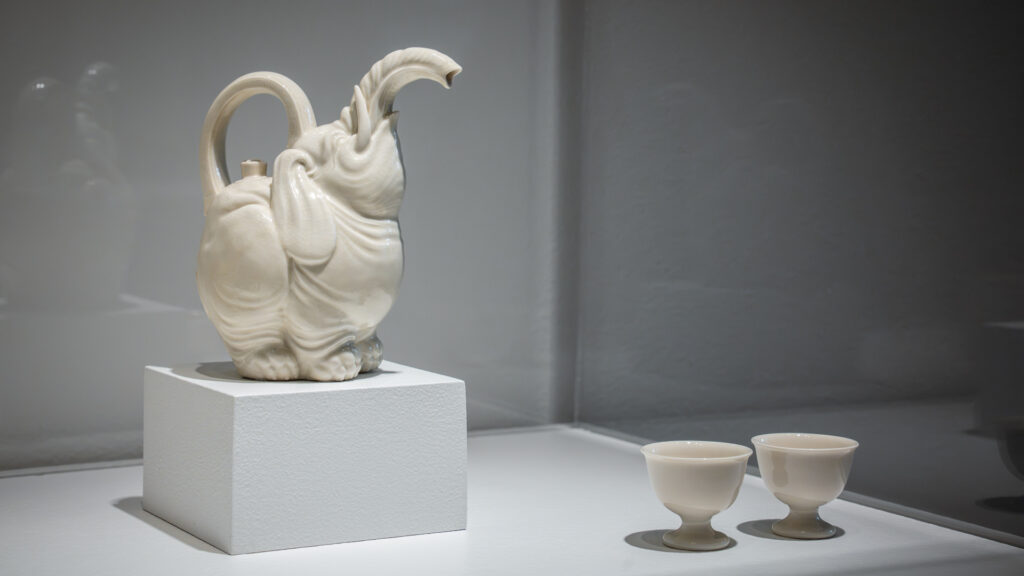
One was Miyagawa Kōzan I, whose porcelain, elephant-shaped sake pot is one of the more playful items in the exhibit. Its elegant form and shiny surface “would give guests great tactile pleasure while handling and drinking,” said Natsu Oyobe, curator of Asian art for the University of Michigan Museum of Art, who contributed an essay on the collection for the exhibit’s catalog. Corti bought it, along with about 75% of his collection, from Robert Mangold of Kura Monzen Gallery in Kyoto.
“The elephant stands almost as though balancing on a ball, its raised trunk forming the spout of the vessel. It is both a functional pouring implement and a charming little sculpture,” Mangold said. “It’s an object that would surely have brought amusement and conversation to the table.”
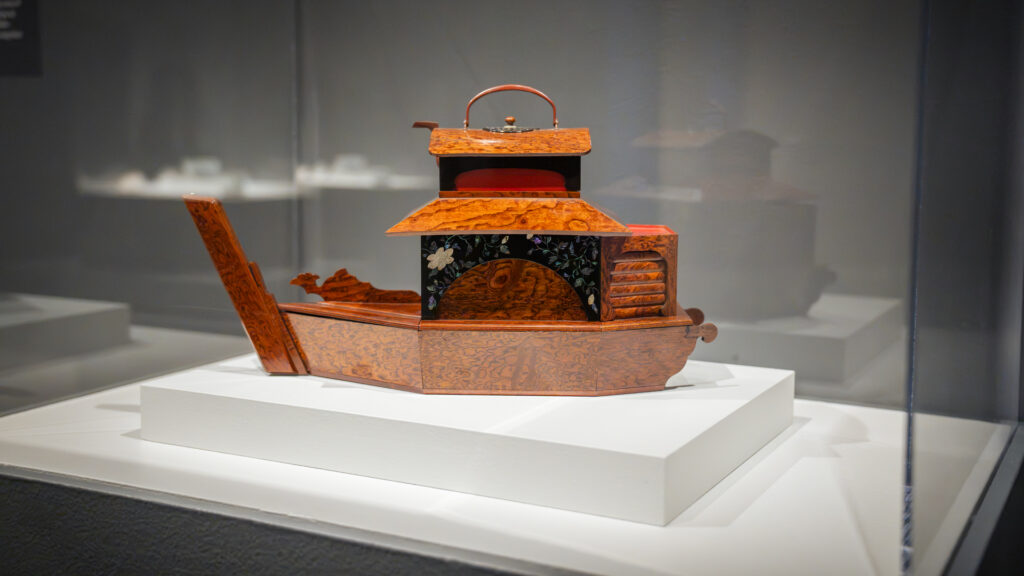
A boat-shaped picnic set of burl wood and mother-of-pearl inlaid lacquer is another piece almost sure to generate widespread appreciation. While at first glance it looks like nothing more than a fancy child’s toy, it is an engineering marvel, an intricate and artful arrangement of everything a party would need once moored at its picnic site.
The boat was meant to be disassembled into 15 individual pieces, each playing a part in the picnic. The upper cabin doubles as a lidded sake bottle, the roof reverses to become a serving plate and the hollow bow contains a cargo of chopsticks.
“Almost every part of the boat serves a practical purpose, transforming an elaborate miniature pleasure craft into a complete dining and sake service,” said Mangold, who sold Corti the piece. “It is an object that speaks not only to extraordinary craftsmanship but also to the pleasures of entertaining, the appreciation of seasonal outings, and the Japanese delight in combining beauty with function.”
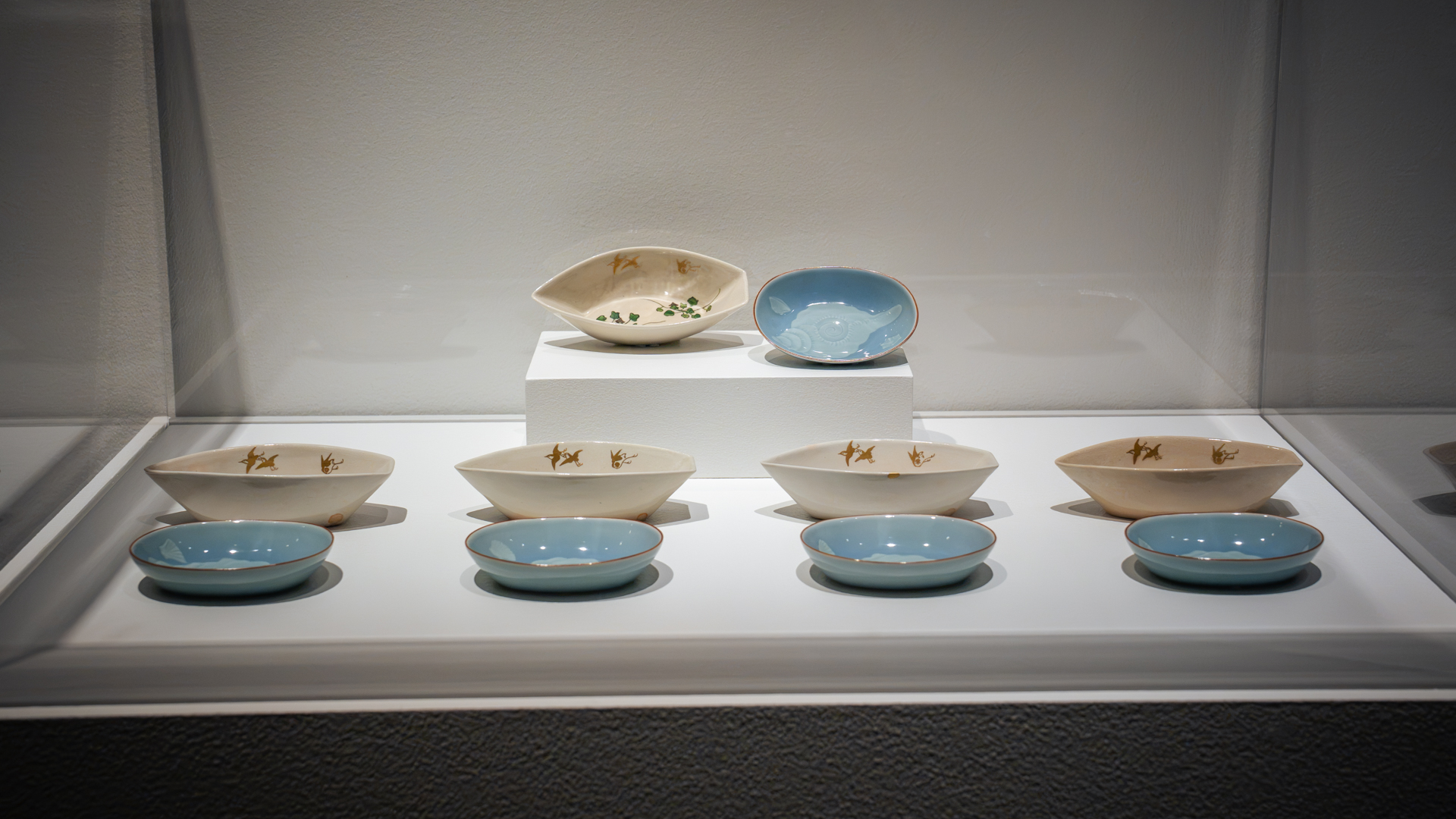
One of the more whimsical sets in the exhibit is a cluster of glazed stoneware boat-shaped bowls decorated gaily with golden plovers flying over leafy tendrils, made by Seifū Yohei III in the late 19th or early 20th century. Such small plates are a fixture of kaiseki, and could be used in diverse ways, including as vessels for sashimi sliced so thin as to be transparent, allowing guests to savor art as well as seafood.
Intentional collection
Corti began to collect pieces in 1985, when he visited Japan for the first time. The refinement, intricacy, history and variety of pieces struck him immediately, and has guided his buying decisions since then, he said.
“If I liked them, I bought them. If it was pretty, if the workmanship was good, I bought it,” Corti said.
He leaned to the antique and the unique, pieces with stories to tell and pieces that represented Japanese culinary customs. Monumental, flashy artifacts hold less appeal for him.
“I’m not interested in armor and swords, things that kill people,” Corti said.
“I think what really distinguishes Darrell as a collector is his innate curiosity. He is drawn to historical objects that have a story to tell, something about the time in which they were made, the person who created them, or the people who once used them. These objects often lead him down entirely new avenues of research and discovery,” Mangold said.
What would Chau like patrons to take from the exhibit? “An appreciation of the high level of artistry and the skills that went into these functional objects. In the West, there’s a sharp distinction between art and craft which doesn’t exist in Japanese art. In Japanese art there’s no distinction between fine art and craft. I would like visitors to think (of these objects) as both functional as well as works of art.”
Corti was more succinct when asked what he would like visitors to take home: “Wow.”