

The Abridged version:
- The Elk Grove City Council voted unanimously on Wednesday night in favor of extending Sacramento Regional Transit’s Blue Line through the core of the city.
- Early plans detail up to 6.4 miles of new light rail track and seven new transit stops. Leaders are considering bus rapid transit lanes along the route as well.
- While the the estimated price tag is between $287 million and $1 billion, representatives from the city and SacRT told Abridged they have not identified funding sources yet in what will be a lengthy planning process.
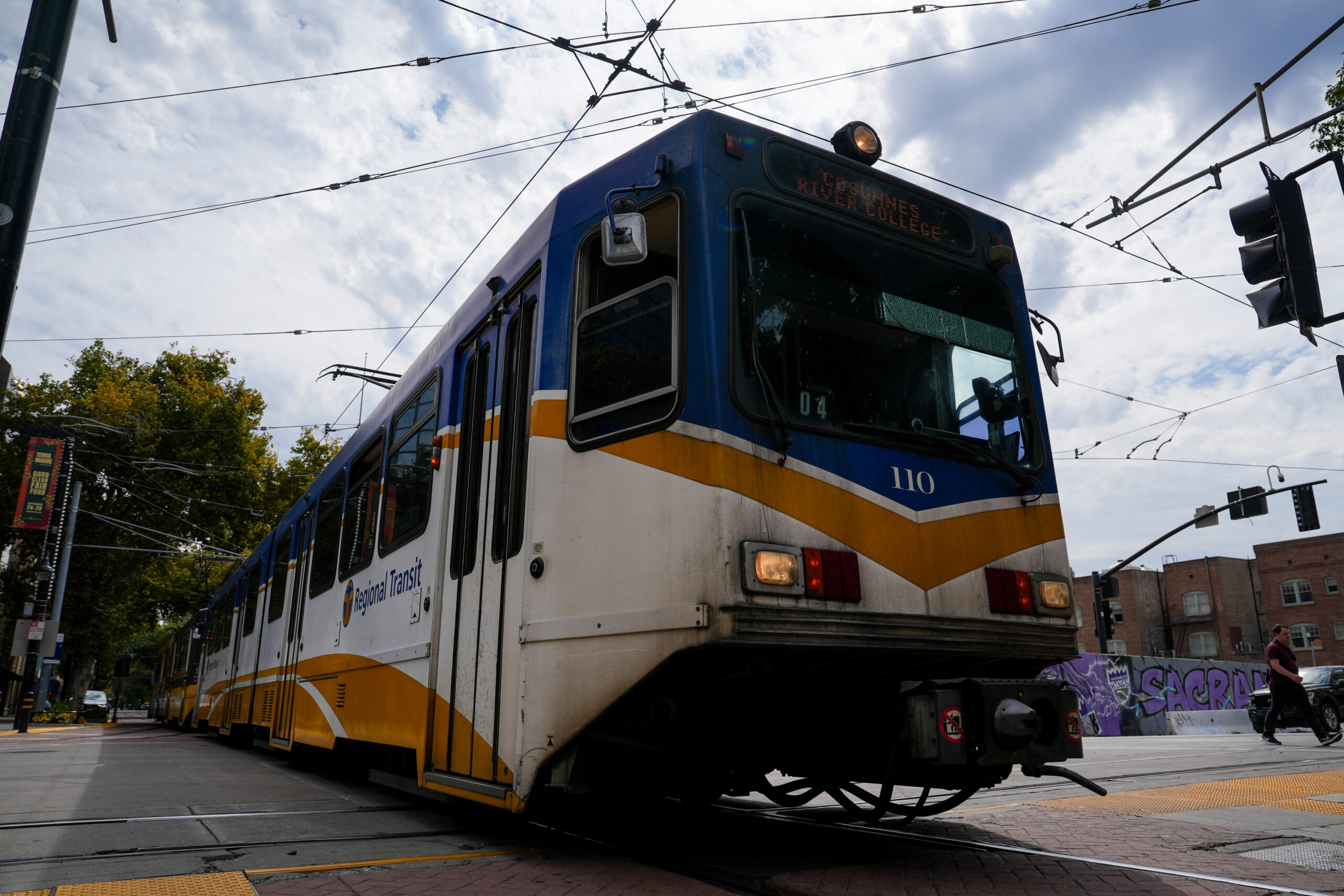
Light rail lines could extend south through the city of Elk Grove for the first time.
The Elk Grove City Council voted unanimously in favor of extending Sacramento Regional Transit’s Blue Line through the city on Wednesday night. The council also approved an implementation plan that will allow the early stages of the project to move forward.
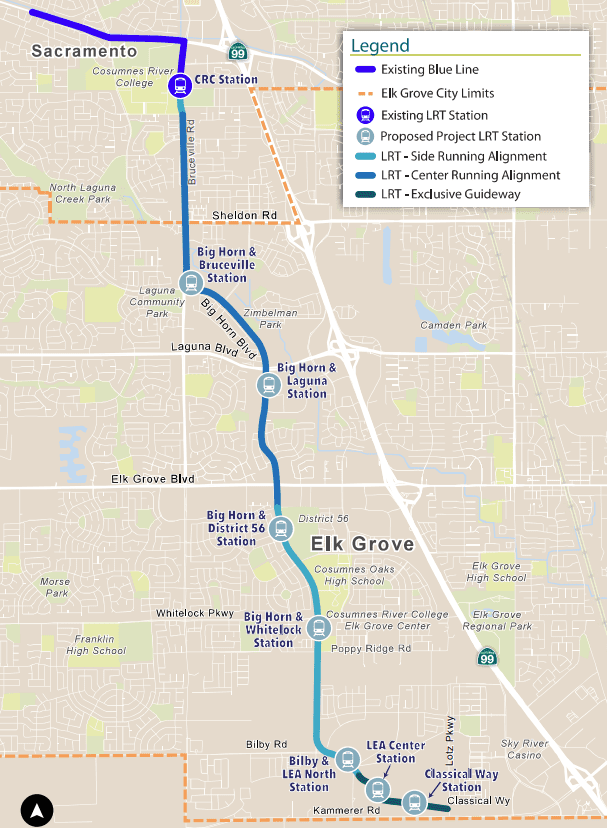
The city is looking to extend the Blue Line from its current terminus at Cosumnes River College to the southern edge of Elk Grove at Kammerer Road. The form that could take, however, is still up in the air.
Options on the table
Multiple extension options remain on the table, which could see up to 6.4 miles of light rail tracks added to the city, new bus rapid transit routes, or a combination of the two.
“We’ve all seen Elk Grove grow but we’ve also seen the traffic congestion grow as well — grow exponentially,” said Councilmember Rod Brewer.
The council was divided on what form the Blue Line extension should take. Multiple councilmembers said they favored a more ambitious approach, including an express route to connect Elk Grove directly to Sacramento’s central city.
“Building it within our city is not enough, the whole point is to move people throughout our region,” said Vice Mayor Darren Suen.
Population growth brings traffic
Elk Grove’s population has seen swift growth, adding more than 100,000 people to its population over the last two decades, and traffic has followed. The Blue Rail extension is expected to serve that growing population. A study into the extension estimated it would have about 14,000 daily trips to start, and could go up to 33,000 daily trips by 2040.
Elk Grove currently doesn’t have any light rail within the city limits, and is predominately serviced by SacRT bus routes. The city has seven dedicated routes, as well as a lineup of commuter bus lines that operate on weekdays.
First three stations planned near Cosumnes River College
CIty leaders are interested in a “hybrid” plan — construction of new light rail tracks with other parts of the route serviced by bus rapid transit lanes. Bus rapid transit, which is different than conventional bus routes, uses dedicated traffic lanes and priority traffic lights to help buses move more frequently.
If the city secures funding for light rail, the construction of the Blue Line extension would start in the north near Cosumnes River College. The first phase would include three new stations at Bruceville Road and Big Horn Boulevard, Big Horn Boulevard and Laguna Boulevard and the District 56 events center.
Other proposed stops are at Big Horn Boulevard and Whitelock Parkway, and a trio of stations near Bilby and Kammerer roads, for a total of seven light rail stops.
Project estimates reach $1 billion
The price tag for the Blue Line extension into Elk Grove stretches into the billion-dollar range.
A study on the Blue Line extension estimated the cost would be between $287 million and $1.059 billion. That range depends on whether the city secures funding for a full light rail extension, or if the project relies on more bus rapid transit lanes.
No funding secured
Representatives for the city of Elk Grove and SacRT told Abridged that no funding has been secured yet.
“Other than what was presented in the staff report, we don’t have any funding clearly identified,” said Kristyn Nelson, spokesperson for Elk Grove, before the council meeting.
SacRT plans to a be a partner on the project, but is also in the early stages when it comes to funding.
“As of right now there’s no funding that we have for the project,” said Jessica Gonzalez, spokesperson for SacRT.
Gonzalez added that SacRT will begin to explore grant opportunities as well as state and federal funding options for the project.
Sales tax increase an option
One option for funding is a “future local sales tax measure” that could help fund between 20% and 50% of the construction cost, according to a study on the project. Federal and state grants are also listed as potential funding sources.
The city still has to land on a design that will inform some of it’s efforts to get funding.
“This really is a years-long, complex effort that we would be working towards,” said Kaley Lyons, the city’s transportation manager.
Felicia Alvarez is a reporter at Abridged covering accountability. She’s called Sacramento home since 2015 and has reported on government, health care and breaking news topics for both local and national news outlets.