
The Abridged version:
- Feijoas, also called pineapple guavas, do well in the Sacramento Valley’s dry summers and mild winters.
- The fruit tastes like a mix of pineapple, guava and strawberry, while the edible petals draw comparisons to jelly beans, marshmallows and sherbet, depending on whom you ask.
- A Davis geneticist-turned-research-farmer grows dozens of feijoa varieties on a research farm and has become one of the few sources in the country for rare cuttings.
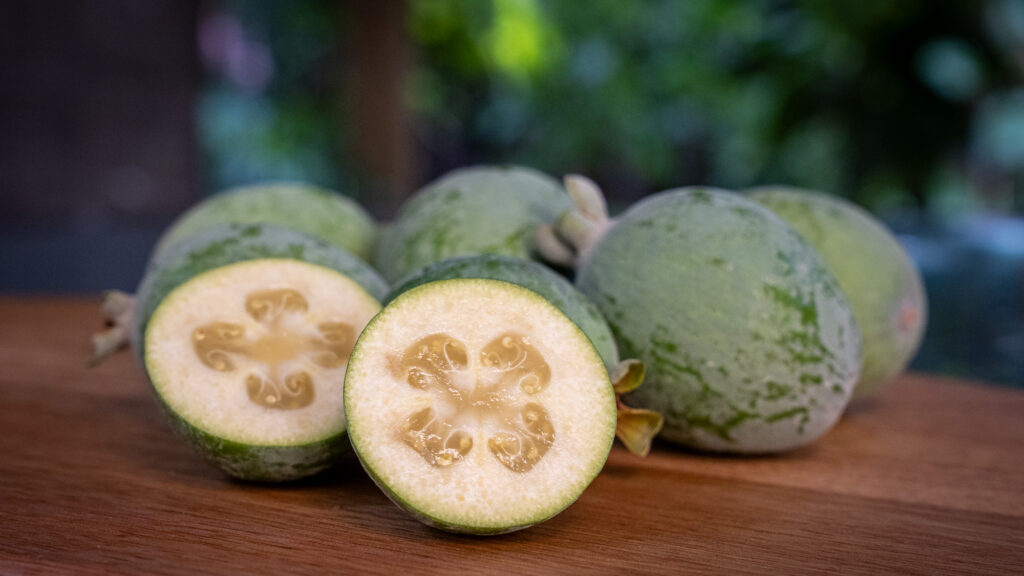
Feijoas (fay-JOH-ahs) are native to the highlands of southern Brazil and Uruguay and sold in the United States under a different name, pineapple guavas. They are often described as tasting like a mix of pineapple, guava and strawberry, with a fragrance that’s perfumey, or even like bubblegum when it’s ripe.
The flesh is soft and jellylike at the center, turning slightly grainy near the skin, similar to a pear. There is no single way to eat one. Some people slice it open and spoon out the center. Others just bite in, skin and all.
The plant does well almost anywhere with a Mediterranean-style climate, including the Sacramento Valley. The fruit is typically in season from late September through December, making now the right time to try it.
On campus
UC Davis includes feijoas on its list of Arboretum All-Stars, recommended as easy to grow in the region. It makes an attractive garden shrub or small tree, with fruit as a nice bonus, said Emily Griswold, director of GATEways Horticulture and Teaching Gardens at the UC Davis Arboretum.
A specimen of the cultivar ‘Coolidge’ grows in the Ruth Risdon Storer Garden at the campus arboretum.
Alessandro Ossola, an associate professor in the Department of Plant Sciences, recently photographed a squirrel eating a feijoa on campus — evidence, he said, of the plant’s value to urban wildlife as well as people.
“A fun fact about this plant is that the petals are edible and they taste like a jelly bean,” Ossola said.
When asked why feijoas do so well in the Central Valley, Jared Sisneroz, a UC Davis researcher and doctoral student who has taught on campus for several years, pointed to two things.
“They can cope with the heat, and they do well with lower amounts of irrigation,” he said.
Sisneroz added that the region sits close to the northern edge of where feijoas can survive in the western United States, since the plant does not hold up to hard frost. Within that range, it thrives.
The plant is part of the curriculum, too. Feijoas are covered every fall in the UC Davis environmental horticulture class Introduction to Environmental Plants as part of a unit on the Myrtaceae family, a group of plants native to the Southern Hemisphere known for scented leaves and flowers with many stamens.
A backyard favorite
Feijoas have found their way into Sacramento homes as well, including that of Stephanie Robinson. A senior operations manager at the Sacramento Tree Foundation and an ISA-certified arborist, Robinson planted 10 feijoa trees at her own home, though she cautioned most people should not do the same.
“I wouldn’t recommend planting 10 like I did. Their abundance can turn into a burden at that point,” Robinson said.
Robinson needed something fast-growing to block views into her backyard, which opens into a public space. Feijoa trees fit the bill: evergreen, drought tolerant once established and safe to plant beneath power lines. Robinson values the tree as much for the privacy and beauty it provides as for the fruit it produces, she said.
“Their thick, leathery, silver-green leaves add a lot of beauty and interest to gardens,” Robinson said. White and red blooms appear in late spring. “Foliage and even fruit makes a beautiful addition to flower arrangements,” she said.
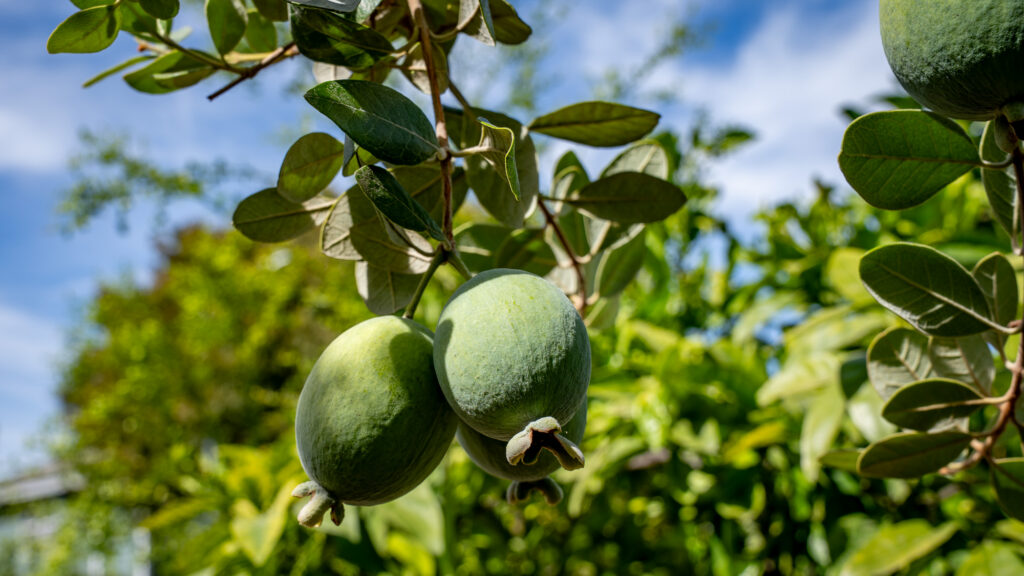
The fruit ripens starting in late autumn and drops from the tree when ready. “They taste vaguely tropical with somewhat of a banana flavor and a hint of wintergreen,” Robinson said. “Not too tart or sweet.” The edible petals, she said, taste closer to marshmallows.
A single feijoa tree will produce fruit on its own, though a second tree nearby typically means a heavier crop, Robinson said. That is because cross-pollination between two trees can push yield higher than either tree would produce alone. Her trees have produced as much as 30 gallons of fruit in a single season, and she gives much of it away to friends and neighbors.
Where to get a good plant
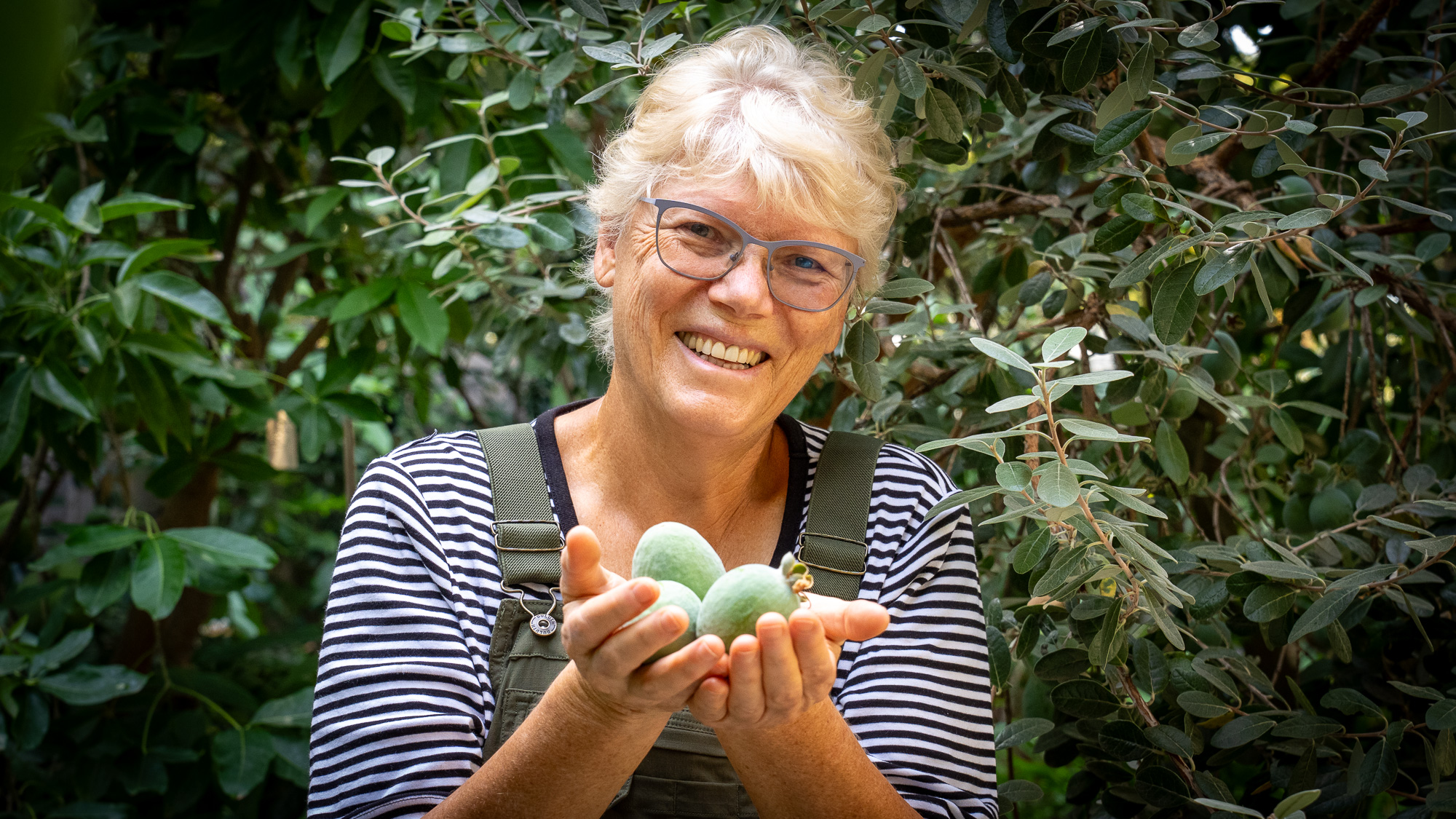
Marta Matvienko, a molecular geneticist turned research farmer, planted her first feijoa tree in her home garden in 2001. She first knew the fruit from her life in the Soviet Union, where it grew in places like Georgia.
In 2022, she started an orchard on rented land near Woodland, where she now grows dozens of feijoa cultivars alongside other uncommon fruiting plants.
Matvienko’s collection comes from known, deliberate sources. Some of her cultivars trace to New Zealand varieties imported by another grower. Others come from an active breeding program of her own, dozens of seedling crosses she is currently testing on the property.
Matvienko, who has a background in genomics, sells feijoa cuttings through her business, Really Good Plants, shipping named cultivars to nurseries and home gardeners across the country who graft their own trees.
“There are basically no resources in the U.S. which would have a lot of good feijoa cultivars,” Matvienko said. Her cuttings, released each December and January, tend to sell out quickly.
Outside a small number of individual growers, she said, her operation has become “the major resource” for the range of feijoa varieties available in the country.
Growing at scale
Jonathan Carter grew up in New Zealand, where feijoa season runs from March to June and the harvest is so abundant that neighbors leave boxes of extra fruit on each other’s doorsteps. As a boy, he used to stop on his walk home from school and eat the ones that had fallen off his aunt’s hedge. To Carter, the petals taste like sherbet.
“It would be as if you couldn’t get strawberries or raspberries or watermelon in California after you’ve grown up with those yummy fruits,” Carter said. “Summer would not quite be the same.”
That childhood memory followed him to the United States, where he spent years trying to find a place feijoas could thrive. He first tried growing them on his farm in Vancouver, Washington, but the cold climate would not allow it.
He eventually bought land in Red Bluff and planted 2,000 feijoa trees cloned from the ones that had not survived in Washington. The farm, called Feijoa Farms, now has about 6,000 trees representing at least half of the 50 to 70 feijoa varieties Carter said exist worldwide.
Carter credits much of his collection to Mark Albert, a mentor who died before he could see how far his cuttings traveled.
“His passion for feijoas is still alive in the 1,000 feijoa starts he gave me,” Carter said. Three or four of Albert’s varieties now anchor the farm’s production under the names Yellow Happy, Blue Juicy, Green Giant and Early Sunshine.
Growers in California have cultivated feijoas for more than 120 years and have tried at least three times to turn it into a commercial crop. None have stuck. Feijoa Farms is in its second harvest season. “We are looking for the right four or five distributors, as this is only our second harvest, so we are pretty new to the whole connecting with distributors piece,” Carter said.
Where to find feijoa fruit and trees around Sacramento
If you are interested in trying feijoas, the season just started. You can find them at the Central Sacramento Sunday Certified Farmers’ Market under Highway 50, where Magda Morgan sells feijoa grown on Jim Brenner’s ranch in Newcastle alongside peaches, nectarines and mandarins.
They’ve also been available at the Rancho Cordova Farmers Market, the Davis Farmers Market and Root 64 Farm Stand in Tahoe Park.
Feijoas are not yet on grocery store shelves, but the Sacramento Natural Foods Co-op plans to bring them in as soon as organic fruit is available. “Last year we got some in early November,” said Fred Avila, the Co-op’s produce manager. “I expect it to be a little earlier this year, though I haven’t heard anything yet.”
SMUD customers can apply for a free feijoa tree via the utility’s Sacramento Shade program, operated in partnership with the Sacramento Tree Foundation.