
The Abridged version:
- Teachers in Natomas Unified and Twin Rivers Unified continue striking, as multiple negotiation meetings over the weekend and Monday failed to draw any resolution. Health care remains one of main sticking points in both districts’ bargaining.
- School district officials in Natomas and Twin Rivers have put forward proposals increasing their contributions to teachers’ health care. Union leaders say while the offerings are a start, they still fall short of demands for 100% district-funded coverage.
- In Twin Rivers, teachers have the public support of at least one school board trustee. Some community members have challenged the push for better benefits at a time when health care costs are a growing burden for many residents.
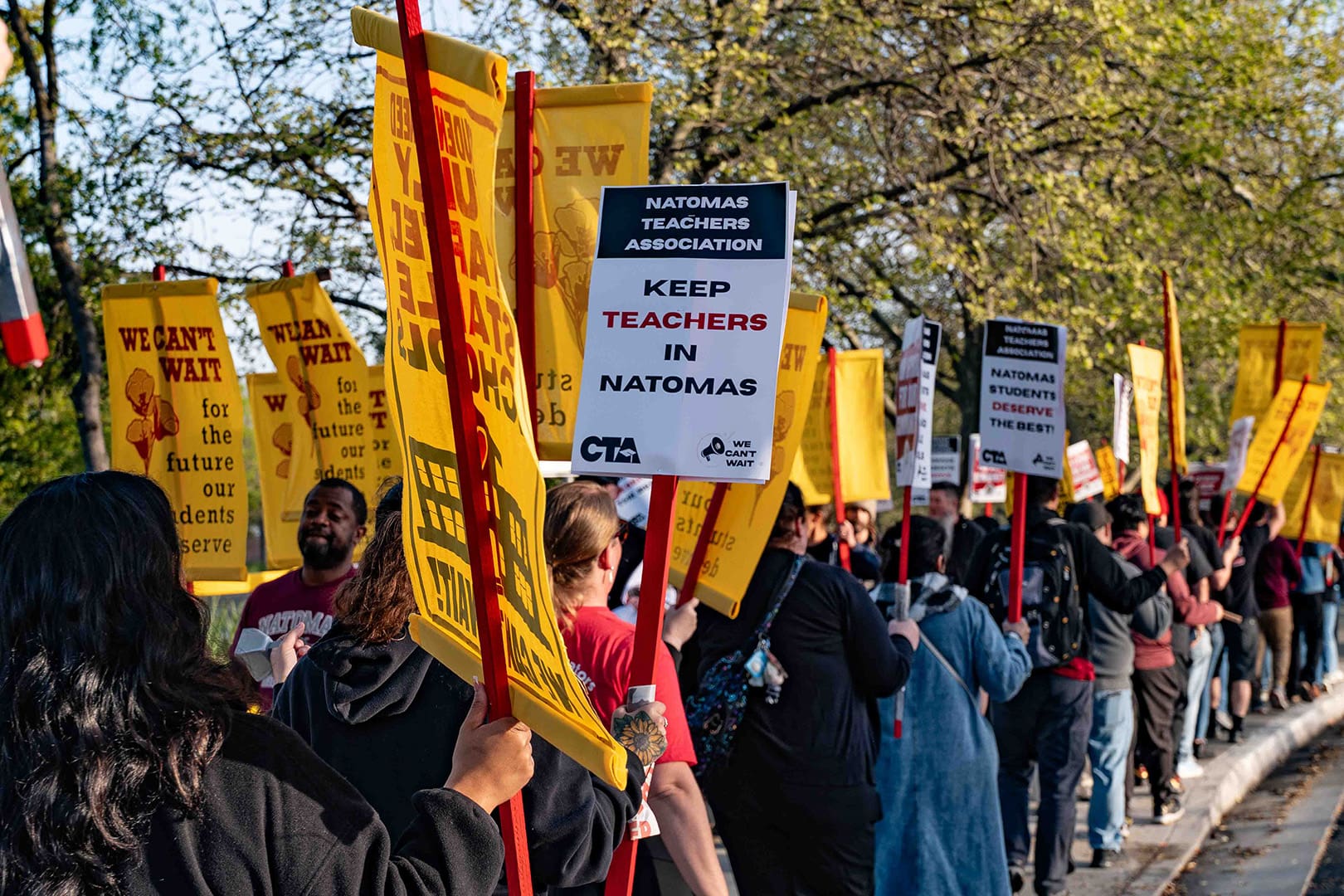
As Natomas Unified School District teachers reach day five of the district’s first-ever teacher strike, health insurance remains one of the top sticking points.
Union and district representatives last met Sunday for a 14-hour bargaining session. As the meeting ended just before midnight, no resolution had been reached.
Natomas Unified is one of two school districts in Sacramento County currently experiencing an educator work stoppage. Twin Rivers Unified teachers on Tuesday entered their ninth day on the picket line, setting the Sacramento County record for the longest teacher strike in recent memory, topping an eight-day strike by Sacramento City teachers in 2022. A third district next-door in West Sacramento is on the cusp of its own strike.
The local unions are part of a broader wave across California, with teachers taking to the picket lines or threatening to. The campaign — titled We Can’t Wait and spearheaded by the California Teachers Association — is pushing for shared demands including higher compensation and smaller class sizes.
Sign Up for the Morning Newsletter
The Abridged morning newsletter lands in your inbox every weekday morning with the latest news from the Sacramento region.
Health care coverage center stage
Health care coverage has been a prominent point of disagreement in the negotiations.
Educators in San Francisco won 100% district-funded health care following a four-day strike in February. In Richmond, teachers will have that same benefit starting next year, after striking last December.
Locally, Sacramento City Unified teachers have set the goalpost for neighboring unions, with fully employer-funded health care in their contract for years.
Anxiety over health care costs is increasing across the state. A February survey by the nonpartisan Public Policy Institute of California found 56% of Californians expect health care will be less affordable for them and their families over the next year.
What are Natomas teachers asking to be compensated?
The most recent proposal from the Natomas Teachers’ Association requests a 7.5% raise, split between this and next school year.
The increase is needed, union leaders argue, to close a gap between their pay and that of neighboring districts. Salaries for teachers in Natomas Unified range from about $56,000 to $121,000. The district’s average of $90,931 is one of the lowest among Sacramento County’s unified school districts.
The union is also asking for the district to significantly increase its contribution to employees’ health care coverage.
Under the union’s proposal, Natomas Unified would cover:
- 100% of the Kaiser premium in 2026, 100% of the Kaiser premium in 2027, and an amount equal to 100% of the previous year’s Kaiser premium in 2028, for employees only.
- 85% of the Kaiser premium in 2026, 90% of the Kaiser premium in 2027, and an amount equal to 100% of the previous year’s Kaiser premium in 2028, for employees plus one or employees and their families.
The union rejected the district’s initial proposal to cover 100% of the Western Health Advantage plan, since they say the majority of their members choose Kaiser.
What is the district offering for compensation?
Natomas Unified has put a 4.25% pay increase, divided over two years, on the table.
Following Sunday’s day-long bargaining session, the district said they increased their offered health contributions.
Their most recent proposal would have Natomas Unified covering, for any insurance option:
- $993.53 a month for employees, $1,987.06 a month for employees plus one, and $2,583.18 a month for employees and their families in 2026. (All amounts are equal to 85% of the Kaiser premium.)
- $1,051.97 a month for employees, $2,103.95 a month for employees plus one, and $2,735.14 a month for employees and their families in 2027. (All amounts are equal to 90% of the 2026 Kaiser premium.)
- $1,168.86 a month for employees, $2,337.72 a month for employees plus one, and $3,039.04 a month for employees and their families in 2028. (All amounts are equal to 100% of the 2026 Kaiser premium.)
A mediator’s report, released just before the strike began, noted current out-of-pocket health care expenses for teachers in Natomas are “quite high in comparison to other districts.”
The same report also cautioned against making all health care plans no cost to employees, a warning the district has cited often in statements during the strike.
“That proposal may just be affordable for this year, but no-cost-to-employee health and welfare options are unpredictable to budget for in future years,” the mediator wrote.
Twin Rivers stalls on health care debate
Much of the same fight continues to play out next door in Twin Rivers Unified.
Twin Rivers officials said they have offered full coverage of the Kaiser premium for employees and their families this and next school year. After 2026-27, the district’s contribution would be capped at that 2027 amount. Bargaining teams would return for negotiations.
Union leaders called the proposal “a step forward” but still insufficient. Twin Rivers United Educators continue to push for 100% district-funded benefits in perpetuity.
Response to Twin Rivers negotiations
Teachers have the backing of some district leadership.
“I just got off the phone with (Superintendent Steve) Martinez,” Sharon Reichelt, a Twin Rivers school board member, told picketers Friday. “I told him that I have always supported the teachers and I support the teachers.”
“I am a teacher, and this is breaking my heart,” she continued. “I told him that I want him to go back to the table and settle on benefits. And I support full benefits.”
Yet tensions have emerged between union representatives and community leaders emerged, particularly over the issue of health care.
“I’m not clear how you justify paying five-year teachers or retiring teachers a lifetime of health benefits when the parents of your Districts are facing rising health care cost due to cuts in the Affordable Care Act,” Derrell Roberts, CEO and co-founder of the Roberts Family Development Center, wrote in a post on Facebook Friday.
Savannah Kuchar is a reporter covering education. She came to Sacramento to be a part of the Abridged team and contribute to a crucial local news source.