

The Abridged version:
- Caltrans’ large-scale project on Highway 50 has gone two years over its initial timeline, causing thousands of hours of traffic snags for local drivers.
- While Caltrans has blamed the delay on weather and aging infrastructure, an Abridged investigation found that rejected concrete also contributed.
- The Highway 50 saga is detailed in 2,000 pages of reports and emails obtained by Abridged, in addition to pending lawsuits involving contractors and concrete suppliers.
Highway 50 in Sacramento seems like a nightmare that never ends.
Commuters losing thousands of hours stuck in traffic. Lane closures. Exit detours. And it was all expected to be over two years ago. Yet the delays and the heart-stopping near misses continue.
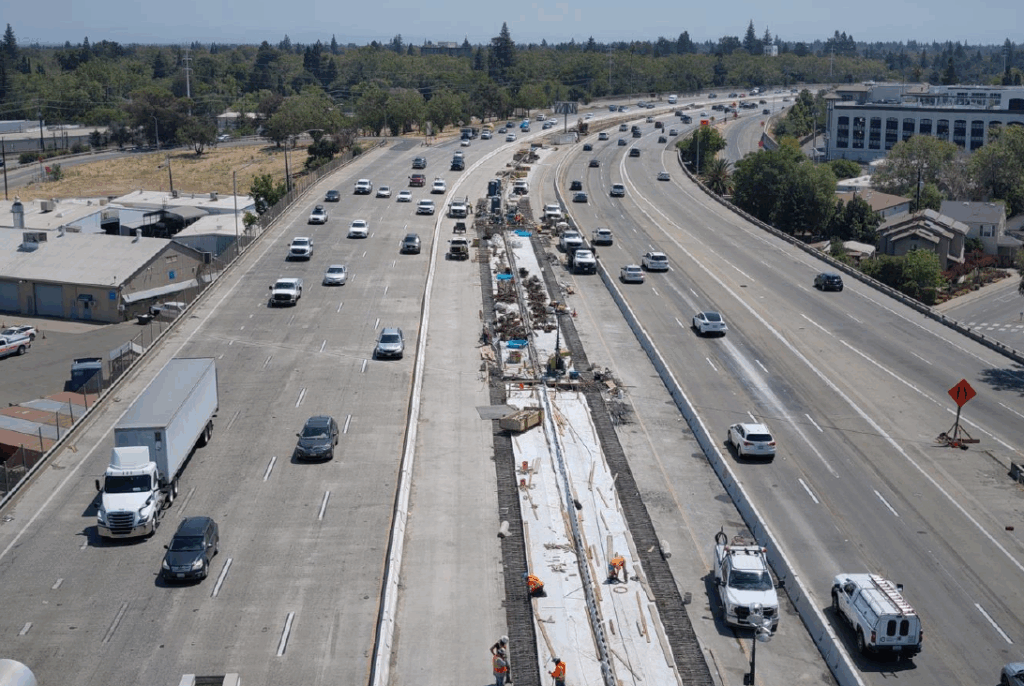
An Abridged investigation revealed that a concrete mixture used for new HOV lanes and concrete replacement on Highway 50 did not meet Caltrans strength standards, leading to the reconstruction of a section of the highway in East Sacramento and a delay in the construction’s completion. That explanation reveals causes that Caltrans never made in statements to the public or media. Instead, the transportation agency had blamed the delays on heavy winter rains, crashes on the highway and the discovery that the preexisting concrete on Highway 50 was in worse condition than expected.
Dueling lawsuits were filed over the use of natural pozzolan in the concrete mix. An engineer in an email obtained by Abridged wrote that “even if the ingredients are good, this does not guarantee that when they are mixed they make a good cake.” The project, which started in March 2021, has stretched into a fifth year. The project cost has soared to $511 million, up from its initial estimate of $394 million.
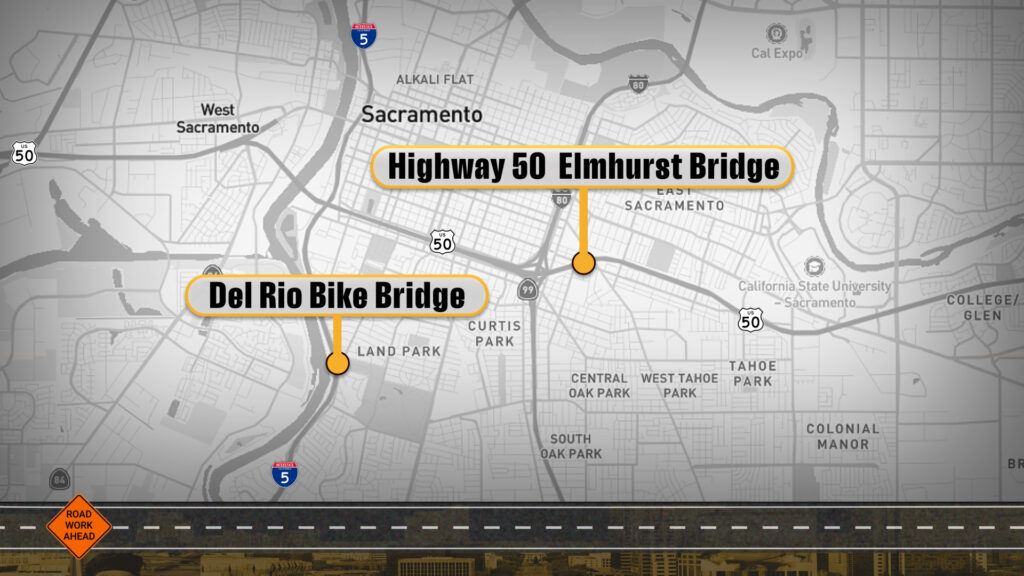
The repair of Highway 50 wasn’t the only local project delayed due to the use of a concrete mix that did not meet Caltrans’ standards for strength. The Abridged investigation also found that similar issues with concrete supplied by the same company working on Highway 50 set back the completion of the Del Rio Bike Trail bridge over Interstate 5 in Land Park by more than 18 months. Contractors had to rebuild portions of that bridge after issues with the concrete and rebar were discovered.
Both projects have led to frustration among residents. Yet few projects in the region’s recent history have elicited such strong reactions as the drawn-out construction of Highway 50, a major transit corridor carrying thousands of drivers each day between densely populated neighborhoods, job centers and suburban communities.
“There’s no question it’s been a daily frustration, a daily set of impacts,” Sacramento County Supervisor Phil Serna said.
Serna, who has been hearing informal complaints about the highway construction for years, said he’s been disappointed by the project running two years over its initial timeline. Any large infrastructure project should build potential setbacks and complexities into its timeline, he said.
“There’s no doubt it’s complicated, but that’s what those contingencies are for,” Serna said. “Talk can be cheap at this point.”
Rejected concrete on Highway 50 and city bicycle bridge
Abridged obtained and reviewed more than 2,000 pages of records — including emails, contracts, lawsuits and other internal documents — that provide the first look into a saga of controversial materials and court battles that have dragged on for months. The investigation found:
- Caltrans rejected concrete that was supplied and poured for Fix50 over four months, from April to August 2023. Project crews had to demolish and replace large sections of newly poured roadway, leading to lengthy and expensive project delays.
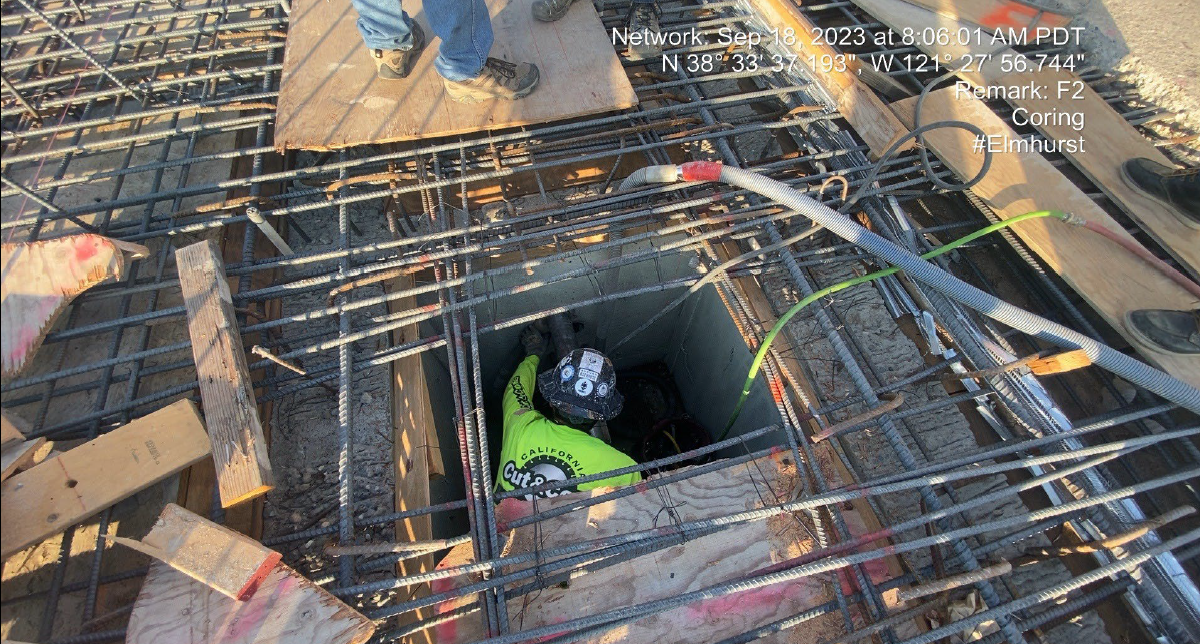
- Work along Highway 50’s Elmhurst Bridge, east of the Highway 99 interchange, had severe alleged deficiencies based on the concrete’s strength metrics that added more than six months to the project timeline.
- The same concrete supply company that delivered the rejected Highway 50 concrete, Elite Ready Mix, also supplied the mix that led to the failure and ultimate replacement of the bridge components on the Del Rio Bike Trail, a project managed by the city of Sacramento.
- One lawsuit alleges Elite Ready Mix quietly substituted the materials in its concrete mix, leading to months of disputes and delays on both Highway 50 and the Del Rio Bike Trail bridge. The city of Sacramento says contractors overseeing the bicycle bridge project were unaware of the change.
- Elite acknowledged in a letter that supply chain pressures pushed them to substitute materials in the concrete mix supplied to both projects.
- In one weekly memo, Caltrans noted there were as many as six nonconformance reports connected to concrete supplied by Elite. Caltrans declined to disclose how many segments were impacted by concrete mix concerns.
Contractors covered cost of new concrete on both bridges
The cost of replacing the rejected concrete on both Highway 50 and the Del Rio Bike Trail was covered by the lead contractors in both instances.
The lead contractor for Fix 50, Flatiron Dragados, sued Elite Ready Mix over alleged construction errors in January. Elite Ready Mix filed a cross-complaint months later, accusing Caltrans of providing project specifications that were not properly studied before they were written into contracts.
Both companies appeared to reach a settlement by late November. In a recent court filing, Flatiron and Elite Ready Mix requested that a judge dismiss the lawsuit and cross-complaint.
Attorneys for Elite Ready Mix and Flatiron declined to comment, stating that they do not discuss pending legal matters. Representatives from both companies declined multiple requests for comment.
Representatives from Mountain Methods Inc. and Sequoia Civil, which provided work on the Del Rio bridge, did not respond to requests for comment. Abridged sent a series of questions to Caltrans on Nov. 19, but the agency has not responded.

Two nights in July 2023 led to rejected work
Two nights of construction work during the summer of 2023 led to months of delays on Highway 50.
During graveyard shifts that began on July 14 and July 28, 2023, crews poured concrete for a new bridge that would fill the space between the westbound and eastbound lanes of Highway 50. Workers laid down the support structure for what would become two new highway lanes near Sacramento’s Elmhurst neighborhood.
Delivery tickets and compliance certificates from the concrete supplier were checked, confirming to construction crews that the right concrete mix had been delivered.
Or so they thought.
In September 2023, quality testing on the Elmhurst Bridge’s concrete began showing strength concerns. Caltrans ordered that more test samples be taken from the bridge, and contractors cut open the road to take cylindrical concrete samples to ship to a testing lab.
“Elmhurst Viaduct Frame 3 & 4 stem and soffit concrete strength concern,” wrote Caltrans in a Sept. 9, 2023 memo, the first appearance of concerns along the Elmhurst bridge.

Caltrans’ concerns grow
For months, Caltrans continued to send concrete samples to a lab for testing. By November 2023, Caltrans noted that it had concerns about the concrete mix, according to weekly project memos. In a lawsuit, Flatiron Construction alleged that Elite Ready Mix made “false representations” about what was in that mix.
“Flatiron later learned, after the concrete had been placed and was curing, the concrete manufactured and supplied by Elite did not contain the materials as represented in the Mix Design,” alleges the lawsuit filed by Flatiron against Elite Ready Mix.
Instead of “fly ash,” Elite Ready Mix supplied concrete that contained “natural pozzolan,” the lawsuit alleges.
Fly ash and natural pozzolan are materials that are added to concrete to improve durability, according to the American Concrete Pavement Association. Fly ash is a byproduct of coal power plants, and natural pozzolan is mined from natural deposits.
In a series of emails, Elite Ready Mix claimed that the materials used in its concrete mix were on a Caltrans approved materials list. Despite those claims, Daniel Eggers, a civil engineer with Caltrans’ Bridge Design branch, urged more testing, according to an email dated Dec. 15, 2023.
“In other words, even if the ingredients are good, this does not guarantee that when they are mixed they make a good cake,” Eggers wrote.
Test results showed that portions of the Elmhurst bridge only met 79% and 85% of the strength tests, according to the weekly memos. The bridge was required to meet or exceed a strength of 6,000 pounds per square inch, but the concrete did not meet that mark, Flatiron later alleged in a lawsuit.

Unclear if other highway sections have rejected concrete
It is not clear from public records if other segments of the highway may have been affected by concrete that was later rejected.
In one weekly memo, Caltrans noted there were as many as six nonconformance reports connected to concrete supplied by Elite. Caltrans declined to disclose how many segments were plagued by concrete mix concerns.
Highway 50 project completion date lags
As Caltrans continued to unravel the issues with the Elmhurst bridge, its estimates for when Fix 50 would be completed stretched into the future. By December 2023, the project’s calendar estimate for when most of the work would be done extended 6.5 months, according to Caltrans’ project memos.
In February 2024, after more months of testing, Caltrans broadly rejected months of concrete supplies that came from Elite Ready Mix.
“Rejected all concrete supplied by Elite from April to Aug. 2023,” noted an internal memo filed by Caltrans on Feb. 17, 2024.
From April to July 2024, workers demolished and rebuilt the section of the Elmhurst bridge.

Companies trade allegations
Lead contractor Flatiron alleged that the alteration to the concrete mix happened quietly.
“The false representations by Elite were made with the intent to deceive, defraud, and induce Flatiron to allow Elite to supply concrete to the Project, not containing Fly Ash, but instead containing Natural Pozzolan,” the lawsuit alleges.
Flatiron originally sought $21 million in damages from Elite to cover the cost of the allegedly defective materials, according to court records.
Elite Ready Mix filed a cross-complaint, alleging that the project specifications allowed them to use fly ash or natural pozzolan “interchangeably.” The company alleged that Caltrans, however, did not test the concrete mixes beforehand to ensure that they would have the proper level of strength and durability.
Elite alleged that the contracts between Caltrans and Flatiron “were neither fully accurate nor complete and that even if relied upon and executed verbatim, the resulting concrete mix could fall below the levels of strength and durability called for under the Prime Contract and Purchase Agreement.”
The specifications under the purchase agreement “were not accurate nor constructable,” Elite alleged.
Elite filed the cross-complaint against another supply company, Golden State Pozzolan, as well, alleging that if they are liable, it’s due to “acts, errors, or omissions” of Golden State Pozzolan, court records state.
“Our client firmly disputes the allegations made by Elite Ready Mix in its cross-complaint,” said attorney Richard Arneal, who is representing Golden State Pozzolan, in an email. Arnael declined further comment on the case.

Bicycle bridge concrete also rejected
That same summer in 2023, two miles south of Highway 50, crews were at work building a bridge over Interstate 5 near Sutterville Road to expand a new bike trail.
Concrete concerns struck again. Elite Ready Mix, working with a different set of contractors on a $12 million project pursued by the city of Sacramento, provided the concrete for a new bridge extending over the freeway, next to an existing Union Pacific Railroad bridge. The bridge marked a key section of the new Del Rio Bike Trail and provided a connection to the Sacramento River Bike Trail.
Concrete that was poured on the bridge in July 2023, the same month as the issues with the Elmhurst bridge on Highway 50, was later claimed by the city to be “nonconforming,” according to emails between city engineers and contractors. Those issues were first reported by Inside Sacramento magazine.
A delivery ticket, noting the composition of the concrete mix delivered to the bridge site near Sutterville Road on July 14, 2023, notes that the mixture included 910 pounds of “fly ash.”
The ticket does not identify natural pozzolan being in the mix, and includes the same ratios of materials noted in the original concrete mix listed for the bridge project.
However, by December 2023, lab test results returned and revealed that fly ash was “not identified” within the concrete.
“It is suspected that Class N pozzolan had been substituted for the Class F fly ash in the concrete mix,” states a letter from a petrographer with MJ2 Consulting sent to the engineering consultants hired by the city of Sacramento.
Tests also showed that the concrete was meeting only 85% of strength tests, according to emails received by the city describing the results.

The city of Sacramento rejected the concrete and called on the project’s lead contractor to remove and replace it.
Disputes over the concrete, the need to test it and arguments over whether it met strength standards stretched across 2024. By August 2024, the city of Sacramento deemed again that the concrete was “nonconforming,” according to a letter sent by the city to the lead contractor.
Investigations by the city’s contracted engineers also found issues with the rebar that required it to be replaced, according to the letter.
The bicycle bridge sat vacant, with traffic barriers blocking its entrance. While it wasn’t uncommon for pedestrians and cyclists to jump the barrier to continue along the bike trail, representatives from the city of Sacramento said the bridge was not in imminent danger of collapsing onto Interstate 5.
Work to take down the rejected concrete and replace it began in July 2025. Elite Ready Mix was not used as a subcontractor for the replacement of the bridge, according to the city of Sacramento.
Supply chain issues blamed
For four months in 2023, Elite Ready Mix substituted natural pozzolan for fly ash in its concrete mixes due to supply chain pressures, according to public records.
“Elite Ready Mix was utilizing Golden State Pozzolan at our Bradshaw plant from April 11, 2023 – August 14, 2023 due to supply constraints of our fly ash sources,” states a letter from Elite Ready Mix to Sequoia Civil, the subcontractor that oversaw the Del Rio bridge construction project. The letter, written by Elite’s vice president Greg Bridges, was dated Dec. 11, 2023.
The letter details that 95% of the company’s materials are imported “by sea and rail.” Natural pozzolan, the letter stated, is sourced from sites near Sacramento and Fernley, Nevada.
“As they are so close, they are often the most reliable during times with the worst supply chain issues,” Bridges wrote.
Bridges wrote that the company needed to switch its materials “to ensure a steady, reliable product, without negatively impacting our customers’ schedules.”
Availability of both materials is “very regionalized,” said Sarah Dalton, a senior director of engineering and construction with the American Concrete Pavement Association
“This regionality also directly impacts the cost of the materials,” Dalton said in an email.
Elite Ready Mix repeatedly denied any wrongdoing in court documents, emails and letters to the city of Sacramento and Caltrans.
“Elite apologizes for any confusion or perceived deception, but we truly were just doing business as usual as we interpret the specifications,” the letter stated.
Coal byproducts dwindle
For the last 40 years, concrete companies have depended on the byproducts of coal power plants to strengthen their products.
As the world shifts away from coal toward other energy sources, the supply of fly ash is becoming much less dependable, according to Nishant Garg, an engineering professor at the University of Illinois Urbana-Champaign.
“The truth is, coal plants are on their way out and one consequence is the fly ash,” Garg said. “I feel for these contractors, they have a key ingredient that they’re now missing.”
Garg’s lab focuses on the quality of different supplementary materials in concrete, especially as the supply of materials is changing. He said it’s important that the quality of these materials is closely studied.
Garg added that it is unusual for concrete materials to fall so far below their strength test, when presented with information from Abridged’s research.
“Typically most of these concrete producers overdesign, so they usually would be 10% or 20% over the strength,” Garg said.
After years of delays, construction on Highway 50 and the Del Rio bridge is coming to a close.
The city of Sacramento estimates that the Del Rio bike bridge will be open to the public before the new year. Caltrans stated that most of the substantial work on Highway 50, such as lane closures, also will be completed by the end of 2025.
Felicia Alvarez is a reporter at Abridged covering accountability. She’s called Sacramento home since 2015 and has reported on government, health care and breaking news topics for both local and national news outlets.
This story was updated at 10:15 a.m. on Jan. 28, 2026 to edit an incorrect reference. Public records show Elite Ready Mix substituted natural pozzolan for fly ash in concrete mixes for four months in 2023.