
The Abridged version:
- The Sacramento region has no Jewish delicatessens, though it had three throughout the 2010s.
- “Seinfeldian cuisine” is having a renaissance in the Bay Area, but little has made its way east.
- Roughly 2,200 people attended Sacramento’s 48th Annual Jewish Food Faire in October, signifying high demand.
How many times has this happened to you?
You have a loved one who’s under the weather. Being the thoughtful person you are, you think to grab a deli quart of the chosen medicine of the Chosen People: matzo ball soup, AKA Jewish penicillin.
But wait: You live in the Sacramento region, home to zero Jewish delicatessens.
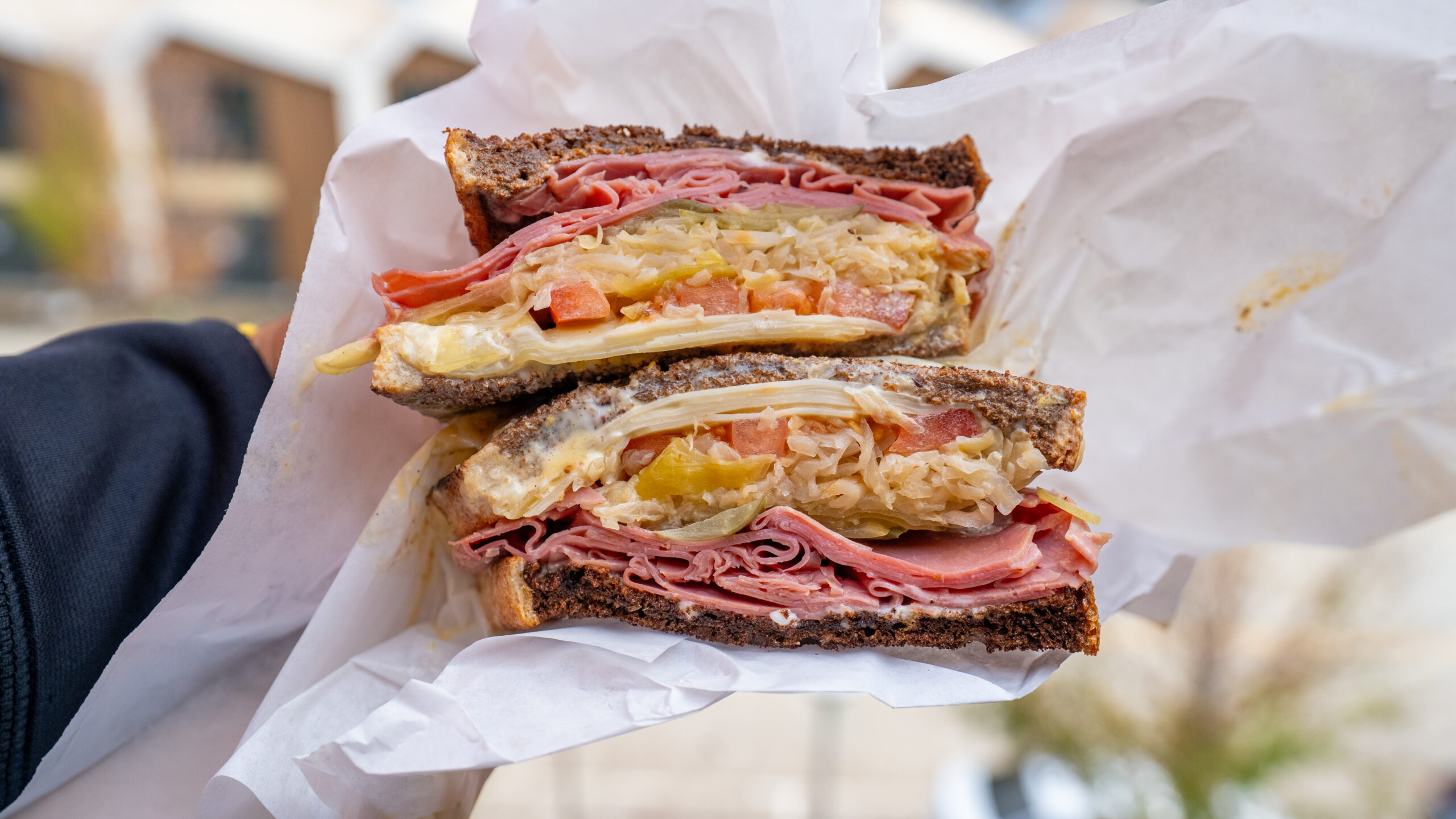
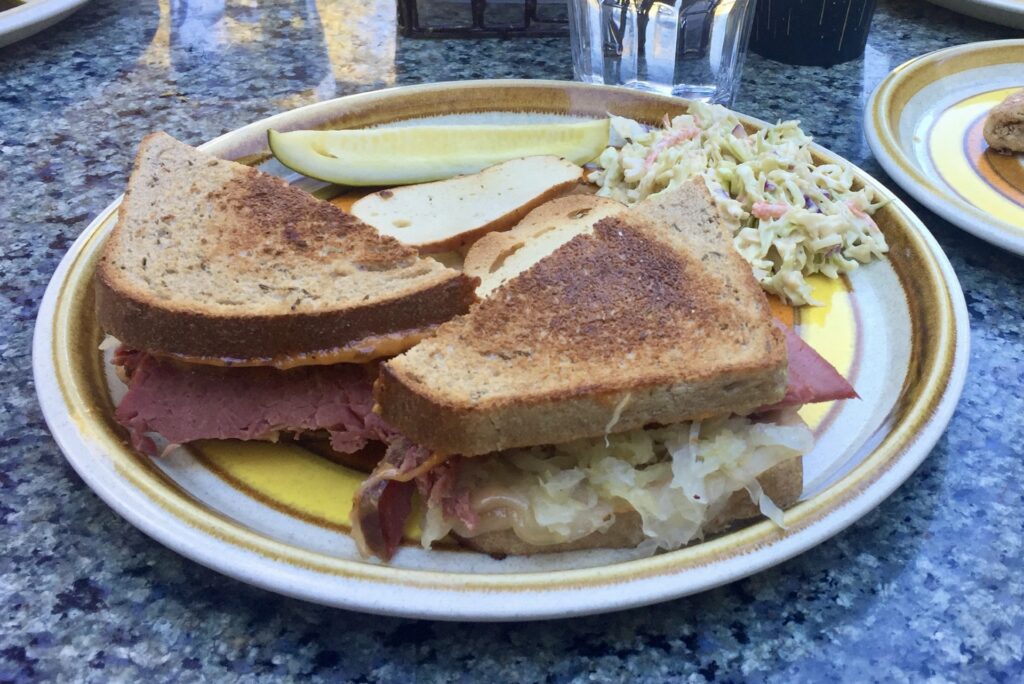
The capital of the world’s fourth-largest economy doesn’t have a sit-down restaurant where one can nosh pastrami on rye, liver and onions, whitefish salad and matzo ball soup all in one place, washed down by a Dr. Brown’s soda.
Sounds like a shanda? It sure did to me.
Delis of years past
Sacramento wasn’t always a Jewish deli wasteland.
Sam’s Kosher Style Restaurant & Deli in Fair Oaks offered a traditional Jewish deli menu with kreplach, lox and hot tongue sandwiches. Bubbie’s Love Deli and Catering opened in Citrus Heights in 2013 with a similarly old-school ethos, expanding on owner Stacie Shoob-Allen’s burgeoning blintz business at local farmers markets.
Both were Jewish owned and operated. Both were kosher-style, meaning they served meat alongside dairy products.
Sam’s closed on St. Patrick’s Day in 2014 after 53 years, and Bubbie’s shut down in 2018 after five. They were followed by Solomon’s Delicatessen, the restaurant that set out to fill Sacramento’s Jewish deli void but lasted only a few years.
What happened to Solomon’s?
Intensely hyped from its 2016 announcement to its summer 2019 debut in Downtown Sacramento (a short-lived Davis branch also ran from 2018-19), Solomon’s never quite seemed to find its footing as a ’70s-inspired modern Jewish deli and cocktail bar with an upstairs music venue. Competing visions saw it transform from Solomon’s Delicatessen to Solomon’s Vinyl Diner to just Solomon’s before its 2024 closure, and Sacramento’s Jewish community never seemed to embrace it in full.
Solomon’s went into the pandemic still working out significant kinks. Those kinks might have torpedoed any dining establishment, Jewish deli or not, COVID-19 pandemic or no pandemic.
That being said, there was the pandemic.
Ryan Ota was Solomon’s chef when it pivoted to a more global menu in summer 2020. He mentioned a particular aspect of Solomon’s that might prove a headache for any Jewish deli: high cost, menu-specific proteins, the price of which “astronomically rose” during the pandemic.
“So we’ve just gone through COVID and the food chain has been considerably impacted from COVID,” Ota said. “(It was difficult) trying to run a Jewish deli with two high-priced proteins alone, being salmon that you’re curing — you’re shrinking down to less than half of what you started with because you’re getting all the moisture out — and then with brisket, you’re also doing about the same thing to produce pastrami.”
Why not here?
Ask people, “Why doesn’t Sacramento have a Jewish deli?” and you’re bound to hear a common response: The region doesn’t have enough Jews to sustain one.
But is this argument legitimate?
Sacramento has a rich Jewish history. Like many a California dreamer, the Jewish people came west with the Gold Rush, and Sacramento became home to the state’s first synagogue in 1852. Jewish businessmen David Lubin and his half-brother Harris Weinstock opened the Weinstock-Lubin department store in 1874 on Fourth and K streets. In 1960, future Solomon’s Delicatessen namesake Russ Solomon opened Tower Records, which would later spread around the globe.
The Sacramento metropolitan area was home to approximately 34,000 Jews in 2020, according to The Jewish Federations of North America, representing about 1.5% of its population. By comparison, New York City is 10% Jewish, and the Bay Area, which the SF Standard recently said is in a “Seinfeldian cuisine” renaissance, comes in at 5.2%.
But here’s the thing: Other American cities with low Jewish populations have Jewish delis, both old and new. People line up for Rosenberg’s Bagels and Delicatessen in Denver, Miracle Mile Deli in Phoenix and The General Muir in Atlanta, and each of those cities has a Jewish population of around 2%. While the number of Jewish delis across the country has declined over the years, as David Sax illustrated in his 2009 book “Save The Deli,” a new wave seems to be breaking out as well.
And the Sacramento region is awash with cuisines from different cultures, including those with small local populations. Sacramento County has fewer than 3,000 Ethiopian residents (0.18% of the county population) but three Ethiopian restaurants, with additional ones in Roseville and Davis.
Keep asking questions, rabbi says
The “not enough Jews” argument could be applied as well to Solomon’s, which never had a Jewish chef. Mo Kalisky attended an early Solomon’s food tasting and was unimpressed, chalking up the poor offerings to the lack of Jewish people in the back of house.
“There were no Jews there,” Kalisky said. “And they didn’t understand the flavor of the Jewish-inspired ambience. So they did the best they could, and it came out wrong.”
Kalisky is co-founder of Davis’ Upper Crust Baking, which has made rye bread, bagels, challah and New York-style cheesecake for almost four decades. The Kaliskys and their son, Lorin, were around for some of Solomon’s nascent stages, but didn’t end up advising on the food.
“I offered the Solomon’s people myself as a consultant, but they were not interested,” Kalisky added.
So then. What is the deal with there being no Jewish delis in Sacramento?
No one seems to know, including Darrell Corti, owner of Sacramento’s most popular Italian deli in Corti Brothers.
“I have no idea,” Corti said.
That doesn’t mean one should stop inquiring. In fact, it’s the opposite, said Rabbi Nancy Wechsler of Carmichael’s Congregation Beth Shalom.
“In Judaism, asking questions is actually more important than the answer, because asking the question creates engagement in the topic,” she said. “So, how do you make peace with unanswered questions? You keep asking, or maybe ask in a different way.”
Food Faire shows hope for future
Is Sacramento finally ready for a Jewish deli? Depends on whom you ask.
“I think that if one were to open with the right kind of menu, it would be successful,” Kalisky said. “We need to find somebody who has $1 million to invest. And I don’t mean that facetiously. I mean, that’s what it would cost.”
“I know know know that a full-on Jewish deli with takeout and sit-down and every option available would succeed in Sacramento,” former Mayor Darrell Steinberg, perhaps Sacramento’s most famous Jewish resident, wrote over email. “I would be honored to cut the first matzah ball when it happens!”
“There’s enough demand that some businesses keep getting started, but I don’t think there is enough demand to sustain them,” Matthew Kurtz, the chef at Sacramento’s 48th Annual Jewish Food Faire, said in October. “I’d hate to see someone put their heart and soul into a Jewish deli only to have it close. If it opens, I’ll visit it.”
Roughly 2,200 people attended the Jewish Food Faire, which was sponsored by Congregation Beth Shalom. Turnout has steadily increased each year since the pandemic, prompting an expansion to the Scottish Rite Temple in East Sacramento.
Solomon’s founding partner Jami Goldstene wore her former restaurant’s T-shirt as she managed the fair’s deli line, which spilled out into the parking lot. Based on fair turnout, Goldstene said Sacramento’s enthusiasm for Jewish food might be entering “a new era” from when Solomon’s was open.
“I would be very hopeful that were timing better, were location better, were the world in a different place, could we recreate something that wasn’t just one day?” she said. “Yeah.”
Two bright lights indicate that year 5786 on the Jewish calendar wouldn’t be the worst time to break out the schmaltz and start plating those Reubens.
In October, Gov. Gavin Newsom signed into law two bills aimed at streamlining the process of opening a restaurant. Assembly Bill 671 simplifies the initial permitting and construction process, making it easier for establishments to open quickly. AB 592 alleviates permitting woes for outdoor spaces, enabling more outdoor dining.
So, what is one to do for mazto ball soup in the meantime?
“Make it at home,” Wechsler said. “It’s not that hard.”
Helen Harlan is a Sacramento-based freelance writer and cocktail server.