
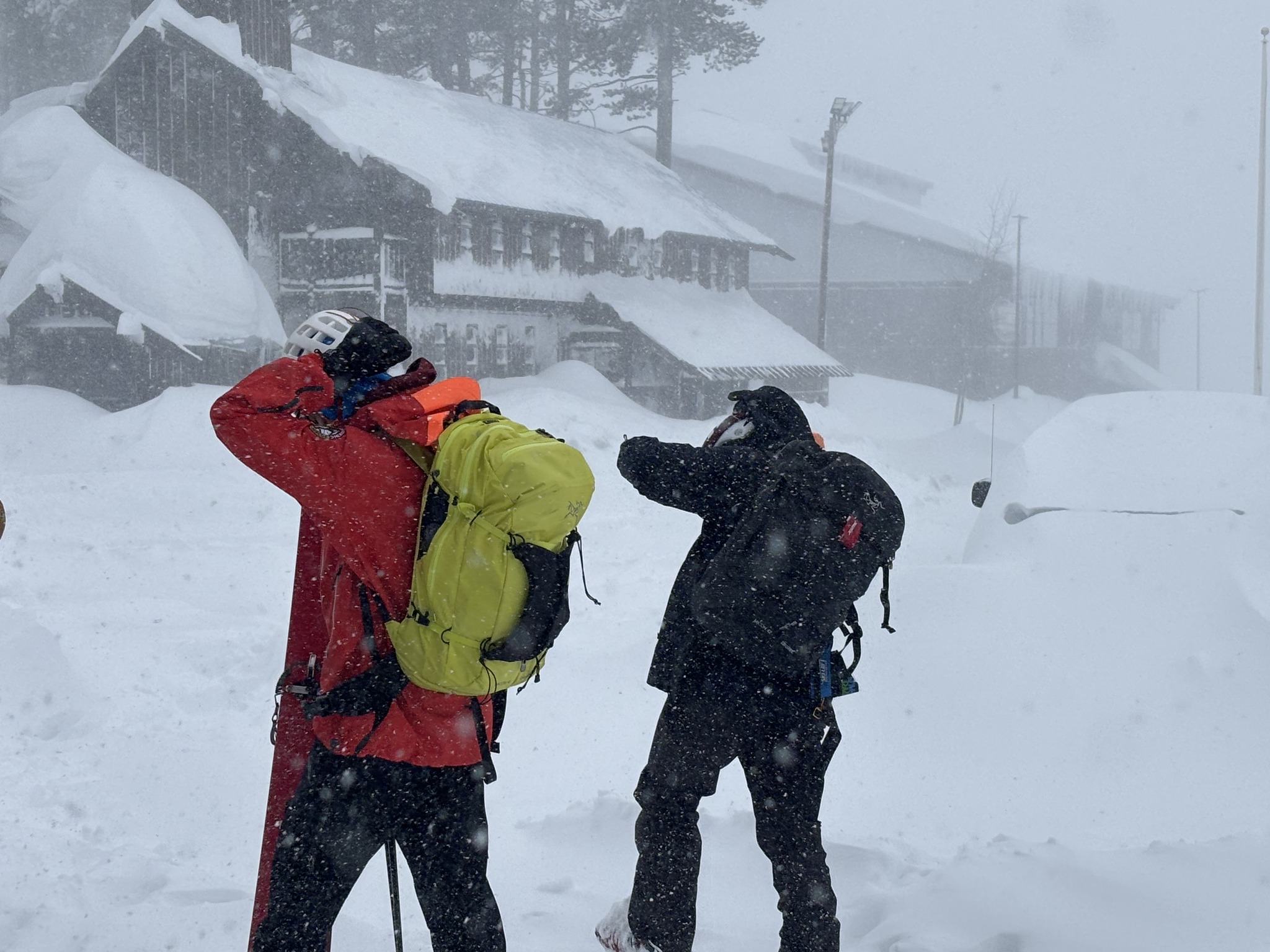
The Abridged version:
- An avalanche buried a group of 15 backcountry skiers in Tahoe’s Donner Summit region on Tuesday. Authorities have confirmed multiple deaths.
- Wendy Antibus, education manager at the Sierra Avalanche Center, said the dry conditions all January allowed weak layers to form at the surface of existing snow, creating a slippery surface that’s prime for avalanches.
- It is now the deadliest avalanche in California’s modern history, surpassing the 1982 avalanche in Alpine Meadows that killed seven people.
This story is being updated regularly on kqed.org. You can find it here.
Eight people were killed, and one is still missing, after an avalanche buried a group of 15 backcountry skiers in Tahoe’s Donner Summit region on Tuesday.
It is now the deadliest avalanche in California’s modern history, surpassing the 1982 avalanche in Alpine Meadows that killed seven people.
Following a 911 call from the survivors around 11:30 a.m. Tuesday, about 50 people from surrounding search-and-rescue teams responded, Nevada County Sheriff Shannan Moon said at a press conference Wednesday.
Six of the skiers, who were part of a three-day backcountry skiing group staying at the Frog Lake huts near Castle Peak, were rescued amid extreme weather conditions Tuesday night, Moon said.
First responders used snowcats to get 2 miles from the site of the avalanche before skiing in to rescue survivors, who were trying to shelter amid the storm with the equipment they had on hand. Two were taken to a hospital with non-life-threatening injuries, and one has been released.
- Jump straight to: What to do if you’re caught in an avalanche
“Due to extreme weather conditions, it took several hours for rescue personnel to safely reach the skiers and transport them to safety, where they were medically evaluated by Truckee Fire,” a sheriff’s spokesperson wrote.
Three people were immediately identified as dead on the scene.
The search for the remaining missing person and recovery for the eight deceased are ongoing Wednesday, pending weather conditions, Moon said.
“It’s not a resource issue as we speak,” Moon said. “It is a weather condition and safety condition for our response teams.”
Initial reports said 16 people went on the trip, but a statement from Blackbird Mountain Guides, the guiding company involved in the incident, confirmed the group was actually 15 — comprising 11 clients and four guides. Among the survivors, one is a guide and five are clients. All had emergency beacons, and rescuers were communicating with some survivors via text message, according to first responders.
Nine women and six men were on the trip, with five women and one man among the survivors. Their identities have not been released, but Placer County Sheriff Wayne Woo said one of those who died is the spouse of a member of the Tahoe Nordic Search and Rescue Team, a volunteer team that responded to the incident.
“This has not only been challenging for our community, it’s been a challenging rescue,” Woo said. “It’s also been challenging emotionally for our team and our organization.”
A major storm hit the Lake Tahoe region this week, producing high avalanche danger. While crews continue their search, the Sierra Avalanche Center issued an avalanche warning starting Tuesday morning that expires on Thursday.
The warning notes high avalanche danger — the fourth level on a five-point scale — and says travel in or around backcountry avalanche terrain is not recommended.
“Rapidly accumulating snowfall, weak layers in the existing snowpack, and gale-force winds that blow and drift snow have created dangerous avalanche conditions in the mountains,” the warning reads. “Natural avalanches are likely, and human-triggered avalanches large enough to bury or injure people are very likely.”
Wendy Antibus, education manager at the Sierra Avalanche Center, said the dry conditions all January allowed weak layers to form at the surface of existing snow, creating a slippery surface that’s prime for avalanches.
Then this week’s sheer volume of snowfall, with more than an inch falling per hour for the past two days, piled on top, said Brian Brong, a meteorologist with the National Weather Service’s Reno office.
“As the slope gets steeper and steeper, that snow doesn’t tend to want to stick — it wants to kind of slide down the hill, so that’s where we get the avalanche threat,” he said.
And with temperatures in the single digits on the mountaintops, that produces light, fluffy snow that can get blown around easily — even a 30 mph wind can create whiteout conditions, he said. The lighter snow leads to more snow drifts, piling up on one side of a mountain and creating a steeper-than-normal slope, prime for avalanche risk.
This slide was around a football field in length, said Chris Feutrier, forest supervisor of the Tahoe National Forest.
“It resulted when a persistent weak layer had a large load of snow over the top of it,” he said at the press conference. “That persistent weak layer is still there and has reloaded with another three feet of snow. So the hazard remains high.”
The slide occurred just one mile away from another in January, which killed a person snowmobiling in the backcountry.
Richard Bothwell, chief avalanche educator for the Bay Area-based Outdoor Adventure Club, warned that people often have trouble assessing risk in the backcountry.
“We just have to be really, really meticulous about the terrain that we choose to travel on,” he said.
At Wednesday’s press conference, Woo warned that travel in the Sierra Nevada is not safe right now. “Please avoid the Sierras during this current storm and in the upcoming days,” he said. “Avoid mountain travel — it’s treacherous. Avoid the backcountry.”
What to do if you’re caught in an avalanche
If you’re planning on heading up to the mountains this winter, keep reading for what to know about avalanches — why they happen, how to prepare for the worst, and what to do if you’re caught in an avalanche yourself.
How to be prepared for avalanches
If you’re venturing into the backcountry — which means beyond the boundaries of a ski resort — then you need to take an avalanche safety course. This will give you far more detail in understanding avalanche conditions and rescue protocols.
If you’re planning to stay primarily in a resort or mountain park, then you should still know the basics — many of which you can learn through the National Avalanche Center’s free course videos and educational materials on avalanches.
The most important rule is not to venture into closed areas of the resort and not to “duck” under out-of-bounds ropes. Pay attention to any alerts or warnings.
The Sierra Avalanche Center has also created a daily flow guide for a simple way to understand the best practices when skiing and snowboarding in the Sierra. This includes:
- Skiing with other people and knowing their abilities in advance
- Knowing the conditions and avalanche risk before you go
- Having a safety and rescue plan and bringing avalanche equipment
How do I know what the avalanche conditions are?
Check, check, check the forecasts.
The Sierra Avalanche Center, along with a number of avalanche experts and offices around the West, puts out daily forecasts with predicted avalanche dangers and conditions to watch out for. They also put out weekly overall updates on the state of the snowpack.
However, reading an avalanche advisory in detail does require some background knowledge. If you plan to stay within the resorts, then the “bottom line” information (which is listed at the top) supplied in the advisory forecasts should give you the main takeaways.
A good rule is to pay attention to the warning signs that an avalanche could happen when you’re out in the snow. According to the Sierra Avalanche Center’s daily flow guide, these include:
- Recent avalanche activity in the area
- Signs of instability in the snowpack
- Recent “loading” (i.e., storms)
- Rapid warming or weather changes
- Terrain with a slope greater than 30 degrees
- Terrain or hillsides that match the advisory warnings
How do avalanches happen?
There are different kinds of avalanches that come with different kinds of warning signs and frequency. The two main kinds are dry-loose or sluff avalanches — which are made up of soft snow that collects as it moves — and slab avalanches, which occur when a cohesive layer of snow breaks and moves as a slab downhill.
The science of how snow layers form and break is complicated, but in essence, avalanches occur when there’s a surface bed of snow at the bottom, with a weaker layer of snow on top — and then new snow on top of that weaker layer.
This creates conditions where the weaker layer can collapse, and the mass of snow on top can fracture and slide. While this can happen naturally, human activity almost always triggers avalanches, causing the weaker layer to collapse.
Things that can affect the likelihood of an avalanche occurring are, according to the National Snow and Ice Data Center (PDF): The instability of the snowpack, the recent weather and snowfall, and the terrain.
Avalanches are most likely to occur immediately after a large storm when there has been significant snowfall. Heavy wind that quickly blows in large amounts of snow on top of an existing layer can also cause dangerous conditions. Slight melting and refreezing each night can stabilize the snowpack — but extended periods of out-of-the-ordinary weather changes can cause instability. Whether or not a slope faces the sun, and the steepness of that slope, can affect the probability of an avalanche.
Within resorts, ski patrols monitor these conditions and conduct avalanche controls — deliberately setting off small avalanches to keep the potential for larger ones from building up. In the backcountry, it’s important to be aware of all these changing variables since you won’t have ski patrols around to do it for you.
What is avalanche equipment?
In the backcountry, avalanche equipment includes:
- An avalanche beacon and receiver
- A probe to stick in the ground to locate someone trapped
- A shovel to dig someone out
Many jackets and ski pants also now come with a RECCO reflector built in. This small transmitter looks like a label or tag on your coat, pants, helmet or backpack, which transmits to receivers operated by patrols or rescue crews. This is not considered a replacement for an avalanche beacon, but it can augment rescue efforts and is an easy add-on to have inbounds at a resort.
What should I do if I get caught in an avalanche?
First and foremost, try to get off the slab or out of the oncoming avalanche track. This is, of course, not always easy to accomplish since avalanches can travel between 60 mph and 80 mph.
The Sierra Avalanche Center recommends two techniques for escaping the path of an avalanche:
- If you’re skiing or snowboarding, try to head straight downhill to build up some speed, and then angle off to the side to get off the slab.
- If you’re snowmobiling, use the momentum and power to your advantage and continue in the direction you’re going to try to get out of dangerous snow.
The reason people die in avalanches is that carbon dioxide in the area around their mouth, where they are buried, builds up. If they’re rescued within the first 15 minutes, there is a nearly 93% survival rate, according to stats published by the American Avalanche Association — but it drops drastically with every additional minute. This is why it’s crucial to take steps to increase the likelihood that you can be found and rescued quickly.
- If you get caught in an avalanche and can’t escape, you can try to grab onto a tree. But you’ll have to do this very quickly because avalanches pick up speed within seconds — and getting carried at speed into a tree or boulder is a common source of fatal trauma in an avalanche.
- If you can’t escape or grab onto a tree, then you need to “swim.” Because people are likely to sink in the avalanche debris, it’s important to swim hard to try and keep yourself near the surface.
- Clear a space for air in front of your mouth as the avalanche slows down just before it comes to rest. This will give you slightly longer before the carbon dioxide builds up.
- Push a hand up (or your best guess of what “up” is) because any clues will help people find you faster.
- Remember: All of these things must be done while the debris and snow are still moving — because once the snow stops, it will instantly be too thick and heavy for you to move.
If you see someone caught in an avalanche, do not try to ski or snowmobile over to them while it is occurring — no matter how strong your instinct is to reach them to help out. Instead, you are likely to get caught in the avalanche yourself. You should try to note their starting position and where they end up, and then immediately start searching for them after the avalanche stops.
KQED’s Madi Bolaños contributed to this report.