

The Abridged version:
- A new safe camping shelter opens this week in the River District, aimed at providing shelter for up to 125 people living on the streets north of Downtown Sacramento.
- The city of Sacramento is providing tents, restrooms and a small amount of storage for people in the shelter. The shelter does not include air-conditioning or a kitchen but will have 24-hour security.
- The new site arrives after a city audit recently found there was “no strong link to positive outcomes” for people in Sacramento’s network of shelters.
A new safe camping site will soon open in Sacramento’s River District, as part of the city’s latest efforts to provide respite for people living on the streets.
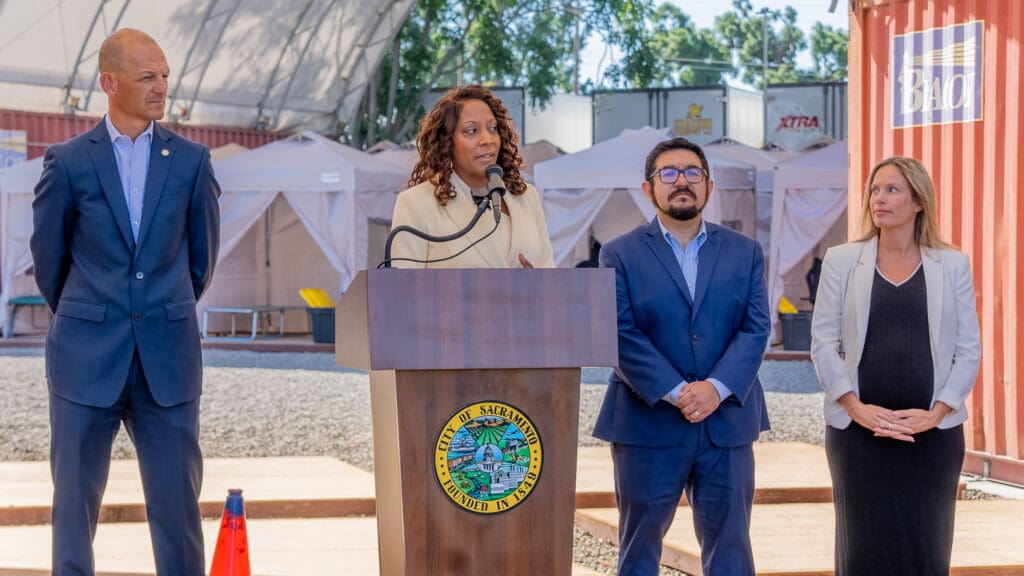
The River District, just north of Downtown Sacramento, has one of the region’s highest concentrations of homelessness. Sacramento leaders gathered Tuesday morning to mark the opening of the new site aimed at providing basic shelter and amenities for people who are homeless in the River District.
Outreach workers with the city have begun signing up people who may shelter at the site, which is expected to have its first tenants by Wednesday.
The site has capacity for up to 125 people and provides basic access to restrooms and showers. Staffers who work with the city’s homelessness programs said the shelter will also help them connect homeless individuals to the region’s broader network of health services and housing resources.
Sacramento Mayor Kevin McCarty said the new safe camping sites are part of a “menu of options” the city is providing to individuals who are homeless.
“There are too many people who are still languishing on our streets, and sometimes, unfortunately, dying on our streets,” McCarty said.
“And look, this isn’t perfect,” McCarty said. “There’s not individual A/C units for everybody here, there’s not individual bathroom facilities. … But, I’d like to go for a walk 100 yards down the street and ask, is it better than what we have outside?”
The new shelter opens as Sacramento County has over 7,400 homeless individuals, including 3,944 who are unsheltered, according to a point-in-time count conducted in January. The count marks a 12.7% increase from the last count in 2024 and is lower than the peak count of nearly 9,300 in 2022.
City provides tents, storage and chairs
The new safe camping shelter has a “low barrier” for entry and is not aimed at any specific populations of homeless individuals beyond people currently residing in the River District.
The amenities on the site are simple as well.
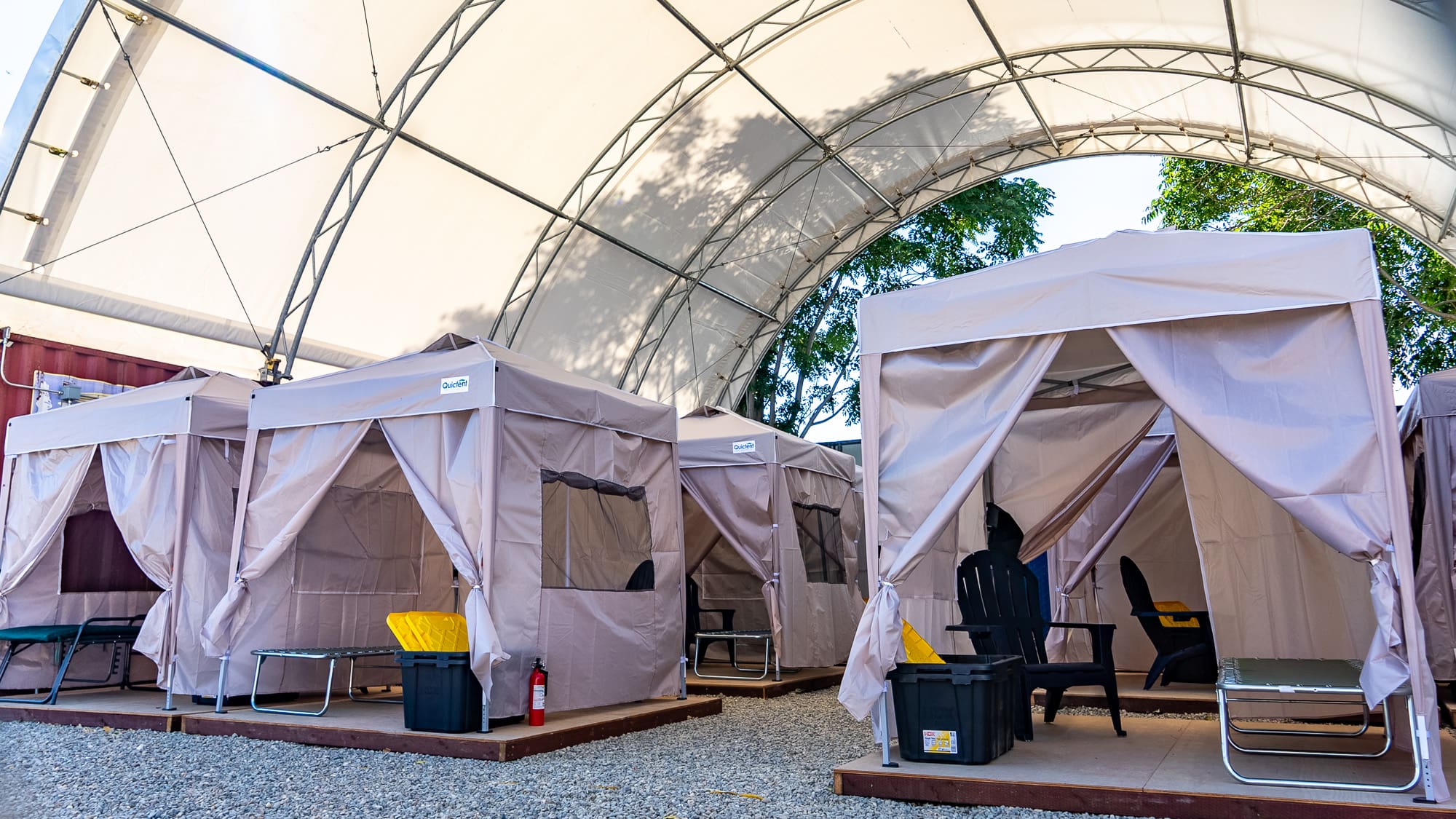
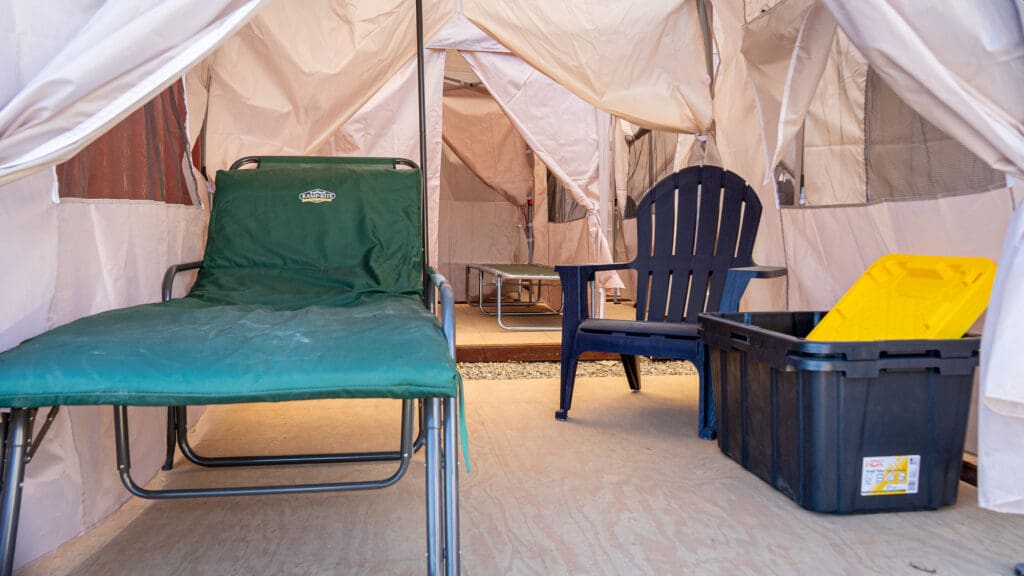
The site includes 100 wooden platforms for tents, sized just smaller than 8-by-8 feet, that sit on gravel. Each platform comes with a city-provided tent, a raised cot, two storage bins and a lawn chair.
The camping platforms are all placed under tall, arching shade structures. There’s no air-conditioning on the site, but shelter managers plan to bring in swamp coolers and fans during the summer months.
During the winter, the city will switch out the current tents on the site for a more insulated variety that are “made for ice fishing,” said program manager Hezekiah Allen.
The shelter also has a common area, spaces for behavioral health and service providers, a trailer with shower stalls and a lineup of port-a-potties. The shelter does not include air-conditioning or a kitchen, but will have 24-hour security.
The city of Sacramento spent $2.5 million on the construction of the site, and yearly operations are estimated to cost $1.2 million, according to City Manager Maraskeshia Smith. Those costs including maintenance, community oversight and security services.
The shelter also marks Sacramento’s latest attempts at safe camping.
The city previously leased property to a self-governed camping site known as Camp Resolution for about 17 months. In August 2024, however, the city deemed the safe grounds camping site a “failed experiment” and forced the site to close.
Brian Pedro, director of the city’s department of community response, reiterated that the new safe camping site functions differently and will maintain a “good neighbor” policy.
City shelters cycle back into homelessness
The city of Sacramento spent $63.2 million on its homeless shelter programs between fiscal years 2024 and 2025. Despite that, a recent city auditor’s report found there was “no strong link to positive outcomes” for people receiving shelter services.
More than half of the people who entered the city’s network of shelters, tiny homes and motel rooms return to homelessness, a recent city audit found. At the city’s largest tiny home shelter on Roseville Road, 65% of people returned to homelessness or had an unknown outcome after leaving the shelter.
The audit also found that the city of Sacramento hasn’t consistently defined how program success should be determined, “making it difficult to measure overall performance and progress” toward the city’s shelter goals.
“These sites are not enough,” said Councilmember Phil Pluckebaum, who represents the River District. “This is a step in the right direction, but we have a tremendous amount more work to do.”
Permanent solutions ‘could take a while’
The mayor, the city’s homelessness director and the city manager acknowledged that bringing people to more permanent stability would be a complicated and lengthy path.
“The long-term solution is to get people into housing, but that doesn’t happen right away,” Smith said.
The recent city audit found that the average length of stay in most of the shelters was more than 100 days. For some shelters, including the city’s motel voucher program, the average stay was more than six months.
“We hope that it doesn’t take six months to a year,” Smith said. “You have to remember these people have to get jobs, they have to get IDs, they have to get services … so it could take a while.”
Felicia Alvarez is a reporter at Abridged covering accountability. She’s called Sacramento home since 2015 and has reported on government, health care and breaking news topics for both local and national news outlets.