


The Abridged version:
- Jinich has hosted 13 seasons of “Pati’s Mexican Table” on PBS, with the 14th debuting on Friday. She also hosts “La Frontera” and “Pati Jinich Explores Panamerica.”
- She espouses culinary invention while respecting traditions, encouraging would-be chefs to learn the practices behind ingredients before adapting them.
- One key difference she sees between Mexican and U.S. dining: Set end times for social events.
Pati Jinich was born in Mexico City, moved to the United States in 1997 and became one of foremost ambassadors on food from her home nation to her adopted one.
She’s the host and executive producer of the Emmy-nominated PBS series “Pati’s Mexican Table,” Season 14 of which premieres Friday, as well “La Frontera,” her James Beard Award-winning docuseries on the foods and people along the U.S.-Mexico border. Her newest show, “Pati Jinich Explores Panamerica,” debuted in April and charts the Panamerican Highway, which stretches from Alaska to Argentina.
Jinich has also written three cookbooks, including “Treasures of the Mexican Table,” which the International Association of Culinary Professionals dubbed the Best International Cookbook in 2022. She was named to the Washington Post’s “Post Next: 50 People Shaping Society in 2025” list earlier this year, and lives outside of Washington, D.C.
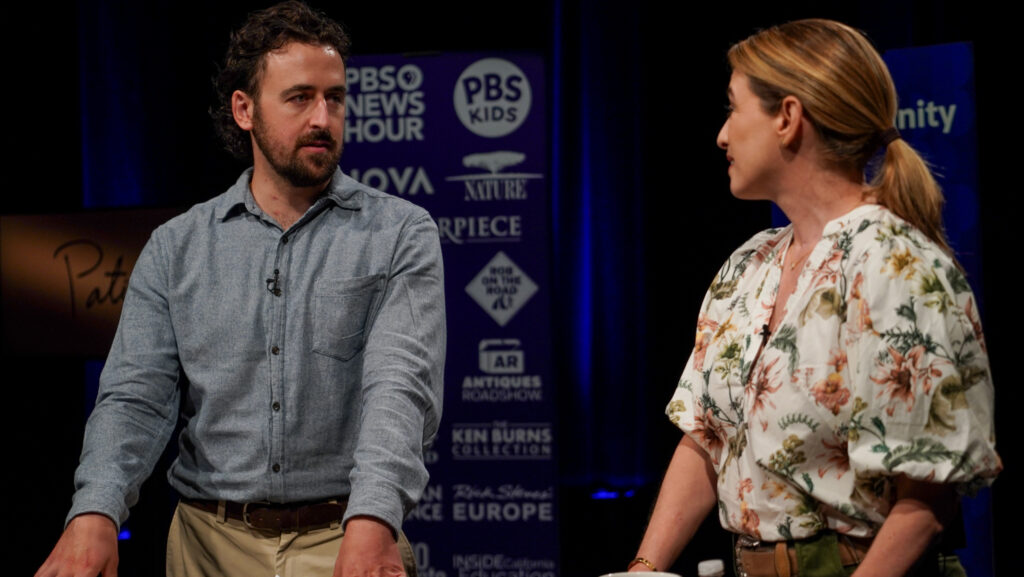
Jinich came to Sacramento earlier this month for a PBS KVIE Studio Series talk at the Crest Theatre, and stopped by our newsroom for lunch and an exclusive interview about creation, authenticity and Mexican food in the U.S. Here’s what she said.
This interview has been condensed for space and clarity.
BENJY EGEL: Pati, thanks so much for being here today. What can you tell us about this coming season of “Pati’s Mexican Table?”
PATI JINICH: I am so excited about this new season, because after 13 seasons, this time I dedicated a full season to my hometown of Mexico City. And I just was able to see it with new eyes, and a lot of humility on the things that I don’t know.
Mexico City’s metropolitan area has 22 million people, and yet every time that I go back there, I go to the same places that I love, that are familiar to me. I realized that there were so many unexplored themes and foods and people for me, and it made me fall in love with my hometown even more. So I can’t wait for people to see it. I get personal. I go visit my sister, my friends. It’s really amazing.
BE: You grew up in Mexico City, but you’ve been living in the U.S. for nearly 30 years now. What do you see as the main differences between food in Mexico and Mexican food in the United States?
PJ: I think it’s been a changing journey. When I first moved to the U.S., I moved to Dallas, Texas and you couldn’t find more than two or three Mexican ingredients. And the American palate was curious about Mexican food, but now it’s so hungry for more. It’s warmed up to learning and knowing everything about Mexican food in so many different areas. We’re talking about “what were the indigenous foods, what were the, the foods during colonial times, the contemporary foods?”
When I see this hunger for more Mexican food and culture and traditions, it makes me so happy. If I was granted a hundred more years of life, I would have 100 more Pati’s Mexican Table seasons. And I think that the exchange between cultures is so enriching, because it’s not only the foods that we’ve learned that we can bring into our homes, but it’s the traditions surrounding them.
For example, when I first moved to the U.S. I was a little bit shocked by a few things. Like how in many restaurants, they bring you the bill before you’ve had dessert. That’s heresy if you have a sweet tooth, especially. Or the times you get invited to friends’ for lunch or dinner, and they tell you, “okay, we expect to have you over from 2-3:30.” How do you know when you’re going to end if it hasn’t even started?
If I host my American friends in D.C., they know they need to get there a little bit late to give me a little courtesy to get ready – that’s a Mexican thing – but also, to relax. There’s nowhere to go. And if we finish the food, I’ll make some more.
BE: You’ve been this ambassador for Mexican food for quite some time now, but you’re far from a traditionalist. How do you balance your role of bringing Mexican food to the U.S. and spreading the gospel to a lot of people, while also inventing and being creative yourself?
PJ: I love walking two parallel paths at the same time. One is to really honor where I come from and to honor the traditions, the foods, the techniques that I’ve been very lucky to inherit, and to do right by them and pass them on.
There are classic dishes and traditions that I believe should be preserved and should be continued through generations so that there are ties. Foods and recipes – most of them are here before we’re born, and they’re going to be here after we leave. They’re so much more powerful than we are. So I believe in my duty to pass them on.
But at the same time, if you don’t open the door in the window for fresh air, you are asphyxiating the culture and the cuisine. And so I believe in being playful while respecting, while giving due credit. If you want to make a new dish with poblano chilis, it’s great to know that Mexicans have historically fire-roasted and peeled and sweated and cleaned them, because you are really bringing the best out of that ingredient.
So I think it’s great have that knowledge in the back of your mind before you’re going to play with that ingredient, because that makes you more powerful while being inventive. Some new dishes are absolutely horrible, and we can call them fusion. And there are some new dishes that may have been fusion, but they may become the new classics. So, hooray for that.
BE: You’ve spoken in the past about not trying to be an ambassador for all of Latin America and all of Latin American food, but in “Pati Jinich Explores Panamerica,” that is sort of the path you’re crafting. How did your thinking change on that?
PJ: I’ve really learned that what you feel today, it may not be what you feel tomorrow or years from now. I used to get a little insulted when people called me Mexican American, and I was like, “hey, I’m a Mexican in the U.S. Now people tell me I’m Mexican American, I’m proud, because I love this country so much too and I’ve grown roots here.
After 14 seasons of Pati’s Mexican Table, sharing Mexico as best I can with the U.S. and the world, and then doing the U.S.-Mexico borderlands and finding the rich diversity and cultures, I got really hungry for understanding what has been the lure, the beauty, the promise for people coming to the Americas. How can we reimagine that concept? By using the Panamerican Highway as a metaphor, because it’s always been a symbol of collaboration and cooperation and idealism.
The goal was to explore the Americas, not wanting to be the ambassador of these places. To learn what things do we share in common, what makes us sisters and brothers, what commonalities we have. And what can we learn from our differences?
I’m taking that approach of awe and exploring. Not coming from, like, “I know better. Let me show you what I know.” This is all new to me, so come with me to learn. What do we have in common and what can I learn from you?
BE: We’re in this age where every celebrity chef and every celebrity, it seems, has a product that they’ve put their name on. And there’s no Pati’s Enchilada Grill at the airport. There’s no Pati’s Salsa in a jar at the grocery store. Why have you chosen not to go down those sorts of paths with restaurants and food stuffs?
PJ: I am a firm and passionate believer in longevity, in quality, in having a good, solid, prestigious name that means something. And if I’m going to do something that you’re going to buy or consume that has my name on it, it better be fantastic.
Every recipe that I share in my show, in my cookbooks, is a recipe that I test to no end. It becomes a magic potion that when you make it, no matter how you make it, it will work. If I can’t have that guarantee, I feel like life is too short, you know? If I leave tomorrow and I didn’t have a Pati Jinich soap, doesn’t matter. But somebody will have my recipe that worked.
Benjy Egel is the senior food editor at Abridged. Born and raised in the Sacramento region, he has covered its local restaurants and bars since 2018. He also writes and edits Abridged’s weekly food and drink newsletter, City of Treats.