

The Abridged version:
- A contingent of local guides and anglers observe a voluntary fishing closure on Putah Creek between December and March to allow the fish to spawn undisturbed. Now, they’ve returned to the far southwestern edge of Yolo County to fish the 8-mile stretch upstream from Lake Solano.
- Catching a fish on the upper section of Putah Creek requires commitment, knowledge and a willingness to get skunked — repeatedly.
- Upper Putah Creek’s native strain of rainbow trout has reached near mythical status in the world of fly fishing.
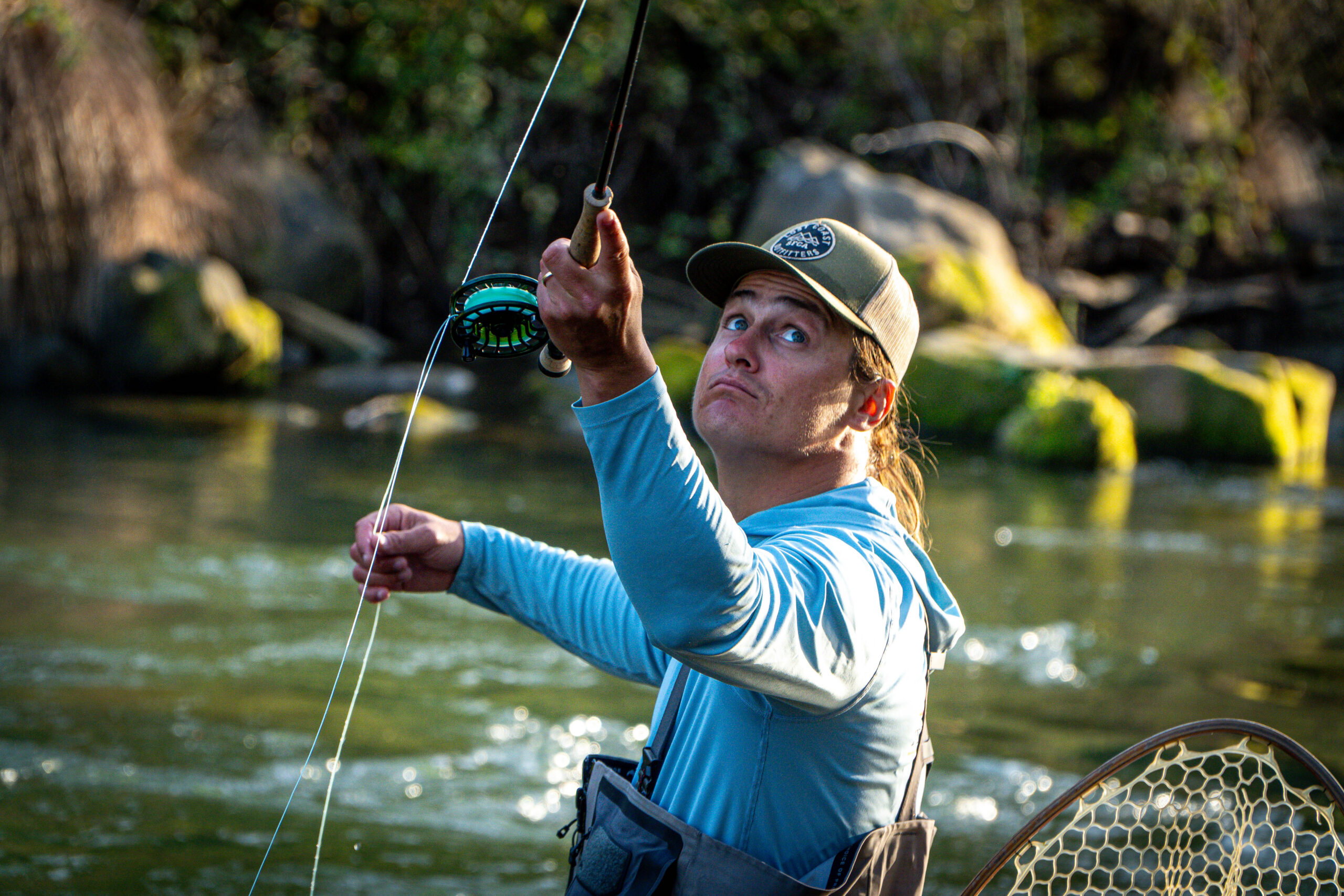
Johnny Feaster has always been drawn to Putah Creek.
As a boy, he remembers fishing with his dad on Lake Berryessa and hearing stories about the 8-mile stretch of riffles, runs and pools that meander their way from Monticello Dam to Lake Solano. It was a beautiful place, one where oak woodlands drop down steep valley walls into cold, green-hued water.
But for a young angler, it was also intimidating.
Catching a fish on the upper section of Putah Creek just outside of Winters requires commitment, knowledge and a willingness to get skunked — repeatedly.
“It’s the double black diamond of trout fishing,” Feaster said, now in his mid-thirties.
For many, the dues paid in time and frustration aren’t worth the effort. But when Feaster caught his first fish on Putah Creek, it changed the course of his life.
“These rainbows blew my mind,” he said. “You can catch the fish of a lifetime here.”

Years later, Feaster lives in Winters and is a full-time fly-fishing guide. Last year, between Putah Creek and other local fisheries, he spent 258 days on the water.
The oak-studded valley, once unwelcoming, has become where he works, plays and brings his family on days off. The creek, and the health of its fish, are central to his existence.
Because of that, Feaster is one of a contingent of local guides and anglers who observe a voluntary fishing closure on the creek between December and March to allow the fish to spawn undisturbed. Feaster said the restriction, which ended Sunday, is not an official regulation but has been pivotal to the preservation of the creek.
“You have to take responsibility for your footprint,” he said.

A fragile fishery
Upper Putah Creek’s native strain of rainbow trout has reached near mythical status in the world of fly fishing. Centuries ago, before the dams created lakes Berryessa and Solano, these fish gorged themselves on salmon eggs in a watershed that stretched far into the coastal mountains.
As California developed and the population boomed, demand for water increased. To help quench that thirst, Monticello Dam and Lake Berryessa were built, as well as an agricultural diversion dam about 8 miles down the creek.
Jay Cuetara, supervising engineer for the Solano County Water Agency, said that those infrastructure projects now supply water to 96,000 acres of farmland and around 450,000 people in Solano County.
To meet that need, the projects altered the environment and fishery.
Sign Up for the Yolo County Newsletter
Stay in-the-know on all things Yolo! Weekly email with stories and insights from Yolo County reporter Daniel Hennessy.
Regulating the creek
When the dams were built, Putah Creek’s runs of Chinook salmon could no longer access the upper reaches of the creek, cutting them off from their traditional spawning grounds.
Phil Stevens, executive director of the Putah Creek Council, said the following decades saw the near destruction of the wild salmon run on the creek. By the late 80s and 90s, so much water was being diverted that the creek below the diversion dam on Lake Solano almost totally dried up during drought years.
In response, the council, UC Davis and the city of Davis sued the Solano County Water Agency and, nearly a decade later, the Putah Creek Accord was signed. Among other things, the agreement regulated how much water the SCWA needed to release to sustain fish populations.
“It’s the document that saved the life of Putah Creek,” Stevens said.
But as the lower section of the creek was getting more regulated, the stretch above the dam remained at risk.
Because there were no longer salmon in the upper watershed, the restrictions put in place by the accord didn’t apply. That meant that resident trout relied on the water that SCWA released from Monticello Dam for commercial uses.
Cuetara said that the only water released from Monticello Dam is the water that is ordered by downstream farmers and cities. In the summer, demand is higher so there’s more water in the creek, but winter flows can drop from around 900 cubic feet per second to below 100. He said there is always enough water in the creek to maintain trout populations, but water supply needs are the priority.

Shifting management
For years after the dams were built, water fluctuations were not much of a concern because the California Department of Fish and Wildlife stocked the upper stretch of the creek. This provided fishing opportunity and meant that the fishery was sustained by trout that were born elsewhere and didn’t rely on the creek to spawn.
But stocking also diluted the genetics of the native trout that lived there.
Because of that, local organizations like Putah Creek Trout lobbied CDFW to stop stocking the creek and classify it as a Wild Trout Water in 2014. The designation ensured that the native strain of rainbow trout would not have to compete with stocked fish and would be given the space to build a self-sustaining population.
Feaster remembered that it took a few years for the fishery to recover. In the seasons after the stocking stopped, the fishing access parking lots were empty as anglers went elsewhere for better fishing.
Year by year, the fish repopulated the creek and grew in size.
Eventually, healthy, wild rainbow trout, some more than 20 inches in length, filled runs and holes along the length of the winding stretch.
As the anglers came back, the pressure on the fish increased. At the same time, the natural spawning cycles of Putah Creek trout coincided with the winter months when the SCWA released less water from Monticello Dam to save up for the summer.
Those who spent a lot of time on the creek began to worry that less water in the system and more anglers would disrupt the spawning cycles of the fish, which was now the only way to sustain the fishery.
So, many made the decision to lay down their rods between December and March.

Respecting the creek
The unofficial regulation is not legally enforceable. Peter Tira, spokesman for the California Department of Fish and Wildlife, said that a formal process would mean a petition would have to be sent and voted on by the California Fish and Game Commission.
As it stands, bait and barbed hooks are illegal on the creek, and all fishing is catch and release.
But Feaster said that his observance of the closure is in recognition of the fact that all fishing has a footprint.
When he’s on the water, he’s conscious of the flies that he loses, the line that snaps and drifts away, where he puts his wading boot and the stress that fish feel when hooked.
In other words, it’s less about rules and shame, and more about respect of the creek.
To illustrate this point, he likes to tell a story about a client of his who caught a 27-inch rainbow on Putah Creek and immediately thereafter became an advocate to his friends about honoring the voluntary closure.
By holding a trout in his hand, the client likely saw something that Feaster had years before.
With time, effort and respect, Putah Creek can change your life.
It’s certainly changed Feaster’s.
“Putah Creek is where I’ll die,” he said with a grin.

Daniel Hennessy joins Abridged from the California Local News Fellowship. He’s a reporter covering Yolo County.