
The Abridged version:
- The Sacramento arts scene features displays and events turning passive viewers into active participants.
- Arts and entertainment organizations are testing ways to engage audiences through hands-on demonstrations, making viewers a part of the experience.
- Examples include an interactive street-art map, immersive exhibits and audience engagement in theater shows and escape rooms.
When Andy Warhol famously predicted that everyone would be famous for 15 minutes, he may have underestimated how much the media landscape would be atomized. Armed with a camera phone and a social media account, everyone is now an artist, editor and curator — framing experiences and deciding how they will be seen by others.
That daily creative practice may be changing what people expect from culture itself, too. Audiences no longer want to stand at a respectful distance from a finished work. They want to watch it being made, meet its creator, touch it, respond to it or help determine what happens next.
Across Sacramento, arts and entertainment organizations are testing how far that invitation should extend. The common thread is not technology — it is the desire to become part of the encounter and to remember it afterward.
Art without a front door
Wide Open Walls is the nonprofit behind public mural projects across Sacramento, effectively turning the city itself into an outdoor gallery. For its director, David Sobon, putting art on the street removes the first barrier to participation: the door.
“The idea that the art is in public is what makes it interactive,” Sobon said. “That’s the most exciting part.”
A mural can punctuate a commute or a walk through Midtown. People can photograph it, step into its optical illusion or return to watch it emerge. Wide Open Walls’ online map lets users build tours by neighborhood or artist, converting individual works into a choose-your-own cultural experience.
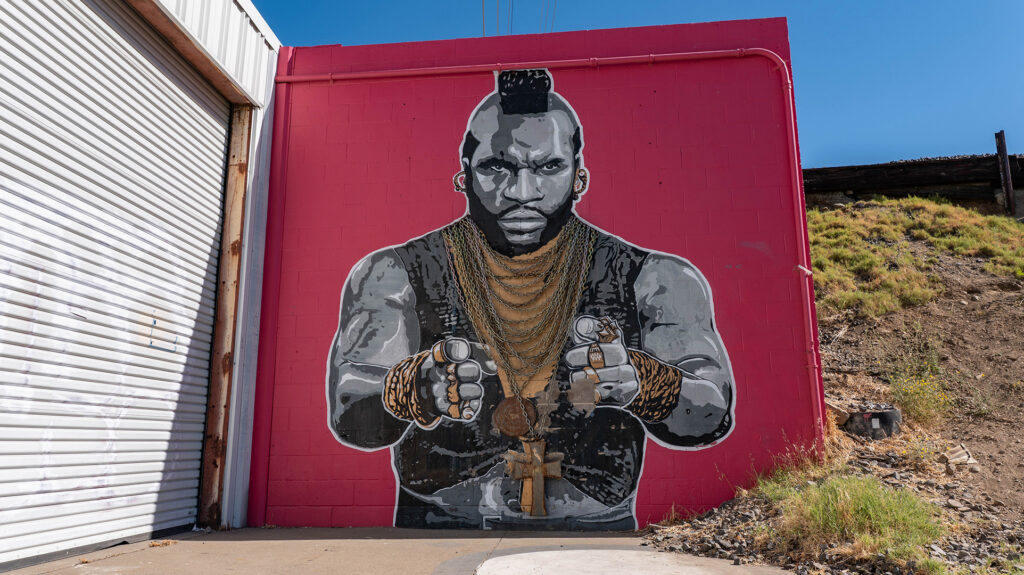
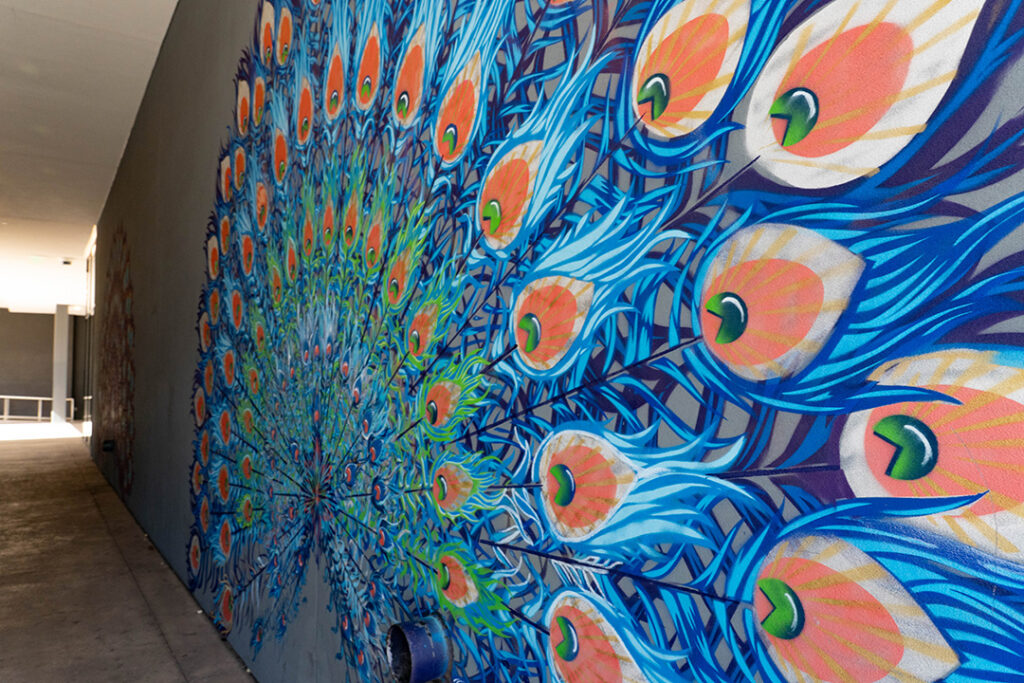
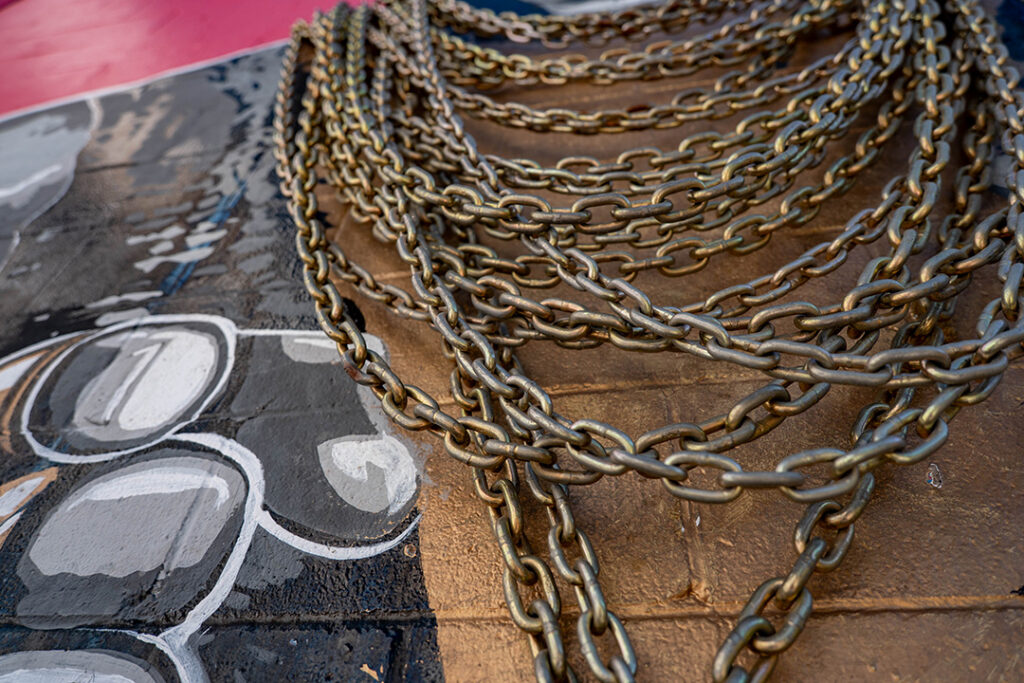
Some murals are made for that sort of relationship. Sobon pointed to Sacramento artist Maren Conrad’s peacocks at Downtown Commons and a portrait of Mr. T, whose chains appear to hang from the wall. “In today’s social media world, everybody wants to get the perfect shot,” Sobon said.
The deeper exchange happens while the artist is at work. Passersby watch murals develop, return to check their progress and talk with the people creating them.
When the film “Lady Bird” was approaching its Academy Awards moment, Sobon had an idea two days before the ceremony: paint a mural of the film’s Sacramento setting before the Oscars aired. He called Conrad, secured emergency funding, then got word it was raining — not ideal conditions for outdoor paint. Conrad kept going anyway. The mural was finished the day of the Oscars.
“The other part is that the artist engages with the public — not just the public engaging with a piece of art, but the artist, as a human being, engaging with the public,” Sobon said. “To me, that’s huge.”
At school projects, that line can disappear altogether. Sobon said Wide Open Walls has produced nearly 200 school murals. Artists sometimes let students contribute with brushes or spray cans and incorporate their contributions rather than painting over them.
Sobon sees the same instinct in what he calls creator culture — an extension, he agreed, of Warhol’s original idea. Giving artists who had never painted a mural before their first wall is one of the things he is most proud of. “taking artists down from a pedestal and handing the same opportunity to a stranger with a spray can,” much like how phone-cameras made publishing images accessible to all.
From visitor to maker
At Verge Center for the Arts, interim Executive Director Chase Dougherty thinks the attraction runs deeper than a good photograph. Dougherty, whose graduate thesis examined multisensory experiences in contemporary art museums, said people are seeking “a memory that’s associated with a multisensory experience.”
That creates a challenge for institutions built around the golden rule of museums: Do not touch the art.
“How do you welcome in audiences and introduce interactivity where it’s appropriate, where it can happen — and in some spaces when it can’t?” Dougherty said. “It’s a hard line to find.”
The question is also one of access. Dougherty said blind and visually impaired visitors are asking for more tactile experiences. Meanwhile, immersive attractions such as Meow Wolf have raised expectations that art can engage hearing, smell and touch as well as sight.
As a non-collecting contemporary arts center, Verge works with living artists who can offer workshops, demonstrate their process or build participation into an exhibition. Sometimes the gesture is small. Dougherty once curated a portrait artist known for painting every subject in the same hot-pink wig — and simply placing that wig in the gallery let visitors connect the object to the paintings on the wall.
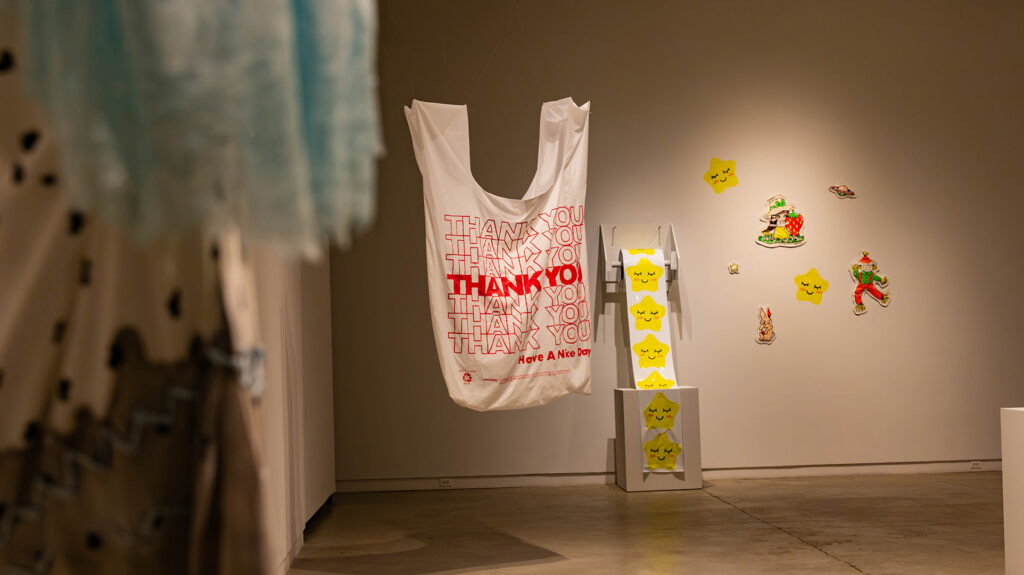
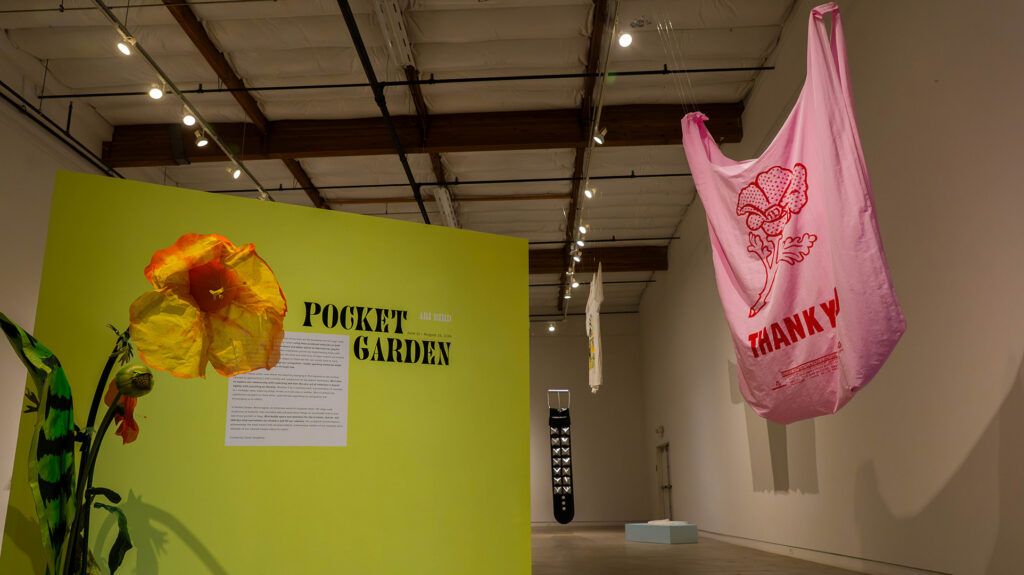
In “Pocket Garden,” Los Angeles artist Ari Bird uses mass-produced fabric to create oversized objects that make visitors feel small. A planned workshop will invite participants to help complete an enormous paint-by-number on the gallery wall.
Verge’s weekly Clay Lab, Print Lab and figure-drawing sessions go further, turning visitors into makers. For a fee, participants can use presses, clay, glazes and kilns without enrolling in a formal class. Other workshops range from wheel throwing to painting a watercolor dumpster fire.
Measuring whether any of it lands is its own challenge, Dougherty said. Time spent with a piece is one indicator; whether someone comes back is another, and for Verge, that second measure may matter more, since so much of what it offers is a standing invitation rather than a single show.
“I’ve never worked for an organization that has such incredibly loyal participants,” Dougherty said. “I think that speaks very highly of the level of interaction that they’re able to have with the local artist community.”
That relationship expands citywide during Sac Open Studios, Verge’s annual self-guided tour of actual artist studios. Over two weekends, visitors can interact directly with the city’s participating artists in their natural habitats. The guide release party Friday, Aug. 7, will reveal this year’s 270 artists and a preview exhibition opens at Verge on Sept. 10.
Beyond the selfie
At the Crocker Art Museum, participation is most valuable when it deepens understanding, according to Javier Plasencia, the museum’s education director
He referenced Yayoi Kusama’s infinity rooms as the recognizable selfie-moment version of interactive art, where the artwork itself does the inviting. “But what we’re going for is a little deeper than that,” he said. “We’re trying to embed educational experiences into the interactive space.”
For “Rebels with La Causa: Royal Chicano Air Force Art and Activism,” the Crocker re-created a printmaking studio, working with UC Davis’s TANA program to build out a space with a print table and ink smudges. Visitors were invited to pull a squeegee across a screen and layer images on a light box to understand registration and proofing — everything a real printmaker’s studio would have. (Except the ink itself, which is not allowed in the second-floor galleries.)
Plasencia recalled visitors saying they had admired the prints on the walls without understanding the labor behind them. Trying the process gave them a new appreciation for the finished work.
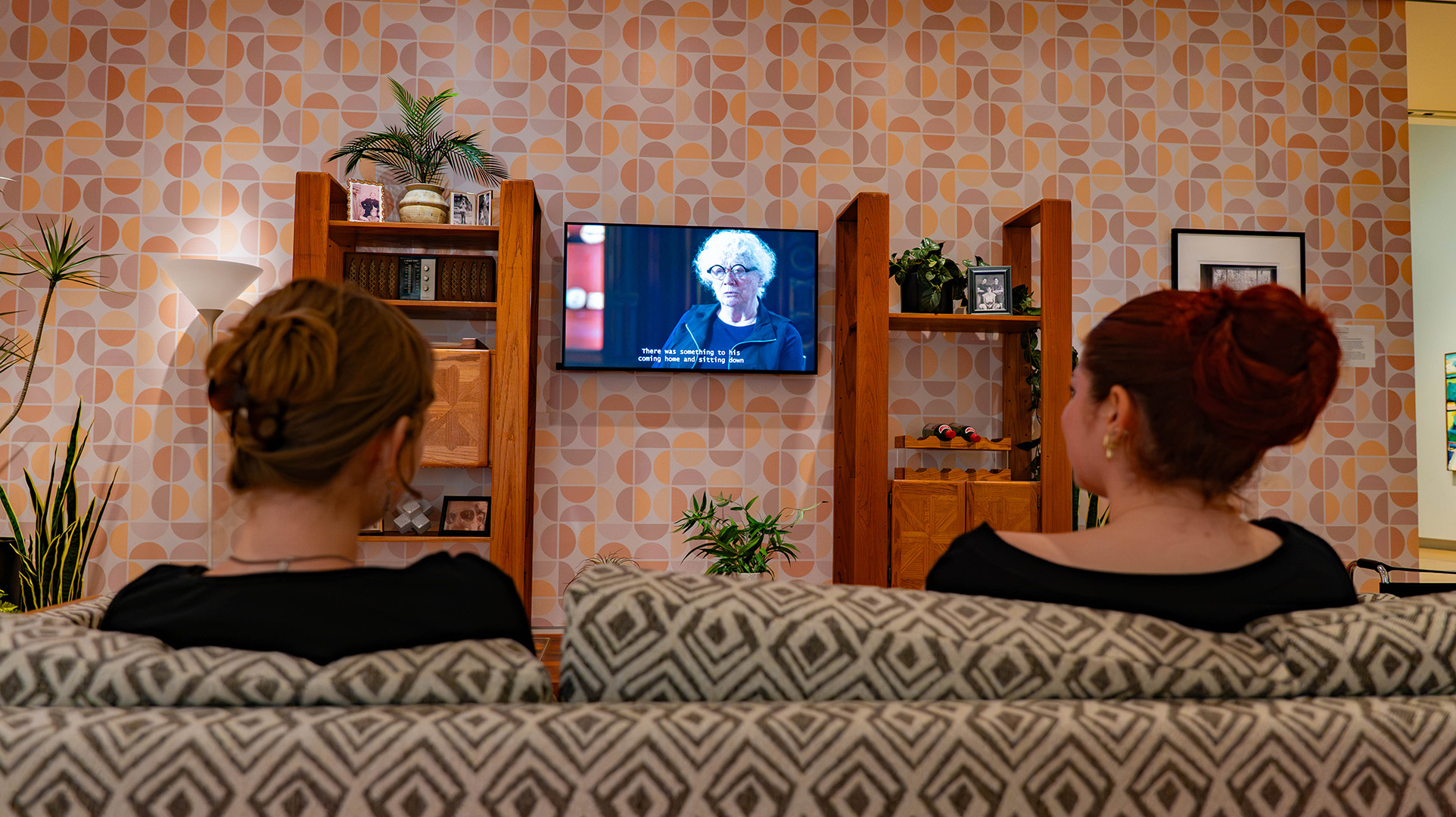
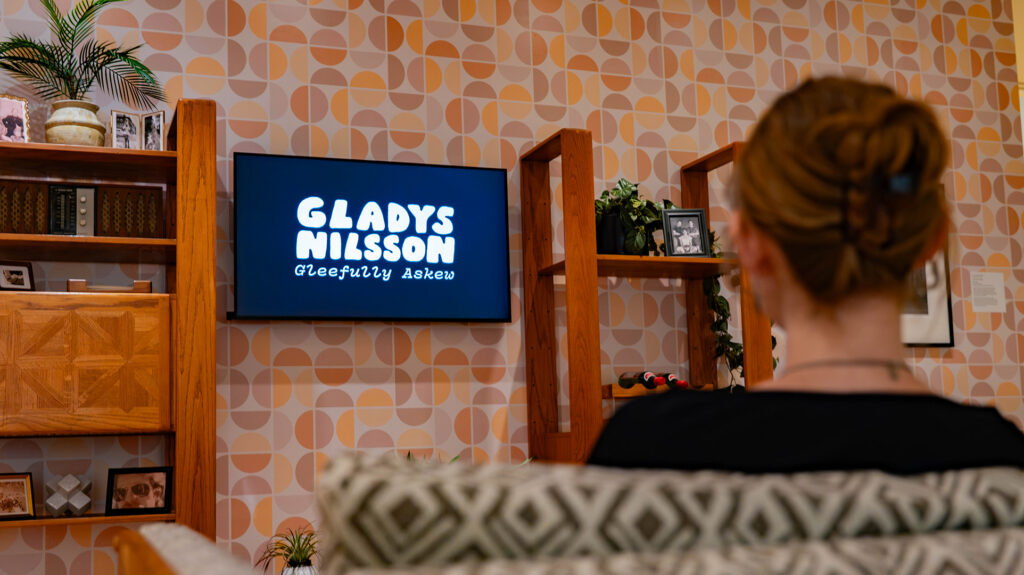
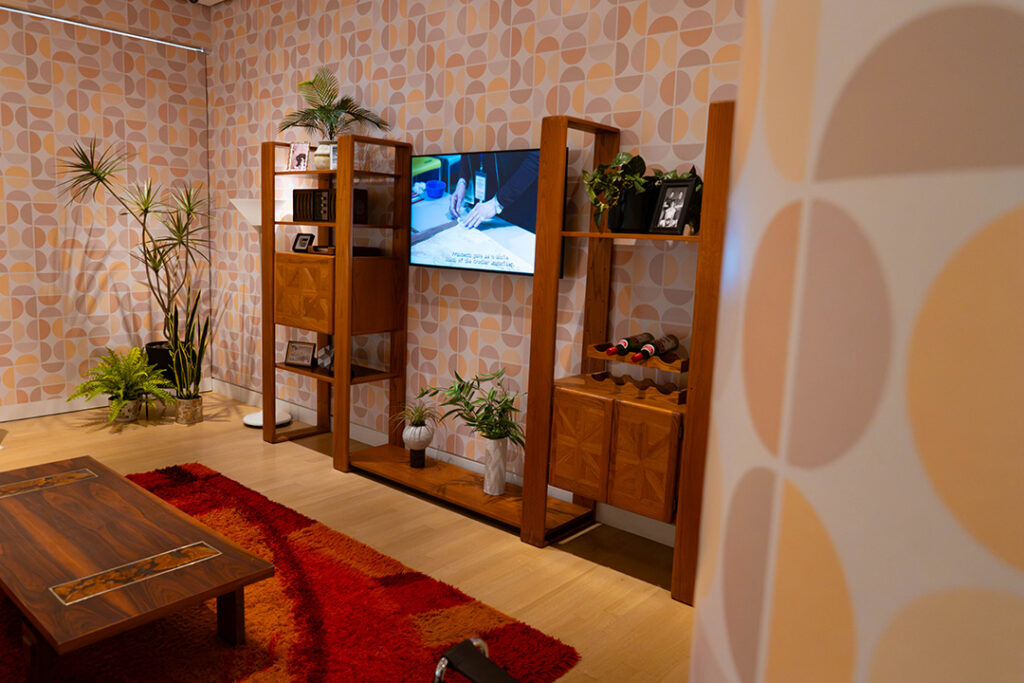
For “Gleefully Askew: A Gladys Nilsson Retrospective,” the museum created a 1960s living room where visitors could settle onto vintage furniture and watch a film. In one space, participation meant doing. In the other, it meant lingering.
At a reception for Nilsson’s show, held alongside an exhibition by artist Suzanne Adan, the museum re-created something the two artists had made together: an “exquisite corpse,” the Surrealist drawing game in which one person begins a figure on paper, then passes it along without revealing the whole, so the finished creature is assembled from pieces nobody fully controlled. Visitors added their own lines to a collaborative version at the reception.
The Crocker offers descriptive tours for visitors who are blind or low vision, as well as periodic “touch tours.” ArtMix, its monthly adults-only event, makes the museum a social space through music, dancing, costumes and hands-on activities. Plasencia also mentioned a previous Alexander McQueen exhibition that invited visitors to handle textures and fabrics and sketch their own designs.
He calls the museum a “third space” — neither home nor work, but a place to gather. A crowd selfie there, he said, is evidence of a community gathering around the art, not a moment staged for the camera.
The museum runs more than 300 programs a year, by Plasencia’s count — a volume he said reflects how much the institution is willing to invest in the space between looking and doing.
Making the theater happen
At The Sofia, home of B Street Theatre, the audience sometimes changes the performance itself.
In the monthly improvised “Seekers of the Strange,” a Dungeons & Dragons-inspired show, actors lobby the audience for tokens that boost their abilities, and one patron becomes “Keeper of Fate,” rolling dice to decide whether they succeed.
“Done well,” Associate Executive Director Liz Baidoo said, that kind of unscripted turn creates “a new kind of contract: a shared experience unique to that particular performance” — one where patrons who return for multiple showings get something different each time, closer to the nature of live performance itself than a fixed script allows.
B Street’s Family Series, which reaches roughly 50,000 students annually through field trips, asks children to warn characters during chase scenes, cheer, sing or respond to prompts. In “A Christmas Carol,” the Ghost of Christmas Present interviews audience members about their own holiday traditions — a small variation that makes every performance unique.
According to Baidoo, even a production without built-in audience participation can be more interactive than expected. In the upcoming “Around the World in 80 Days,” a Foley artist performs every sound effect live on stage, in full view of the crowd. The minds of audience members are actively engaged in both the story itself and the world of stagecraft revealed to them.
Not every patron wants the invitation. Some make eye contact hoping to be picked; others look away on purpose so they won’t get cast as Tiny Tim. The response splits generationally, too. Millennials, Gen Z and Gen X tend to embrace it, Baidoo said, while Baby Boomers are more divided — some enjoy the new approach, others miss “a more traditional theater experience.” Adult audiences do not walk in expecting to participate, she said, which is part of why it tends to land as “a nice, unexpected surprise” rather than a demand.
Audience becomes the protagonist
At Enchambered, a locally owned, family-run Sacramento escape-room business, spectatorship is not an option. Each adventure is conceived, designed and built in-house, but the story will not advance unless the audience moves it forward.
“It’s not like going to a movie theater, where you sit and watch,” co-owner Colleen Messteri said.
Hints arrive without breaking the illusion. In “Skull Witch,” they appear in a magical book. In “Trouble in the Toy Shop,” an unseen game master speaks through a teddy bear. In “Containment Breach,” a telephone rings — or players pick it up to “phone a friend,” as in “Who Wants to be a Millionaire.”
The challenges require players to share what they notice, listen to one another and decide which idea to pursue. A date becomes a lesson in how someone communicates. Families and co-workers discover who takes charge, sees patterns or stays calm as the clock runs down.
Some newcomers arrive apprehensive about being enclosed. But once the game begins, Messteri said, their minds become so occupied with solving puzzles that they stop thinking about their claustrophobia. By the end, “they have smiles on their faces and can’t stop talking about the experience and the story they helped create.
That transformation — from watching a story to having a hand in its outcome — captures what audiences increasingly seek: not just stimulation, but a deeper sense of connection and involvement.
Interactive culture has not replaced passive art, and none of the people interviewed for this story thinks it should. A painting can still reward silent attention. A play can ask an audience to sit in darkness and listen. Even the organizations experimenting most boldly with participation say that, sometimes, people just want to watch.
But “audience” no longer describes a single role. A person can be spectator, student, collaborator, subject, player and creator — sometimes in the same afternoon.
Warhol imagined a future in which everyone would briefly become famous. But maybe the less dystopian read on this evolution is that everyone can become — to whatever degree they wish — an artist shaping their personal art.