
The Abridged version:
- With more nonprofits joining the Big Day of Giving, organizers see a connection to the recent loss of nonprofit funding from other sources.
- Most gifts are $50 or less with 25% coming from first-time donors.
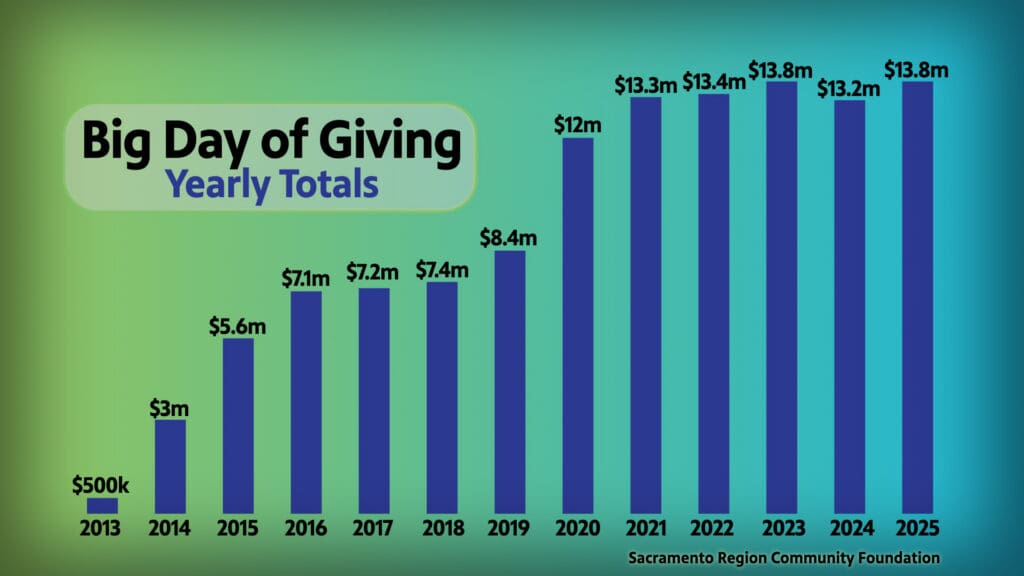
- Since 2013, Big Day of Giving has raised $117 million for local nonprofits.
A record year and a growing need
The numbers are climbing again.
This year, 910 nonprofits across Sacramento, Yolo, Placer and El Dorado counties are registered for the Big Day of Giving, the highest total since the event launched in 2013. Over the past decade, the 24-hour campaign has raised more than $117 million for local causes.
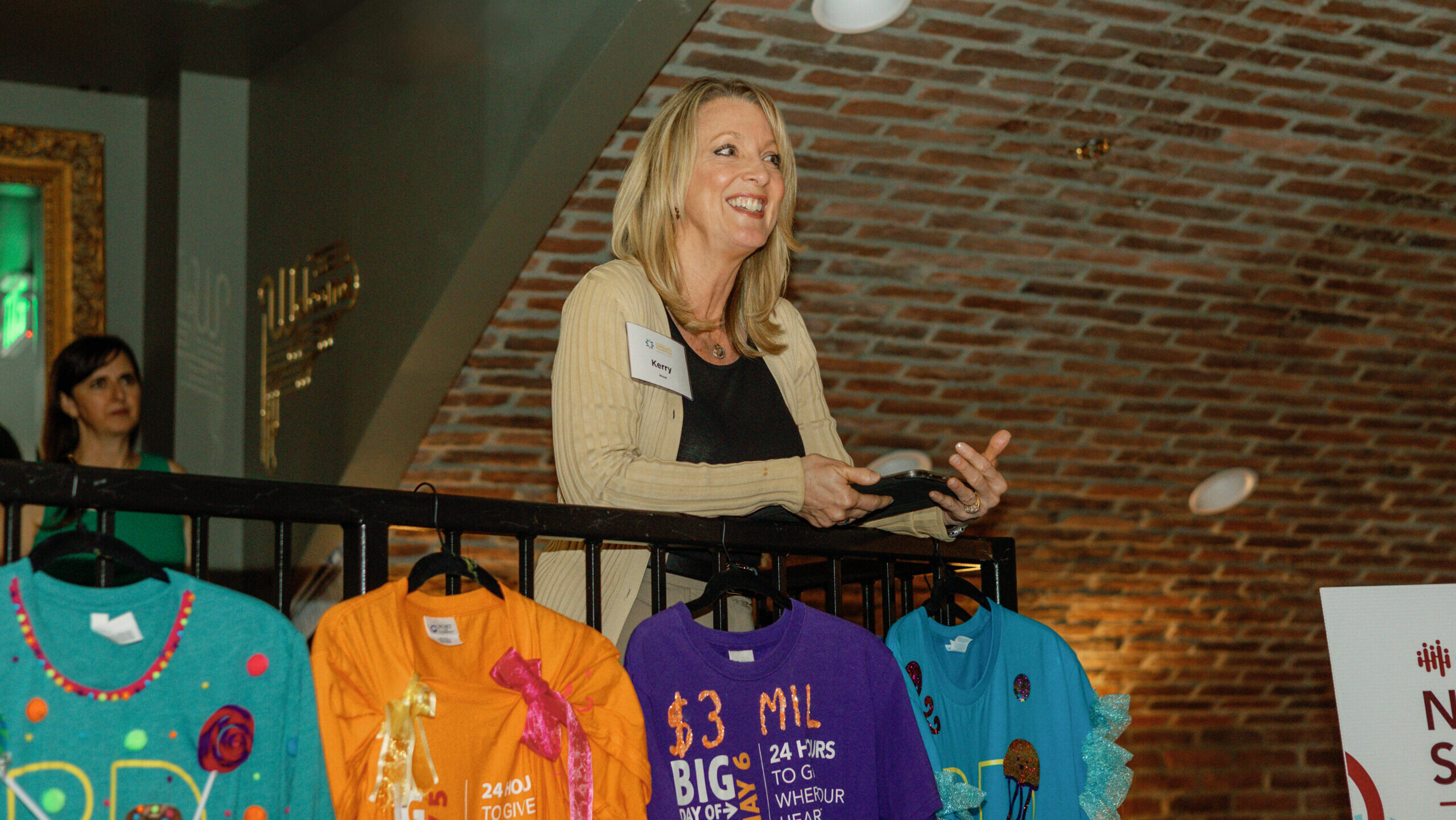
“I have seen the Big Day of Giving grow year after year after year, and not just with dollars raised, but with the number of nonprofits that are involved,” said Kerry Wood, CEO of the Sacramento Region Community Foundation.
“Gosh, just from last year, we grew last year from 855 to 910 nonprofits this year who are registered,” she said.
For Wood, that increase signals more than participation.
“It shows that not only do we have nonprofits who care about building their capacity to do more and to serve more, but it really demonstrates the importance of philanthropy, especially now,” she said.
As more nonprofits join Big Day of Giving than ever before, organizers believe the increase reflects more than enthusiasm alone. Wood said the foundation has internally discussed the possible effects of nonprofit funding cuts, along with national and worldwide events placing additional pressure on community organizations. While nonprofits are not asked about those issues during registration, Wood said organizers see a connection.
“We believe the significant increase from 2025 to 2026 is not a coincidence,” Wood said.

One day that many depend on
For some organizations, this is not just another fundraiser. For some, it is a make-or-break event.
“Yes, definitely,” Wood said. “There are many nonprofits that rely on Big Day of Giving as their one fundraising event of the year.”
The event has become a central funding source for organizations serving families, seniors, animals and communities across the region.
“Big Day of Giving is a critical fundraising tool for local nonprofits that help our children thrive, put food on the table for families, care for older adults, welcome new immigrants, protect animals, and bring the arts to life in our communities,” Wood said.
That need is increasing with inflation and cost-of-living pressures, Wood said. “We know that some people are hurting,” she said.
Despite economic uncertainty, people continue to give. During the COVID-19 pandemic — a time of historic unemployment and widespread need — the Big Day of Giving saw its biggest jump in history, spiking from $8.4 million in 2019 to $12 million in 2020.
A giving model built on small donations
Despite the millions raised, the average donation remains modest.
More than half of all gifts are $50 or less. The minimum donation is $10.
“Philanthropy is the love of humanity. And the Big day of Giving is an opportunity for just about anyone to be a philanthropist,” Wood said.
“All it takes is $10 dollars.”
That accessibility is by design.
“The word philanthropist scares a lot of people. But hear me – you become a philanthropist with $10 dollars.”
The approach is working. Roughly a quarter of donors are giving to a nonprofit for the first time through the event.
“We’ve had so many stories of people that just think they couldn’t possibly be a donor,” Wood said. “And when we made it accessible, it opened their eyes to all the ways that they could give back.”
A personal connection to giving
Long before she was leading one of the region’s largest philanthropic efforts, Wood was on the other side of it. She saw the power of giving as a little girl, as the child of struggling single mother in the 1970s.
“You know, watching my mom volunteer. My single mom, we had very little, in fact, we were the beneficiaries of nonprofits back in the day,” she said. “We visited our share of food banks and clothing closets, and I watched her.”
Even then, giving was part of daily life.
“She found a way to give maybe a few pennies here and there,” she said.
“Watching my mom, who didn’t have a whole lot to give, still gave.”
That experience continues to shape how she views the event.
“Among the definitions of philanthropy, my favorite is the love of humanity,” she said.
A community moment
Each year, thousands of donors log on during the 24-hour window. Watching the leaderboard on the Big Day website is like a sport to many donors.
“It has been such an educational opportunity for donors,” Wood said. “There are thousands of nonprofits in our region that people learn about for the first time on Big Day.”
The scale has also drawn attention beyond Sacramento, with other communities looking to replicate the model.
“We’re one of the longest running days of giving in the nation,” she said.
How to take part
Big Day of Giving begins on Thursday, May 7, with early giving already underway.
Donations start at $10 and can be made online at www.bigdayofgiving.org.
For Wood, the message is straightforward.
“Every dollar makes a difference,” she said.
“And when we collectively donate $10 here, $20 there, it adds really adds up and up and is the chance to be a part of something bigger,” Wood said.
In the end, it’s simple: a region shows who it is by how it gives.
Editor’s Note: PBS KVIE is a participant in Big Day of Giving.
Rob Stewart is a senior correspondent and host with PBS KVIE, and reports for Abridged.