
The Abridged version:
- Sidewalk Astronomers is a loose-knit global organization that traces its roots to the Sacramento area.
- John Dobson, a self-taught astronomer and inventor who lived for many years in Fair Oaks, founded Sidewalk Astronomers in the late 1960s.
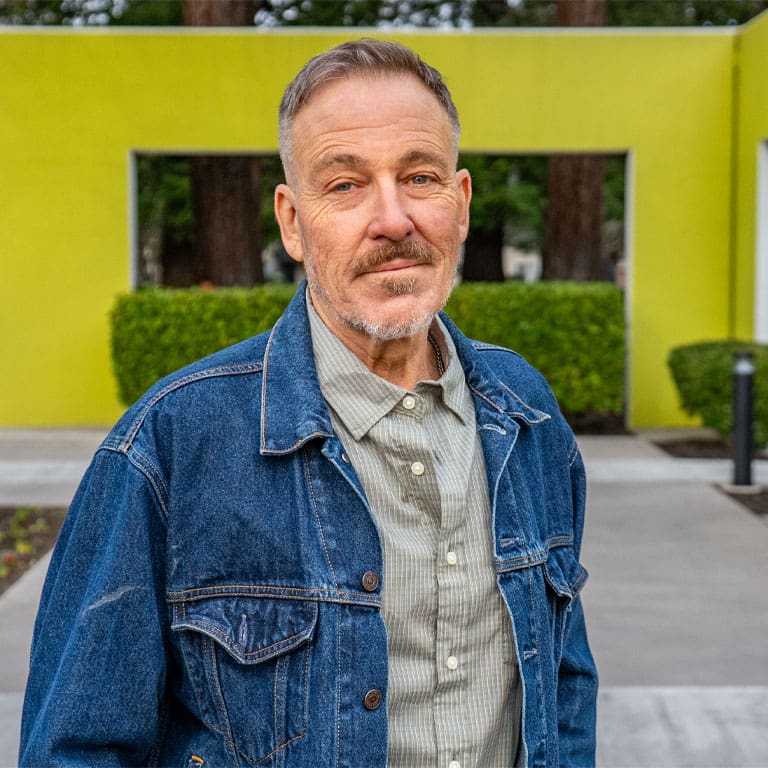
- Douglas Wolfe, Sacramento’s local sidewalk astronomer, regularly sets up his telescopes near the Shady Lady Saloon in Midtown.
This story was reported by a member of the Abridged by PBS KVIE Community Reporters program. The Community Reporters program empowers local residents to report stories with guidance and support from the Abridged editorial staff.
Live music filled the night air outside the Shady Lady Saloon on a recent Friday night, but the more spectacular show filled the evening sky above. It was a perfect spring night for stargazing with a bright moon and Jupiter shining in the distance.
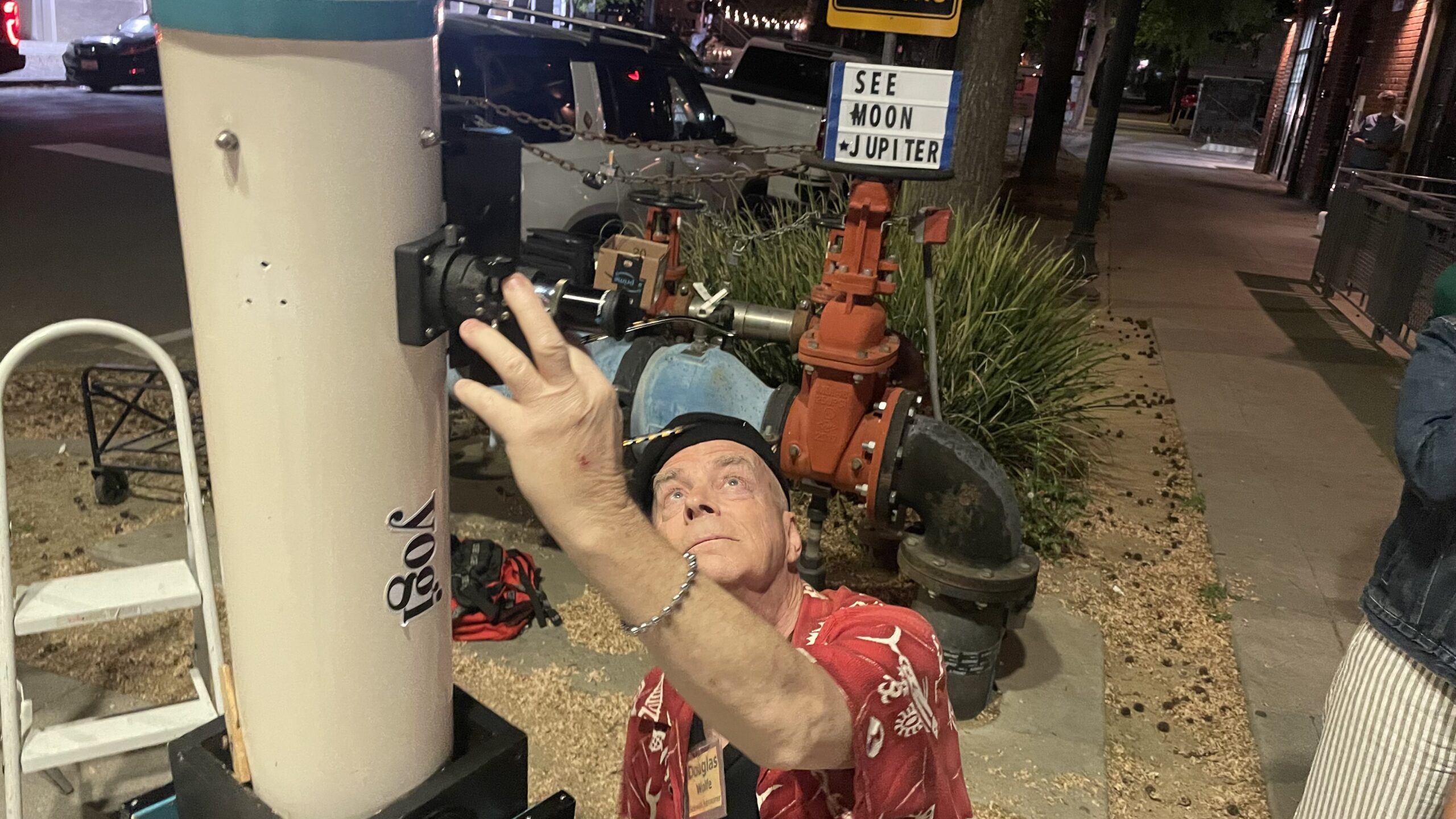
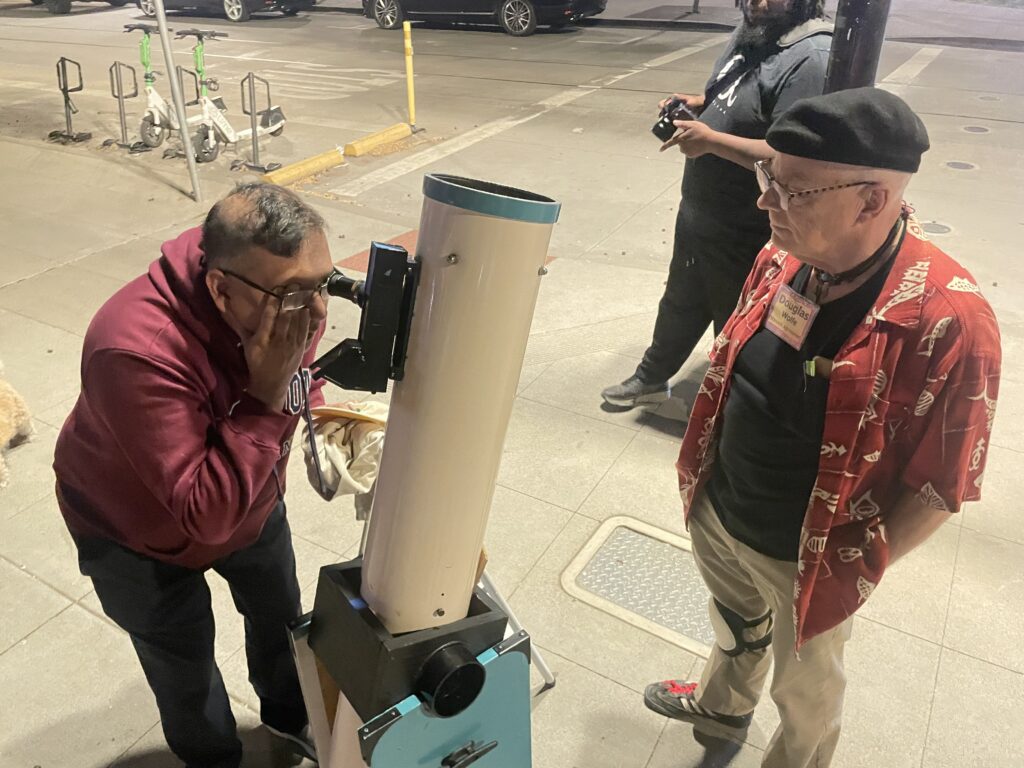
Sidewalk Astronomer Douglas Wolfe was there to take advantage of the situation. At the 14th and R corner, he stood next to two large telescopes in his signature black beret and red Hawaiian shirt. A homemade backlit sign behind him read simply: “See Moon Jupiter.”
Leslie Adams was out walking the neighborhood with some friends and spotted Wolfe’s setup on the sidewalk.
Adams put her eye to the eyepiece. Her mouth fell open.
“Wow!” she said. “You can see Jupiter and its moons!”
Through another smaller red, pill-shaped telescope, Adams saw the earth’s moon closer than she had ever seen it before. “You can see the craters on the moon!” she said.
Sign Up for the Morning Newsletter
The Abridged morning newsletter lands in your inbox every weekday morning with the latest news from the Sacramento region.
A middle-aged man with four children approached.
“Would you like to see the night sky?” Wolfe asked. One by one, each family member stood in line to see what all the commotion on the busy street corner was about. And there was the show: all four of Jupiter’s Galilean Moons – Io, Europa, Ganymede and Callisto – were lined up like a string of pearls in the spring sky. To Jupiter’s left, the moon was in her waxing gibbous phase, 75% full and illuminating the scene for the gazing crowds at the Shady Lady.
A global group of amateur astronomers
Wolfe represents Sidewalk Astronomers, a loosely knit group of enthusiasts who set up large DIY telescopes around the world to encourage people to look at their universe, free of charge.
Sidewalk Astronomers is a movement started right here in Sacramento by John Dobson, a chemist and self-taught astronomer who died in 2014. He attended a Hindu swami talk in 1944 and was so moved he became a monk (Ramakrishna, practicing the Vedanta branch of Hinduism) at monasteries in Sacramento and San Francisco for more than two decades. Dobson was tasked in his work to reconcile Vedanta teaching with the scientific discoveries of astronomy.
Today, there are about two dozen Sidewalk Astronomers in the U.S. and a dozen international members, referred to simply as contacts, in countries from Russia to Iran. “Of all the amateur astronomy organizations in the world, we are the least organized,” Wolfe said.
Across the globe the astronomers offer passers-by the chance to see celestial spectacles like Saturn’s rings and solar flares. Dobson’s invention of the Dobsonian mount changed every telescope now made around the world, making huge scopes with large apertures that concentrate light to bring dim, distant planets to life, portable and easy to use. Even the Hubble space telescope launched in 1991 used Dobson’s light-gathering, portable, mirror-reflecting principles.
While the technology behind the telescopes is important, Wolfe insists that sidewalk astronomy is about providing people with something they deserve as humans: the wonder and awe of seeing the universe. That undertaking has become harder in more recent decades, he says, as light pollution and smog clog the night skies.
Wolfe, 73, who was a schoolteacher for 20 years and now owns a telecom company, said that the Sidewalk Astronomers can usually be found operating at the Shady Lady on Friday and Saturday nights “when the moon looks like a capital letter D.” He’s been doing this since 1985, and you can find him stargazing anytime he’s not on his bike or playing banjo. “Never the two at the same time,” he quipped.
Making astronomy accessible
Are the Sidewalk Astronomers a movement? A science? A religion? It’s hard to pin down. Dobson’s co-existing beliefs in both science and the spiritual realm helped bridge the two in this planetary pastime, Wolfe said. “It’s a combination of Eastern and Western science and spirituality. If I were any more serious about it, it would be like a cult,” he said, only half-joking. So central is John Dobson to the movement that the legendary figurehead is now surrounded by charismatic apostles like Wolfe.
The link between the human psyche and stargazing isn’t hard to make, Wolfe insists. “Every culture based its first religion on what is in the sky. It is deep in our DNA. It’s beyond culture.”
Despite how expensive Dobson’s astronomical invention may sound, the Sidewalk Astronomers’ mission is to make seeing planets available to everyone. That means low cost.
Dobson’s telescope, which astronomers call a Dobsonian or simply, a “Dob,” is inexpensive and, by definition, made of readily available materials that make planet gazing an egalitarian experience. The Dobsonian mounting system, usually built of plywood, provided a rocker system, allowing the view to move up and down and side to side in a smooth, steady direction. These telescopes are plentiful, portable and perfect for setting up in nightlife-rich areas like outside bars and restaurants or bookstores.
“This one cost zero dollars,” Wolfe said, pointing to the larger of two telescopes in front of him, this one the size of a large bazooka. Many of Dobson’s original scopes were built with portholes from ships ground into huge, cheap lenses. “Dobson believed that all humans should be able to see the planets with their own eyes.”
In an age of selfies and self-absorption, simply looking at the moon can be a humbling experience. “I think it’s a beautiful service for everyone to get the enjoyment of looking at something that’s bigger than themselves,” Adams said.
The passion is palpable
Sarah Cook, new to Sacramento, was out for some ice cream and stepped up to the Dobsonian and took it for a spin. She couldn’t remember the last time she looked through a telescope. That night she ended up having fun and learning something new.
Those who meet the gray-haired Wolfe can see his conviction and passion as he guides them onward. “He was adamant that we see the moon first, and all her craters, because it’s waxing,” Cook said. “He was adamant about it.”
Many Sidewalk Astronomers become local quasi-celebrities; there was Frank Manning in New Orleans in the ‘30s, and Herman Hayne, a self-proclaimed “star hustler” at Fell’s Point, Maryland for nearly 40 years. Here in Sacramento, Wolfe himself has been a fixture on the nighttime sidewalks for several decades.
“This was a wonderful experience,” said Shyam Sundararaman, who lives a few blocks away and was passing by with his family. “We were just going home from dinner and to be able to see the moon and Jupiter so clearly was quite amazing.”
Wolfe finds it difficult to define what happens to people when they see the planets, but he knows it goes deep to the human core.
“It’s a spiritual journey,” he said. “It puts things in perspective. I see one or two people cry every time I do this.”
James Smith is a member of the Abridged Community Reporters program.