
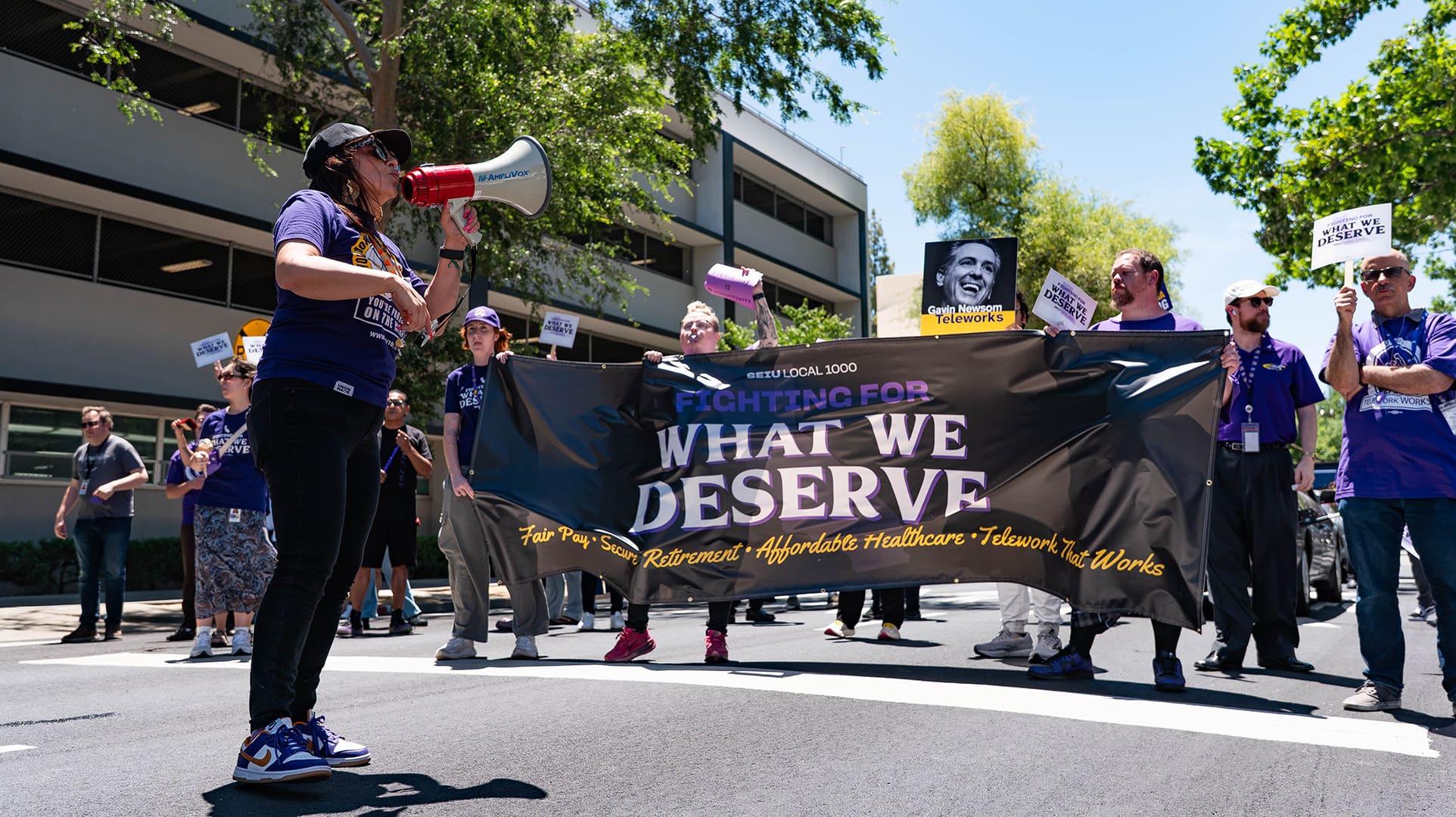
- If SEIU Local 1000’s state employee members vote to authorize a strike, the basis would be distinct from state scientists’ historic 2023 work stoppage.
- State scientists stopped work after the state’s labor referee declared a negotiations impasse. The proposed Local 1000 strike would be over unfair practices.
- The local has not held such a strike previously, though one almost happened in 2016.
When California state scientists held the first civil servants’ strike in state history, a government labor relations referee had already decided that their negotiations with Gov. Gavin Newsom’s administration had reached a stalemate.
But if California’s largest state worker union authorizes a strike this year, thousands could walk off the job without having to get the same approval.
That’s because the action that Service Employees International Union Local 1000 leaders seek to call — if members allow it — would be what’s known as an “unfair practice strike,” which is a work stoppage with a different legal pathway from state scientists’ historic action three years ago.
“We filed (an unfair labor practice) charge … and now our members are voting on whether to authorize an Unfair Practice Strike,” Local 1000 President Anica Walls said in a statement Tuesday. “We’re standing up for our right to be treated fairly at the bargaining table.”
Union leaders announced a strike authorization vote on Labor Day. Voting is underway through Oct. 7. If authorized, the strike would build on Local 1000 leaders’ July claims that the Newsom administration deployed unfair practices during negotiations over union members’ next contract.
Claiming unfair bargaining practices
Local 1000 represents 100,000-plus state employees including office workers, custodians, librarians, food service workers and many more, though not all they represent are official members.
In July, the local accused the state of negotiating in bad faith by rejecting large tranches of its proposals simultaneously, without engaging in talks on each point, among other claims, according to charges it filed with the Public Employment Relations Board.
Those unfair practices claims would form the basis, and legal pathway, for the strike Local 1000 is now calling for, according to spokesperson Amber Rich.
And it could be a more direct path than the one California’s first state worker stoppage took.
Here’s why: A main pathway for resolving stalled negotiations between public employees and their government bosses involves what’s known as an impasse declaration.
Either workers or the employer appeal to PERB, the state’s public labor referee, arguing negotiations have come to a stalemate.
If PERB agrees, the agency provides a mediator to help the two sides break gridlock.
Under California’s labor laws — and the host of cases that have built precedents upon them — a strike called after an impasse is considered legal.
On the flip side, “a strike occurring before the completion of statutory impasse procedures creates a rebuttable presumption that the strike violated the union’s duty to bargain and participate in the impasse procedures in good faith,” according to the agency.
In plain English: the law assumes such a strike is not allowed.
But there’s an exception — and that’s where unfair practice claims come in.
Establishing a right to strike
Under PERB precedent, “a strike provoked by an employer’s unfair labor practices would be protected at any time during the bargaining process as long as the striking employee organization has not failed to participate in good faith in the statutory impasse procedure,” according to the agency’s website.
In essence, if unfair practices happened, the union can argue a strike before impasse is allowed.
Or, as SEIU Local 1000 sees it, “State workers have a legal right to strike when there’s an unfair labor practice charge,” Walls said in a statement Tuesday.
The strategy may reflect what some view as SEIU’s greater willingness to authorize strikes than some other unions.
“SEIU has always been, to some extent, more willing to call for strikes than some other unions. Maybe related — or maybe not related — they’ve also been one of the unions that’s grown a lot in the last five years,” said Tim Yeung, a lawyer with Sloan Sakai Yeung & Wong.
Yeung is an employment law expert who’s advised PERB and often represents employers in labor lawsuits, according to his bio.
Various SEIU branches have voted to authorize strikes amid unfair practice claims several times in recent years. In 2016, Local 1000 members voted to authorize a strike amid claims of unfair tactics by then-Gov. Jerry Brown’s administration, but the sides reached a deal before the strike occurred.
Last year, faculty at Loyola Marymount University, represented by SEIU Local 721, voted to authorize an unfair practice strike. And this month, San Francisco security guards represented by SEIU United Service Workers West too authorized a strike over what they described as unfair bargaining tactics.
Beyond SEIU, there’s also been an uptick in public worker strikes in the past five years, Yeung said.
As government budgets try to keep up with inflation — and face increasing demands — unions may be feeling the results at the bargaining table, Yeung said.
“From the union perspective, they haven’t been able to achieve the economic gains that they’ve wanted to,” he said. “I think from the employee perspective, (their wages) haven’t been keeping up with real wage growth.”
Arguing for higher wages
Wages will be central to Local 1000 members’ decision on whether to authorize a strike. A hypothetical weeklong strike would cost an employee roughly 2% of their yearly wages, Yeung said.
If the discrepancy between the union’s proposed wage and the employer’s preferred wage is around that figure or smaller, workers may be loathe to strike.
But if the gap is bigger, workers could view striking as ultimately worthwhile, despite losing wages in the process.
“If you’re farther apart, maybe 5 to 7% down … you’re coming out ahead” if the strike proves a successful bargaining tool, because an employee would make up the difference later, Yeung said.
In June, Local 1000 proposed a 20% general salary increase over three years: 7% this year and next year, and 6% in 2028. The state rejected that proposal, the union said.
On paper, an unfair practice strike could still be risky. The state would likely file its own unfair practice charge with PERB, claiming the strike itself was out-of-bounds.
PERB would weigh that claim, sending it to a judge if the facts suggest there could’ve been a violation.
But even if judge determines the strike wasn’t allowed, Yeung said the main consequence would be a cease-and-desist letter to the union.
As for workers, “in theory, if the strike was not a lawful strike the employees could be subject to discipline for missing work,” Yeung said.
“I don’t think I’ve ever seen that,” he added.