

The Abridged version:
- Hundreds of union members took to the streets of Downtown Sacramento on Wednesday afternoon during a demonstration against return-to-office policies.
- Unions are backing legal action and a pending bill in the Legislature to allow state workers to work from home.
- The governor, two Sacramento mayors and multiple local economic leaders have called on state workers to return to their offices to help revitalize downtown.
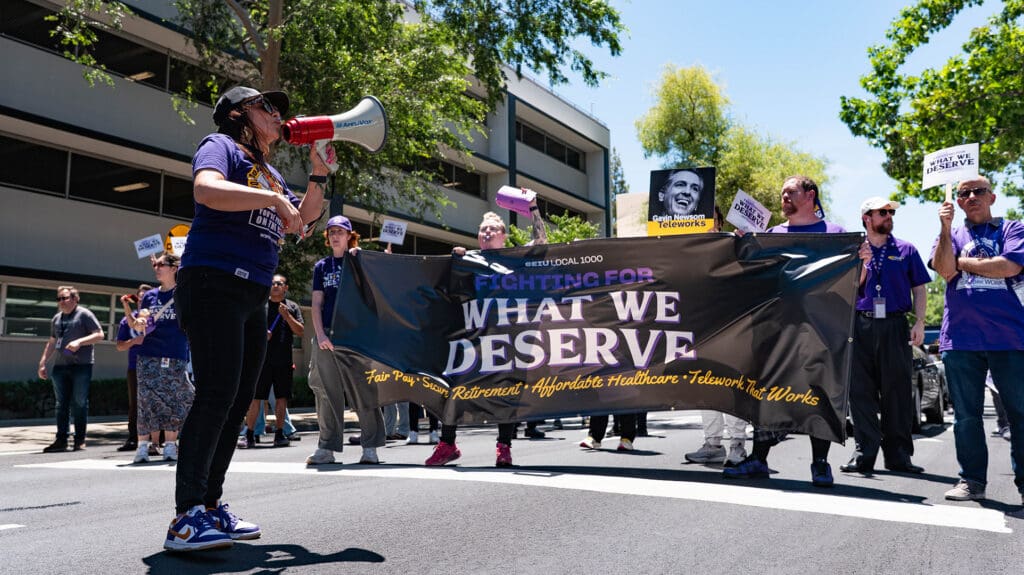
A cacophony of cowbells, whistles, vuvuzelas and bullhorns filled the streets of Downtown Sacramento as hundreds of state workers protested against an impending end to telework.
After years of tug-of-war between some of California’s most powerful unions and Gov. Gavin Newsom, state workers are on the cusp of returning to offices at near prepandemic levels. Newsom has mandated that most state workers return to working in person four days a week starting July 1.
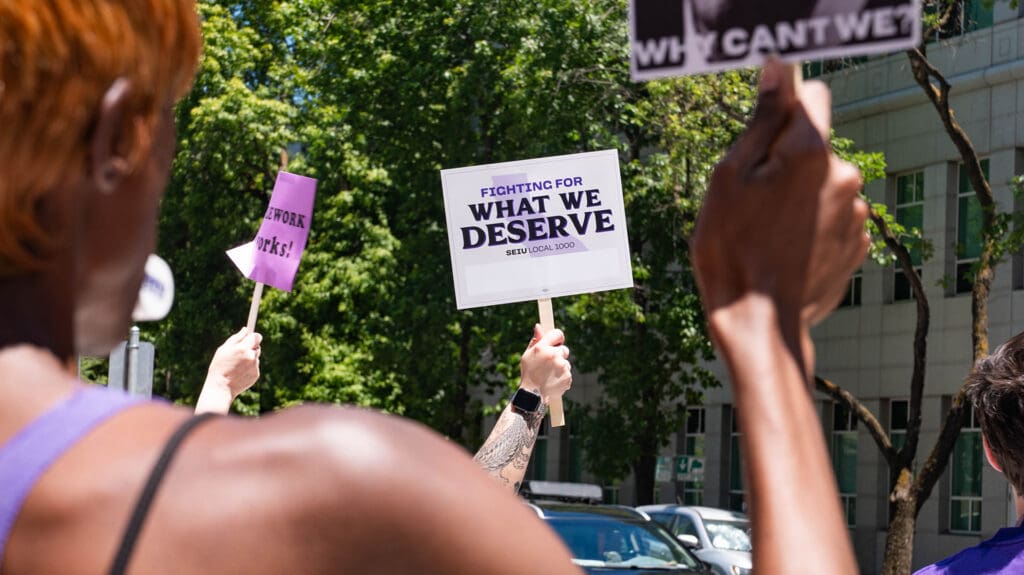
Hundreds of members of Service Employees International Union Local 1000 drove their cars through downtown Wednesday afternoon, stopping traffic for at least three blocks outside of multiple state office buildings to decry the mandate.
Unions that represent tens of thousands of state workers are gearing up campaigns to keep telework, or fight for extra dollars to compensate for the cost of commuting.
Workers say telework is effective
Jenny Ceja hopes to keep working remotely to avoid her 90-minute commute between Folsom and her job at the Employment Development Department. She said she opts to take the light rail to work, rather than pay for parking and gas.
“We absolutely can do our work from home,” Ceja said.
Ceja, who began working for the department in early 2020, said she has spent most of her time there working remotely.
“If it’s going to stimulate the downtown economy, I’m bringing my lunch to work,” Ceja said.
Sabir Muhammad, who has worked for the state Employment Development Department for 17 years, said he has been a proponent of telecommuting for decades.
“In 2020, it was (Newsom) who sent us home. We were getting the job done and then some,” Muhammad said, recalling the pandemic days when millions of unemployment claims swamped his department.
Muhammad said that track record proves that telework is effective. Meanwhile, he said his office is among those that do not have enough space to accommodate workers for four days a week. He said his floor’s return to office plans have been constantly shifting as well.
“Depending on what floor you work on it’s something different,” Muhammad said.
Leaders tout revitalizing downtown
Newsom, two Sacramento mayors and local economic leaders have been pushing for state workers to return to offices downtown since the COVID-19 pandemic began to wane.
Many workers returned to their offices two days per week starting in 2024. Newsom last year tried to raise that number to four days per week, but that proposal was delayed. The governor issued the latest mandate in March.
Newsom, during his May budget revision news conference, doubled down on his intentions to bring state workers back into the office.
“I want to get it done,” he told reporters.
Sacramento’s leaders have made repeated calls for state workers to return to their offices, arguing that their return would boost a long-awaited revitalization of Downtown Sacramento.
Earlier this year, Sacramento Mayor Kevin McCarty voiced support for the governor’s return-to-office mandates.
“Having more people working downtown delivers tremendous economic and social benefits to Sacramento,” McCarty said in a statement.

Labor group alleges environmental issues
Last month, CASE, the union that represents attorneys and administrative judges, filed a challenge to the return-to-office mandate, alleging a violation of California’s environmental laws.
The group sent a letter to Caltrans and Attorney General Rob Bonta alleging that the mandate violates the California Environmental Quality Act. The group alleged that the state failed to study or account for the amount of air pollution that could arrive by requiring state workers to commute more frequently.
Proponents of the work-from-home policies have frequently pointed to a state auditor’s report that found allowing telework three days a week could save the state up to $225 million.
Union demands stipends for commuters
SEIU Local 1000’s contract with the state expires July 1, and if telework goes away, the union is teeing up a list of new demands to compensate for costs workers will face by going into the office more often. The union is advocating for full-time telework options, as well as salary increases and boosts to health benefits.
The demands include a $25 daily stipend for employees who commute to work, and a $25 daily stipend to compensate for Newsom’s “objective to use the state workforce to bolster … downtown economies and local businesses.”
The union is also calling for a $500 monthly stipend for workers in “high crime” worksites. Representatives for the union declined to confirm whether those worksites specifically include offices in Downtown Sacramento.
Pending bill in the Legislature
The state’s most powerful employee unions are also backing Assembly Bill 1729, which would require all state agencies to develop telework plans for their workers. Those plans would have to provide a detailed justification to bring workers back into the office.
The bill currently has 10 coauthors, including local Assembly Members Stephanie Nguyen, D-Elk Grove, and Josh Hoover, R-Folsom.
The telework bill was passed by the State Assembly and is yet to be voted on by the State Senate. If the bill gets approved by the Legislature, it would still require a signature from the governor’s desk.

Felicia Alvarez is a reporter at Abridged covering accountability. She’s called Sacramento home since 2015 and has reported on government, healthcare and breaking news topics for both local and national news outlets.