

The Abridged version:
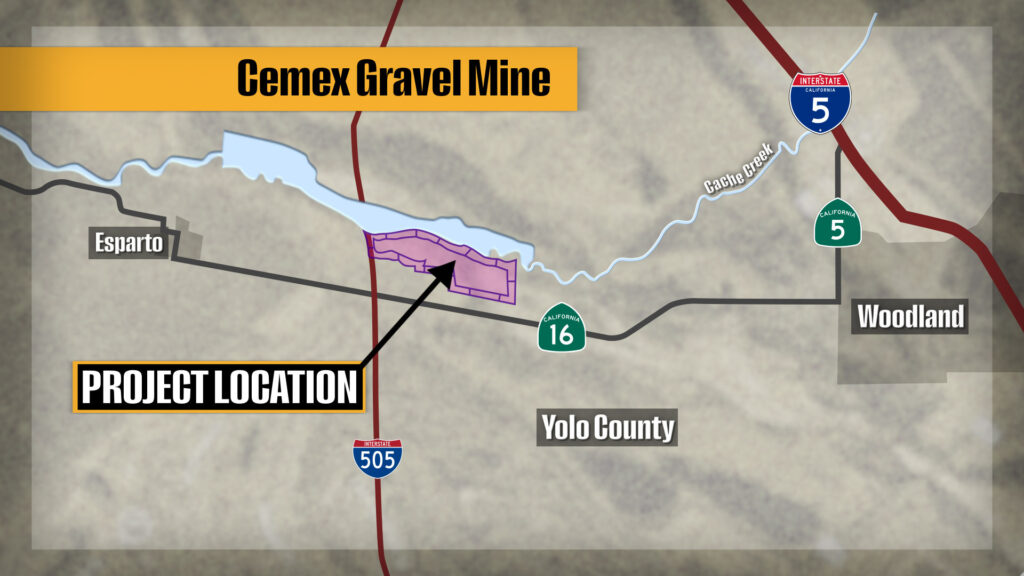
- The Yolo County Board of Supervisors voted to extend Cemex’s permit to mine gravel along Cache Creek.
- The extension grants the company at least 20 more years to operate.
- Supervisors will also revisit the Cache Creek Area Plan, which regulates industrial activities in the area.
For the time being, Cemex gravel mining along Cache Creek in Yolo County is here to stay.
The Yolo County Board of Supervisors voted Tuesday to extend Cemex’s permit to operate its gravel mine for 20 more years. The move came in front of a divided crowd, from which dozens of public speakers stood to express support of and concerns about an industry that’s been operating in the region for over a century.
Some stressed the environmental consequences of gravel mining — like soil and water degradation — and called on supervisors to vote no or delay granting the permit.
“We can imagine a future without gravel mining that still supports everybody,” said Davis resident Gabriela Acosta at the meeting.
Others described the importance of gravel to infrastructure in Yolo County, like the causeway, local streets and buildings, and California more broadly.
“Our quarry provides essential materials. We are literally the building blocks of your communities,” said Debbie Wells, director of communications for Cemex.
After a five-hour discussion, supervisors voted unanimously to extend the Cemex permit until 2047. It was set to expire in 2027.
Next year, the board will also revisit the Cache Creek Area Plan, which regulates gravel mining in Yolo County, implementing land-use restrictions. Cemex agreed to consider the updated plan in its operations.
How is Cache Creek protected?
The CCAP imposes limits on the land used for gravel mining operations and requirements for land reclamation. As part of that plan, Cemex is required to complete projects that restore land to be used for agriculture, habitat restoration or recreation.
Gravel mining requires the digging of deep pits that drop below the water table. As a result, Cemex has converted some of the former mining areas into lakes or ponds surrounded by habitat. For the purposes of CCAP, these count as reclamation projects.
A handful of the public speakers focused on this issue, saying reclamation projects should instead prioritize restoring the kinds of wetlands and habitats that were abundant along Cache Creek before industrial-scale mining operations began in the early 1900s.
“The extension of continued gravel mining will put the creek and its wildlife in danger,” said UC Davis student Alondra Ozuna.
‘Trying to thread the needle’
Supervisors said they needed to balance the needs of the environment with the legal rights of Cemex and the demand for aggregate gravel for construction purposes.
“This is a balancing act and we’re trying to figure it out,” Supervisor Oscar Villegas said.
“I’m trying to thread the needle here,” Chair Vixie-Sandy said.
Supervisor Lucas Frerichs, who raised the issue of revisiting the CCAP in 2026, noted the importance of both the product and environmental restrictions.
“This is one of the more stringent restrictions on mining in the entire state of California,” he said. As a result, if gravel mine operators were to move elsewhere, they would likely be subject to fewer regulations.
The vote didn’t go through without adjustment. After more than five hours of discussion, the board approved the permit. It also included an amendment that Cemex commits 100 acres of land for habitat restoration. That land, which belongs to Cemex, had previously been reclaimed as agricultural land.
Daniel Hennessy joins Abridged from the California Local News Fellowship. He’s a reporter covering Yolo County.