


The Abridged version:
- Seniors at Center High School this week were given imaginary jobs, families and debt, in a simulation meant to teach budgeting skills and financial literacy early on.
- Experts with SchoolsFirst Federal Credit Union regularly host events and offer presentations to students. Interest in financial education has boomed in recent years, they said.
- By 2030-31, schools across California are required to offer a course in personal finance as a graduation requirement.
Buying groceries was one of the most difficult purchases for Morgan Kelly.
“I’m trying to figure out if it’s worth getting higher quality food,” she said. “It’s hard to decide what’s worth it for my family.”
But Kelly doesn’t actually have kids to feed or a spouse to plan meals with. Instead, she’s a high school senior, soon to graduate from Center High School in Antelope and months away from starting school at California State University, Monterey Bay.
Her shopping dilemma was part of a simulation, hosted by SchoolsFirst Federal Credit Union, to teach students like Kelly how to balance a budget and make smart spending decisions.
A growing emphasis on students gaining a financial education, ahead of starting college or entering the workforce, has led to a ramp-up in opportunities in recent years. New state requirements for a personal finance course are also going into effect soon.
“I would love to have had this as a student,” said Brittney Owens, financial education specialist with SchoolsFirst. “I had to go out there and make money mistakes the hard way.”
Students navigate spending simulation
At tables throughout the Center High School gymnasium, volunteers in purple vests played merchants eager to separate students from their fictional dollars.
Each high school senior had been given a pretend job, income and credit score, plus a spouse and children to account for. Sitting in the bleachers, waiting for an app to spit out their assignments, one student called out she was a blogger. Someone else was a carpenter, another a musician.
Then, the crowd dispersed to visit stations selling everything from housing to clothing.
“You want to look professional,” said a volunteer, trying to upsell attire to the student at his table.
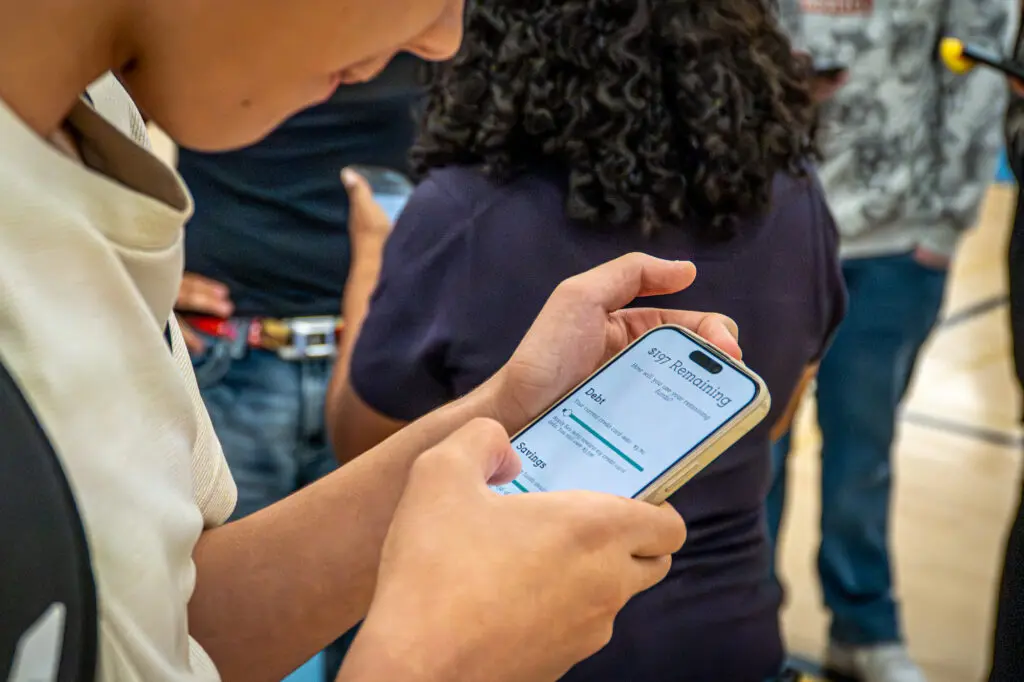
Teens across the gym were easily swayed to spend large sums on bigger apartments, pricier meals and flashier electronics. Several ran through their assigned monthly incomes before finishing shopping.
“I just dropped, like, two grand on a car, bro,” one high schooler said to his peer.
‘It’s like a trial run’
“We learn best when we fail. And we want these kids to fail.” A training video, played for volunteers ahead of students’ arrival, clarified the goal of the exercise is to teach students what not to do, before they end up in an actual bad spot.
Mindy Zielke’s son is a current Center High School senior. With a part-time job, car and bank account, he has had some taste of the real world and how to budget expenses, she said.
But, Zielke said, “This is even more. I think this is nice.”
While in middle school, Zielke had a similar experience. She and classmates were also given a random career and certain amount of money to use wisely.
“It’s memorable,” Zielke said. “It has an impact, because it’s like a trial run.”
“Back then,” she added, “they taught you how to balance a checkbook.” Her son’s experience this week was centered entirely on a phone with a hypothetical checking account.

Teens navigate real life struggles
Like her classmate Kelly, who waffled on which groceries to buy, Nargis Mukhtar said she struggled the most with how to budget for her imaginary children.
“A grown-up can, like, handle any situation,” Mukhtar said. “But for a kid, they should have, like, good education, good clothing.”
At the housing station, a student who had been handed a 472 credit score and 6-month-old daughter, inquired about a small house, to give his fictitious family room to grow.
“Unfortunately, you’re going to need a higher credit score,” was the volunteer’s reply.
Some teens had better luck, yet still wrestled with their options.
“I got, like, a good setup,” said Shane Brown, who was a computer programmer with a little more than $4,000 a month in income. “Had a good credit score and all that, but it’s just, like, annoying when you have to pay for everybody in your family.”
Financial education interest growing
State lawmakers in 2024 approved adding a one-semester personal finance course to high school graduation requirements as part of a bill authored by then-Assemblymember Kevin McCarty. The requirement goes into effect starting the 2030-31 school year.
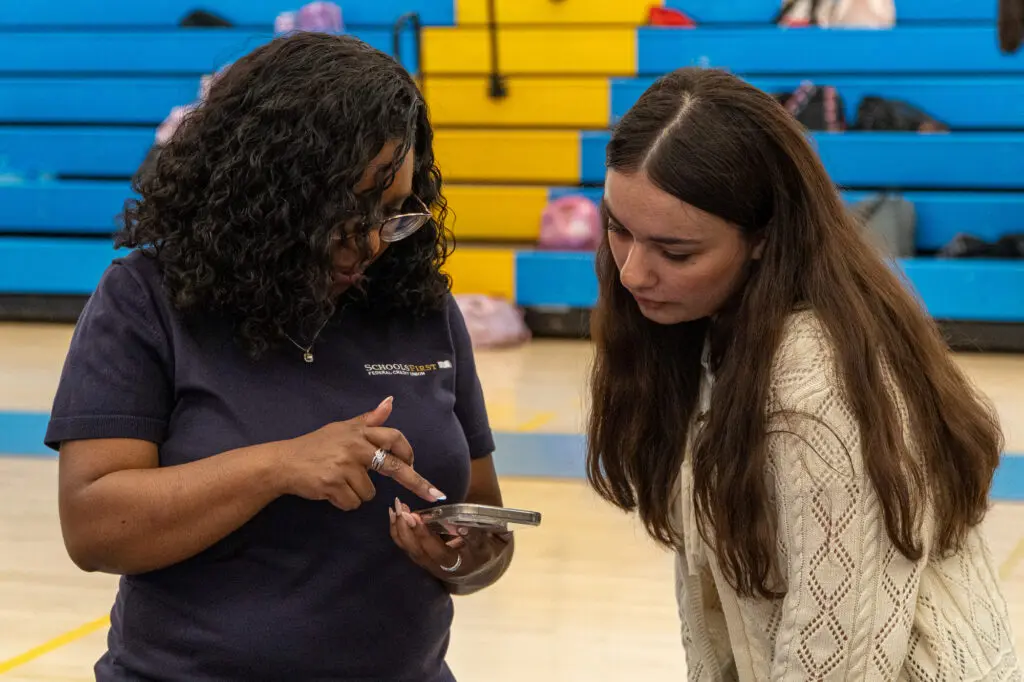
Owens, with the credit union, said she and her colleague host about two to three large events like this each month across Northern California. Other days, she said they are in the classroom, giving presentations on budgets and credit.
When she started her role about six years ago, Owens said she would give roughly 75 presentations annually. Now, between her and her team, that number is closer to 400 a year.
Savannah Kuchar is a reporter covering education. She came to Sacramento to be a part of the Abridged team and contribute to a crucial local news source.