

The Abridged version:
- Many people in Sacramento’s tiny home shelters want to move on to permanent housing.
- Hundreds of people have been served by tiny home shelters, but only a few go on to live independently.
- Nonprofit leaders acknowledge that high levels addiction and mental illness pose a challenge for the sites.
People tend to stick to themselves in the tiny home shelter on Stockton Boulevard.
Beyond the chorus of individual air conditioning units, humming from many of the 155 cabins at the site, it’s quiet.
There’s the occasional person who can be seen leaning against a door frame to smoke a cigarette. Others sit on a small piece of wooden porch near their unit, scrolling on their phones while their dogs sit by idly. One tenant occasionally opens his door and sings out a few lyrics before going inside again. The door opens with a brief burst. And closes with a weak clap.
It’s a tenuous calm in the tiny home shelter as people try to find respite from homelessness and – if they’re part of a lucky but thin cohort – gain enough stability to live on their own again after lives filled with hardship.
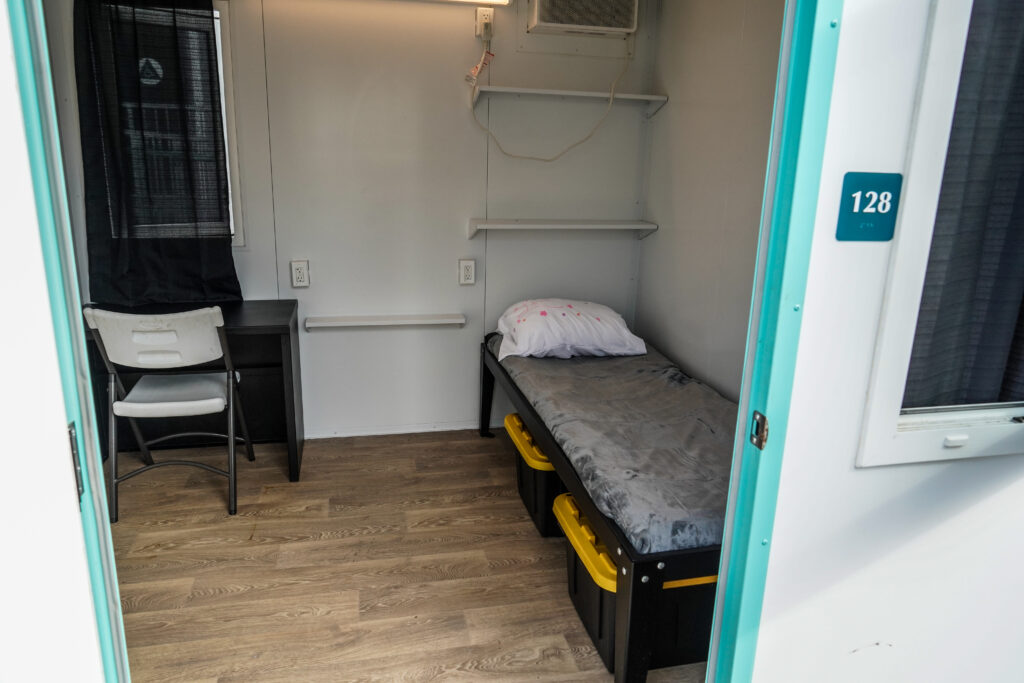
The Sacramento region’s leaders increasingly look to tiny homes as a solution to the homelessness crisis, and the Stockton Safe Stay shelter in South Sacramento is the newest of these shelters. With room for up to 175 people at a time, people get a cabin with a bed, desk, lock and key.
The site launched last December as a collaboration between the city and the county and is fueled by $17.6 million in state funding over the next three years. Those state dollars were earmarked specifically to help the city clear encampments underneath Highway 50 near W and X streets by providing an option for shelter. Shelter managers say the people cleared from the encampments face two choices: a stay at the tiny home shelter or jail.
Abridged spent time in the shelter to learn about the lived experience inside these tiny home villages, especially as local leaders look to put more dollars toward four more tiny home shelters (160 homes total) and set aside more publicly owned land to curb homelessness.
‘It’s a culture shock in a way’
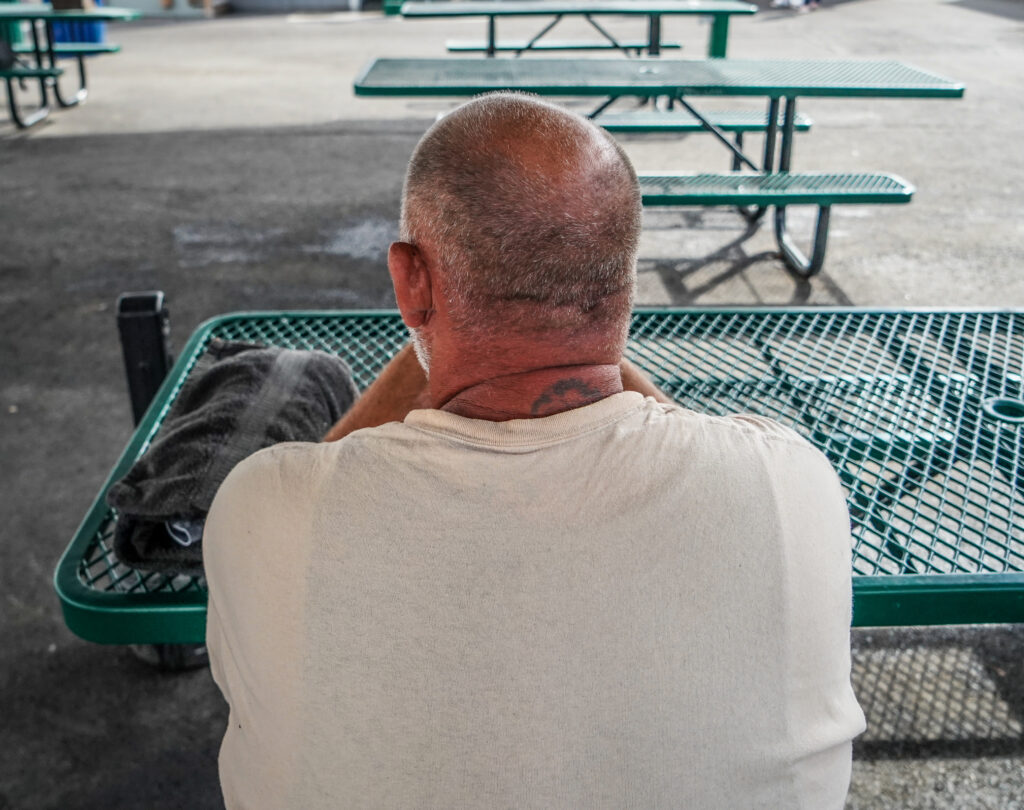
Shawn Caywood, 40, spends his days sitting and people-watching from the site’s communal courtyard area, with its green lunch tables and broad gazebo. He scrolls on his phone and drops into counseling sessions offered on site.
He arrived at the shelter after being on the streets for 10 years. Now 10 months into his stay in the shelter, the first issues that come to mind for him are boredom and overcooked pasta.
“Before I got here, everyone was like ‘it’s gonna be like prison,'” Caywood said.
“Most of us aren’t used to having rules,” he added. “It’s a culture shock in a way”
The road to housing has been difficult for him, especially as he’s seen frequent turnover for case managers. He said he has had three case managers during his time on Stockton, including one that was only there for a few weeks.
Rules, like the 10 p.m. curfew, were frustrating at first, but Caywood said he is used to them now. Staff checks rooms every night and residents are allowed to miss the curfew up to five times per month or otherwise face immediate eviction from the site. There are zero-tolerance rules for drug use and violence at the shelter.
Curfew violations are the top reason for discharges from the site, according to Justin Pagdilao, program director for the site with First Step Communities.
“The biggest thing you gotta worry about in here is other people’s personalities,” Caywood said.
‘All’s I’m waiting for now is housing’
When asked how living in the tiny home shelter is, William Mercer, 55, first recalls the violence he experienced while homeless. Two pins on his well-worn Raiders hat commemorate a dear friend who was killed while living in on the streets of Sacramento.
“No one’s trying to catch people’s tents on fire,” Mercer said.
By comparison, life in the tiny home shelter is much calmer. When tensions do rise, staff aim to de-escalate situations quickly, he said.
Mercer recalled one incident where a resident near the site tried pulling a knife. A security staff member grabbed his arm and quickly disarmed him by saying “you’re not going to hurt me,” Mercer said.
Staff members from First Step Communities clad in the green polos are frequently seen around the site cleaning common areas and restrooms, preparing meals and overseeing the trailer where a stream of movies is projected on the wall.
“I made a lot of friends here,” Mercer said from his spot under the gazebo, his black-and-white Chihuahua, Tiko, napping on top of one of the tables.
He shows off his one-room cabin with pride. Filled with cans of chili and a large cooler, he’s ready for a space where he can cook his own meals.
“All’s I’m waiting for now is housing,” Mercer said.

‘There’s people here nine months, and they don’t have a place’
Frankie Brown, 69, has been at the Stockton Safe Stay Shelter for about a month, after nine years of unstable housing. The experience has left her skeptical and worried about residents cycling back to the street too quickly.
“There’s people here nine months and they don’t have a place,” she said.
Brown’s words trail off, but she adds that she is eager to get back into permanent housing and see her grandchildren.
Attempting to secure housing has been fraught for Brown. She said she called Adult Protective Services for herself in February, as her housing options became unstable. Unable to connect with housing, she said she lived on the streets for months before arriving at Stockton Safe Stay.
The shelter is a rocky solution for her, as she says people she’s been trying to avoid for years while homeless also live in the shelter.
In the meantime, she spends her time in her room, “talking and thinking to myself,” Brown said.
‘I just had tears of joy’
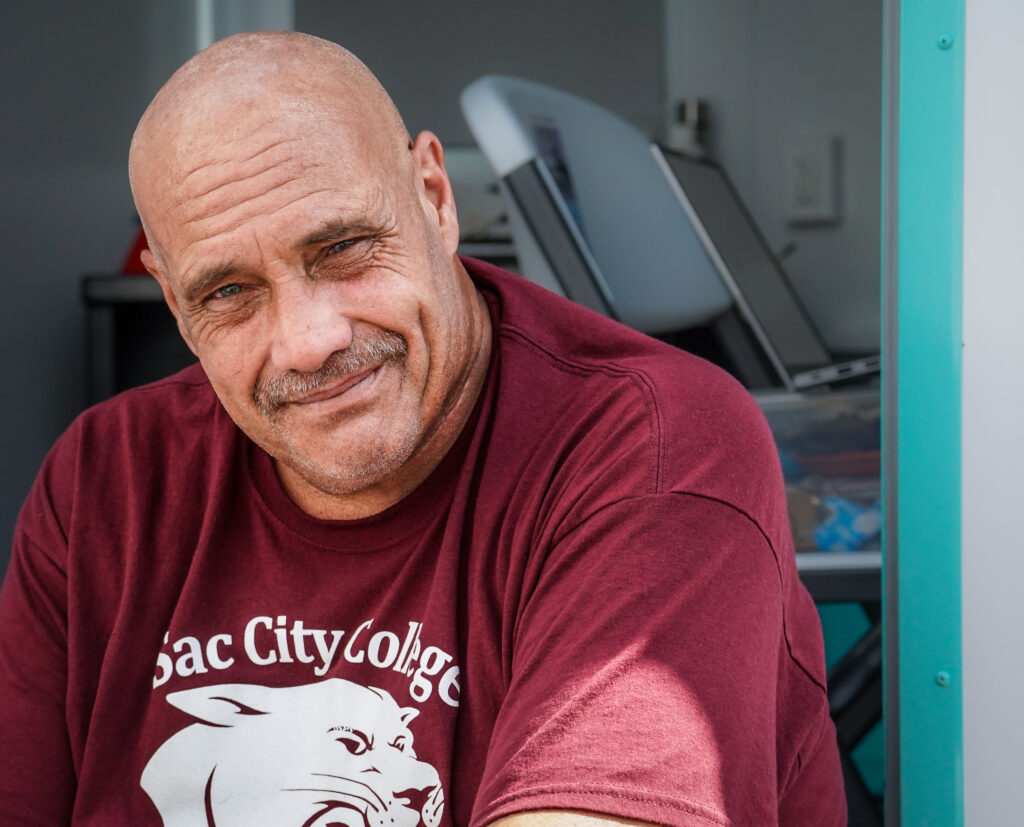
Even from his tent on the banks of a creek near Stockton Boulevard and Elder Creek Road, Kevin Klahn was trying to study for his exams at Sacramento City College.
Klahn, 57, was homeless for nearly a year, when authorities swept the creekside area near where he was sheltering. When he returned to his spot, his tent, identification and all of his belongings were gone.
“Not all of us are smoking dope,” Klahn said. “Some of us are trying to do shit.”
With his school notes and books taken away in the encampment sweep, Klahn flunked his classes that semester and hopelessness set in. Shortly after, he was approached by social service workers with the county, who eventually offered him a spot at the Stockton Safe Stay site.
“I just get so emotional. We got in the truck and drove two minutes” to the tiny home shelter site, Klahn said. “I just had tears of joy.”
He breathed the biggest sigh of relief, he said, knowing he was safe.
“We slept the better part of two days” after arriving, Klahn said, referring to himself and his dog, Dinkles.
Klahn’s tiny home now features small stacks of schoolwork alongside dog food bowls for Dinkles. With pride, he pointed out a thermostat that was set to a chilly 64 degrees.
Now five months into his stay at Stockton Safe Stay, Klahn is reenrolled in classes and nearing completion of an associate’s degree in sociology. He now dreams of going on to get his bachelor’s degree, with the hope of eventually working with troubled youth.
“I just want to save one or two; I don’t need to save the world,” Klahn said.
Most do not land in permanent housing
Since the first site opened in Sacramento in June 2020, hundreds of homeless individuals have received shelter at tiny home shelters overseen by the city of Sacramento and Sacramento County.
While the sites serve different populations, across all sites, the majority of people who leave (by evictions or voluntarily) do not get permanent housing.
During Stockton Safe Stay’s first 10 months of operation, a total of 303 people have been sheltered at the site. As of late September, 24 people have landed permanent housing, according to Sacramento County.
“I’m never quite satisfied, but I think we’re doing very well,” said Stephen Watters, CEO of First Step Communities.
Watters acknowledged that the Stockton Safe Stay site has faced more of an uphill battle than other tiny home shelters operated by First Step Communities. His organization also operates a site at Roseville Road and The Grove, which is aimed at housing young adults ages 18 to 24.
The Stockton Safe Stay site often provides shelter to people swept from encampments near the X Street and W Street corridors under Highway 50. The site, compared to others operated by First Step Communities, has clients with a higher level of mental illness and higher rates of substance use disorders, Watters said.
“There’s a high level of addictions going on,” Watters said. “Some of those folks, they’re not quite ready to be indoors. Some are voluntarily walking, some are not ready to be around other people.”
While the sites offer wraparound services like on-site alcohol and drug counseling, primary care services and a six-week independent living course, not all of those courses are used to their full potential. The schedule for counseling services, while much needed, is not fully booked out, according to Kayley Glaspell, community information specialist with First Step Communities.
Shelter staff face the challenging task of building rapport and providing services to people who have experienced dire situations, violence and may severely distrust authority, Glaspell said
“How do you make someone believe and want something different?” Glaspell said. “This is a place they can live and exist and not get hurt.”
Felicia Alvarez is a reporter at Abridged covering accountability. She’s called Sacramento home since 2015 and has reported on government, health care and breaking news topics for both local and national news outlets.