
The Abridged version:
- What’s not to love about sandhill cranes? Here are some favorite spots in the Sacramento region to watch their graceful return each year.
- Several excellent viewing areas are within less than an hour’s drive.
- The first birds arrive in late September, and by December, over 5,000 are feeding in the close-cropped stubble of the recently harvested grain fields just south and west of Sacramento.
The sandhill cranes arrived yesterday. You always hear them before you see them; their prehistoric calls are unmistakable. You look up but it takes time to spot them. They are way up high, thousands of feet, and the early October sky is cloudless, a dizzying deep blue, shimmering with golden autumn sunlight.
Tracking their calls you finally spot them, a flock, also called a “sedge,” of dozens of birds soaring in a lazy spiral. Seeing them riding the thermals, doing their eons-old “all change partners” dance of meet and greet after a summer apart raising their young, spotting them is a sure promise that another blazing, baking Sacramento summer is ending.
Sandhill cranes, the scientific order Gruiformes, have a genetic lineage at least 60 million years old. Not only is their arrival a sure mark of the season’s change, they have been faithfully marking time this way for epochs. As I try to cope with today’s human world — complex, crowded, conflicted — such simple constancy gives me great comfort. I love these birds!
Sacramento region draws thousands of cranes in winter
Luckily for us Sacramentans, the Sacramento and San Joaquin River deltas are prime wintering ground. The first birds arrive usually in late September, and by December, over 5,000 are feeding in the close-cropped stubble of the recently harvested grain fields just south and west of Sacramento.
From Sacramento, seeing them up close is easy to do. There are several excellent viewing areas within less than an hour’s drive. Our favorite is the Cosumnes River Preserve, also the closest to Sacramento, just off Interstate 5. Access to the ponds is excellent — lots of paved accessible trails, even an accessible boardwalk that runs 400 yards to an observation deck in the middle of the marsh. A plus: front-row sunset-view picnicking: Just bring your own chairs, blankets and food, of course.
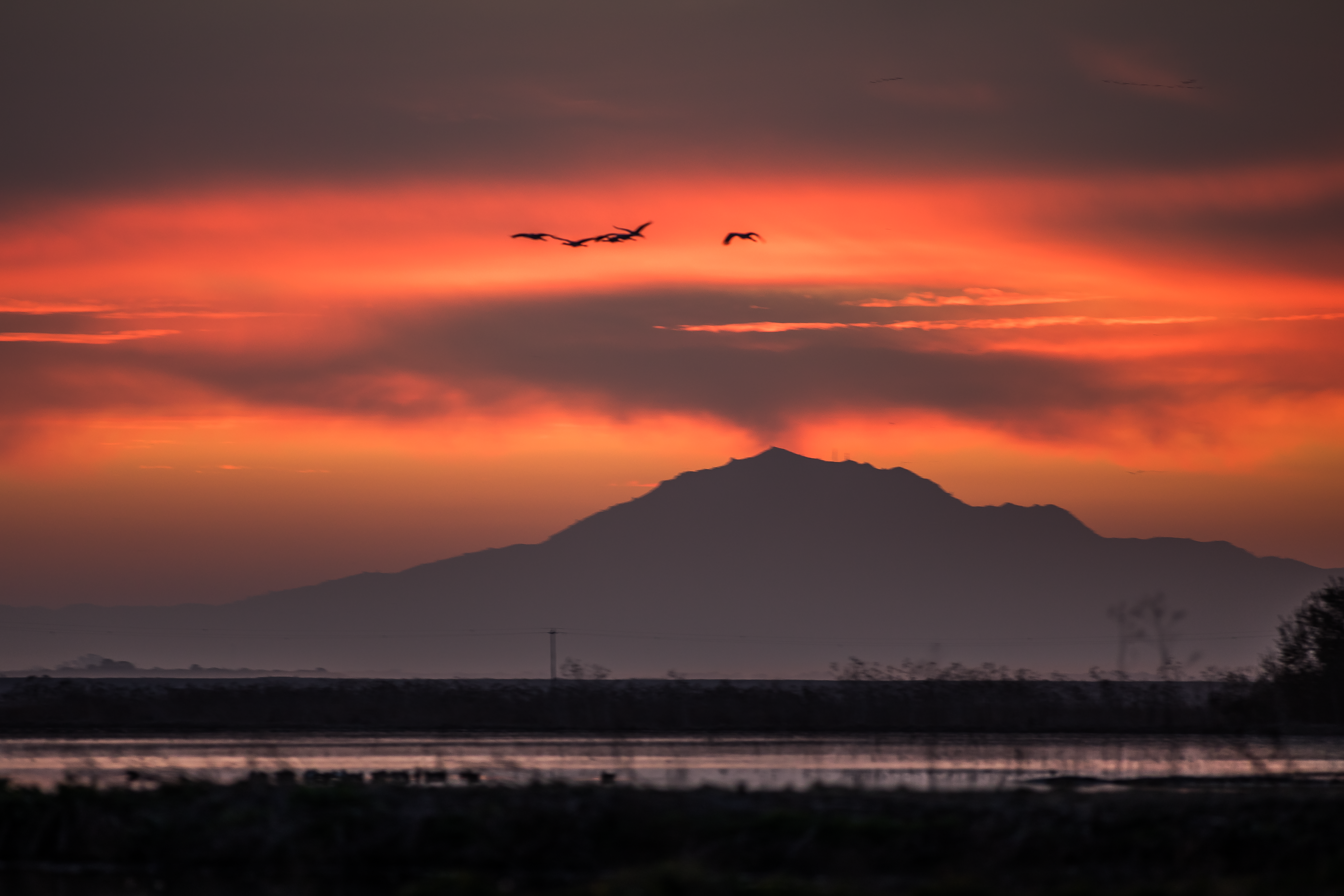
Cosumnes is where the birds roost. You will see them here just before sunrise and just after sunset. We are not morning folk, so we catch the beautiful sunset, then wait another 30 minutes for the cranes to arrive. Don’t leave early. They don’t roost until after sunset, and, on good nights, several hundred will arrive in the 30 minutes between sunset and dark.
Sunset at Cosumnes is a good bet
They glide in on set wings, long necks and legs outstretched, sometimes passing just overhead. Their stuttering baritone cackles, a language tens of millions years old, carries for hundreds of yards across the flat marsh. Against darkening gray-black sky, they drop in like squadrons of gentle, graceful aliens.
As a bonus, well after sunset, with only a dim red glow coloring the sky, is when the small ducks fly. Look closely and you’ll see hundreds swarming past, just overhead, racing to roost in safe water before total darkness falls. Listen too, you’ll hear the whistle of their wing feathers.
If you can, go a night or two before the full moon. At Cosumnes you’ll get a double dip of celestial beauty, a blazing sunset to the west paired with a silver-bright moonrise to the east.
A midday drive in Staten Island
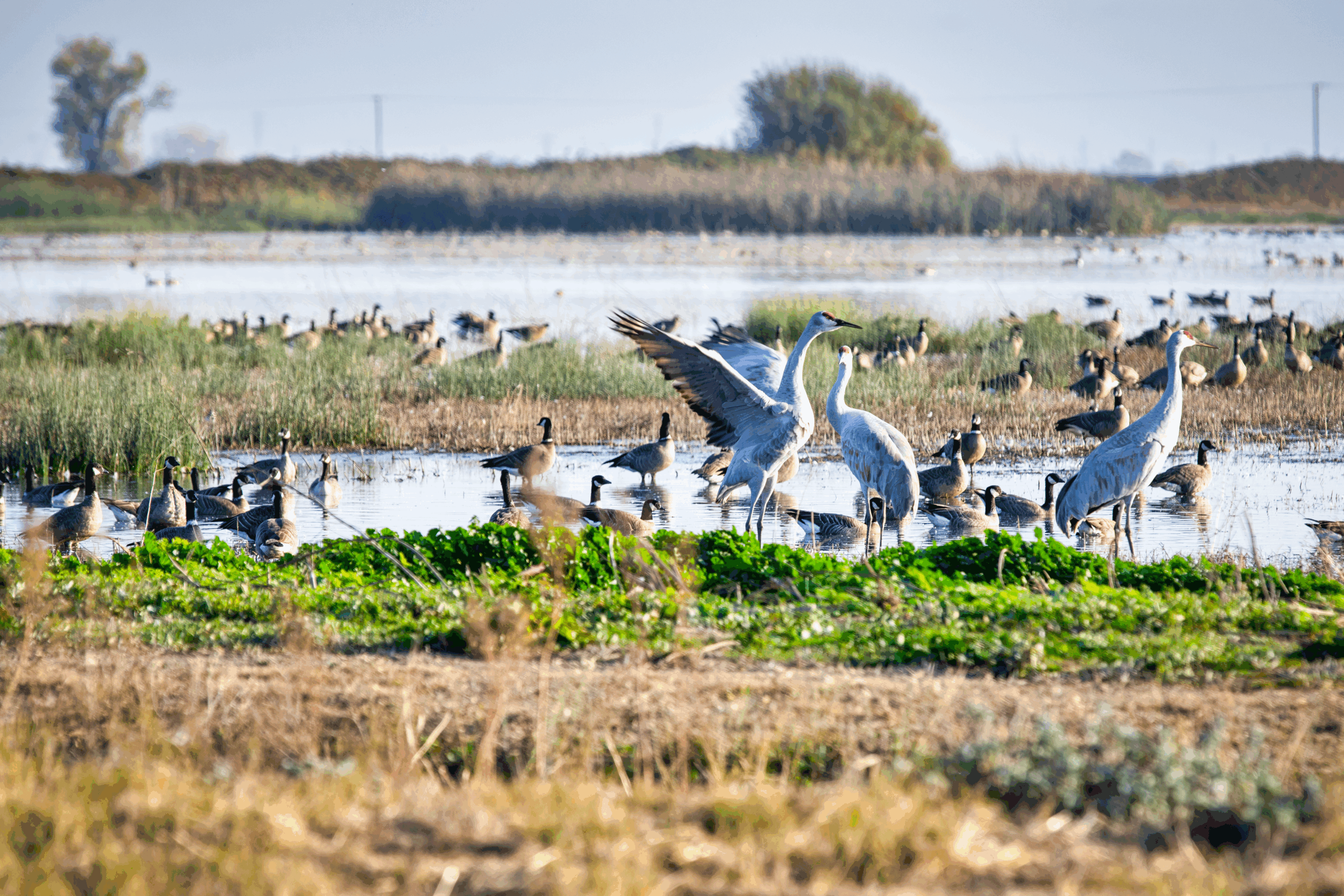
Staten Island, near Lodi, is excellent for midday viewing, as the birds spend all day feeding there. An unpaved road runs 2 miles straight through the wide fields on both sides. While feeding, the birds tend to split into family groups of four to eight. Still, on the 2-mile drive you can often see several hundred birds.
Bring binoculars. The birds are shy in the daylight. They try to keep their distance, getting comfortable only when a hundred yards or so away. Viewing is mostly a driving experience. Only the roadway is public. The fields are private agriculture, so please don’t enter. If you get out of the car, be prepared for muddy feet.
Woodbridge Ecological Reserve is a third option. It is located roughly between the Consumnes Preserve and Staten Island, a bit further south. Access is a bit harder and the property is less developed, but it is well-rated. As relatively new Sacramentans, we’ve not been yet. Perhaps others can provide feedback?
Get up early to book a tour for Woodbridge
California’s Department of Fish and Wildlife offers free sandhill crane tours at Woodbridge Ecological Reserve. Although tours in November are sold out, reservations open up at 9 a.m. on the first working day of the month for the following month, so set your alarms.
Now that the cranes have arrived, we’re planning our return visits, an annual family tradition. Most years, we can’t wait and so make our first visit to the Cosumnes Preserve in early November. This is just to scratch our itch, to be out among the birds again. We make return visits to Cosumnes in December and January when the bird count is at its peak.
In February, we’ll switch strategy and make a daytime trip to Staten Island. With the lengthening days, the birds are preparing to migrate north. As part of their preparation, they will often display their intricate courtship dances as the bonded-for-life couples add one more generation to this bird’s amazing heritage.
Back at home after our February visit, I’ll wait for that warm, sunny afternoon in early March when their prehistoric calls cut through the white noise of city life. I’ll look up, search, spot them and enjoy one final display of their graceful aerobatics before wishing them safe passage until their next return.
Allen Robinson is a retired IT manager, active grandfather and proud Sacramentan since 2017.
Related from PBS KVIE: Rob on the Road: Cosumnes River Preserve