


The Abridged version:
- While difficulties finding or affording childcare are not necessarily new, parents and experts in the Sacramento area say it is getting even harder for many families.
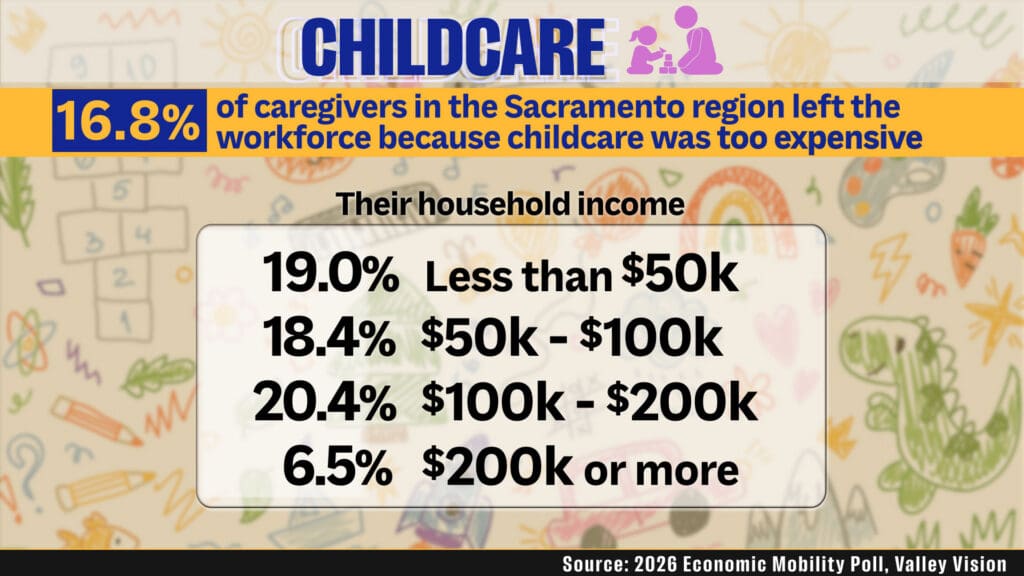
- Valley Vision, a civic leadership group for the Sacramento region, released a poll this week that shows one in six parents are staying home instead of working because childcare is too expensive.
- Factors like rising costs and the statewide expansion of transitional kindergarten have upended the private daycare and preschool industry, according to one business owner.
Childcare is getting harder to find and afford in the Sacramento region, according to parents, experts and new data, who point to rising costs of living and an unsteady industry.
For some families, daycare or preschool is so expensive it makes more sense to live off of one income.
About one in six parents in the Sacramento region say either they or their coparent is staying home to care for their children instead of working, specifically because care outside the house is too expensive. These findings were part of an economic mobility poll, released this week by Valley Vision, a civic leadership nonprofit group for the Sacramento region.
And the impact is disproportionately hitting families with lower income or less education, the data showed.
“We’ve always had an ebb and flow,” said Kari Roberts, owner and director of Alphabet Soup Childcare in Woodland since 1994. “But I have never heard people so desperate as I have in the last five years.”
Choice is a ‘nonstarter’
Alison Alexander, Sacramento mother of three, said she would have stayed home anyway. With young children, she didn’t want to work a full-time job and be away from her kids all day.
But the cost of daycare also made the choice “a nonstarter.”
“A part-time paycheck was not going to cover the cost of childcare,” Alexander said.
Sign Up for the Morning Newsletter
The Abridged morning newsletter lands in your inbox every weekday morning with the latest news from the Sacramento region.
Before having kids, Alexander said she worked a variety of jobs, including in restaurants and as a yoga teacher.
She was preparing to go back to work once her second son, and at the time youngest, was heading into kindergarten. Armed with a special education credential, she planned to begin substitute teaching.
But then her daughter came along as a surprise, and she thought, “There is no point in me going back to work right now until she is in public education — free public education.”

Childcare businesses facing higher costs
Options for affordable preschool or daycare within a reasonable driving distance are thinning, according to Roberts, who has worked in the industry for decades.
Strict city and county regulations can make the process of opening a new childcare center costly or slow-going, she said. Existing businesses are also having to raise prices to keep up with insurance hikes and minimum wage adjustments.
Payroll costs at Roberts’ center have tripled since 2010, she said, while state reimbursements for subsidized spots have not kept up. That leaves a gap for families to pay, and some, Roberts said, just do not have the means.
“And it’s not like we’re an industry that makes, you know, millions of dollars a year and can absorb all of this inflation,” Roberts said.
Transitional kindergarten shakes ecosystem
The statewide expansion of transitional kindergarten has also upended the childcare industry in recent years, Roberts said.
Four-year-olds — TK’s demographic — often keep the centers afloat.
Younger ages need, by law, smaller child-to-adult ratios, meaning higher staffing needs. At Alphabet Soup Childcare, Roberts said care for kids 0-3 years old consumes about 50% of her payroll costs. Those students in turn account for roughly 10% of her center’s income.
“If you take the 4-year-olds out of the ecosystem, you’re going to crash a bunch of daycares,” Roberts said.
She has seen that crash happening all around her. Other facilities in Woodland, she said, stopped offering after-school programs. A few have shut down entirely.
Parents look for alternatives
For parents who cannot afford or find care, alternatives include having one partner stay home. Roberts knows of some young families moving back in with their own parents to make it work.
In the recent Valley Vision survey, more than a third of respondents said they have reduced their hours at work, as a result of being a parent or primary caregiver. A similar number said they have passed or avoided a promotion for the same reason.
The impacts of limited childcare options do not hit families evenly.
Poll data showed parents with an education level below a bachelor’s degree were more likely to stop working and stay home. Almost 20% of families with a household income of less than $50,000 had made that same decision.
More often, Roberts said, she witnesses mothers being the ones to step out of the workforce.
“With the cost of living in California, I don’t even know how they do it on one income,” Roberts said. “But at the same point, if you’re going to work to end up having two nickels to rub together at the end of the month, what’s the point?”
‘It’s a nightmare’
Alexander’s family is facing the possible shuttering of her daughter’s preschool, Edward Kelley. Sacramento City Unified has targeted the Rosemont school for closure as part of multimillion-dollar budget cuts. She has been paying $301 a month for a five-day program, considered a good deal.
The Sacramento mother of three is scrambling to find a plan B for next year.
Her daughter is not yet eligible for transitional kindergarten. “She’s only 3,” Alexander said. She said she visited the school district’s central office looking for alternatives but had no success.
Alexander then tried the Arden Park Recreation & Park District preschool program. “They’re full already.”
If an opening comes up at Arden, she would pay $222 a month — but for just two days a week.
“Then I start looking at private,” though she has not begun to explore what that would cost her, she said.
“There are no options,” Alexander said. “It’s a nightmare.”
Savannah Kuchar is a reporter covering education. She came to Sacramento to be a part of the Abridged team and contribute to a crucial local news source.
Valley Vision will host a webinar Thursday 10 a.m. to discuss findings from their poll, which also surveyed residents of the Sacramento area about transportation, artificial intelligence and housing affordability.