
The Abridged version:
- The Sacramento region has the highest rate of homeownership it has seen in decades, according to U.S. Census data.
- At the same time, the home market remains soft, with few buyers and low housing inventory, with most people staying put and a relatively small number of new homeowners.
- Bay Area transplants are an exception, with many cashing in on the higher median incomes in that region and reinvesting inland.
The Sacramento region’s homeownership rate has risen to its highest level in decades, but most renters are priced out of the market and relatively few sales are taking place.
That’s the paradox at the heart of the local real estate market this spring.
Nearly 64% of family households in the region own their homes, up from about 59% in 2014, according to an analysis of the latest U.S. Census Bureau data by the Sacramento Area Council of Governments. The rate is at its highest reported level since at least 1980, though it is barely higher than the rate in 2006, the height of the housing boom.
Sign Up for the Morning Newsletter
The Abridged morning newsletter lands in your inbox every weekday morning with the latest news from the Sacramento region.
Raw numbers show more stark increase
The raw numbers are even more striking: In 2024, about 615,000 households lived in homes they owned, up from 500,000 in 2014, census data shows. Meanwhile, the number of households living in rentals — about 350,000 — remained roughly constant.
But the real estate market itself is dormant, with most people staying put and a relatively small number of new homeowners — often from the Bay Area — picking from historically low inventory.
“On one hand, we could say something like, ‘Hey, the homeownership rate is the highest it’s been in decades in the region,’” said real estate appraiser Ryan Lundquist, who runs the Sacramento Appraisal Blog. “But, in the way that the market feels, I think so many people are priced out and can’t afford (a home).
“This is a glowing metric in the midst of a market that feels very stuck.”
Monthly sales plummet
About 900 homes have sold, on average, each month in Sacramento County and West Sacramento since the start of 2023, according to data from the Sacramento Association of Realtors. By comparison, about 2,400 homes sold each month from January 2018 through the end of 2023.
High mortgage rates remain a leading culprit. Before inflation boomed following pandemic lockdowns, mortgage rates were near historic lows for many years. Existing homeowners today do not want to give up their 3% interest rates from before the pandemic, and many renters cannot afford to pay the 6.5% mortgage rates on offer.
“It just economically doesn’t make sense to trade that mortgage for a much more expensive one unless you absolutely have to,” said SACOG Senior Planner Dov Kadin, though he added that eventually enough time will pass that formerly low mortgage rates will not have as much effect on the market.
Home prices out of reach for most
Home prices remain out of reach for most renters. The median home sale price in Sacramento County has hovered around $550,000 for roughly four years, while the county’s median household income is around $94,000.
The typical family in the Sacramento metro area would need to pay 37% of their income on a mortgage to buy the median-priced home, assuming they could also come up with the $55,000 down payment, according to the latest NAHB/Wells Fargo Housing Affordability Index. Financial advisers generally say that families should not pay more than 30% of their income on housing payments.
“A lot of people are eyeing the market and going, ‘Hey, I can’t participate,’” Lundquist said.
Bay Area transplants immune
High payments are not as much of an issue for many people relocating from the Bay Area, where the artificial intelligence expansion pushed the median home sales price in San Francisco to more than $2 million in March.
“The Bay Area has long been a source of in-migration,” said SACOG Senior Analyst Garett Ballard-Rosa. “Our thesis is that in-migration — more and more of it is the more affluent.”
Regional housing construction exceeds state
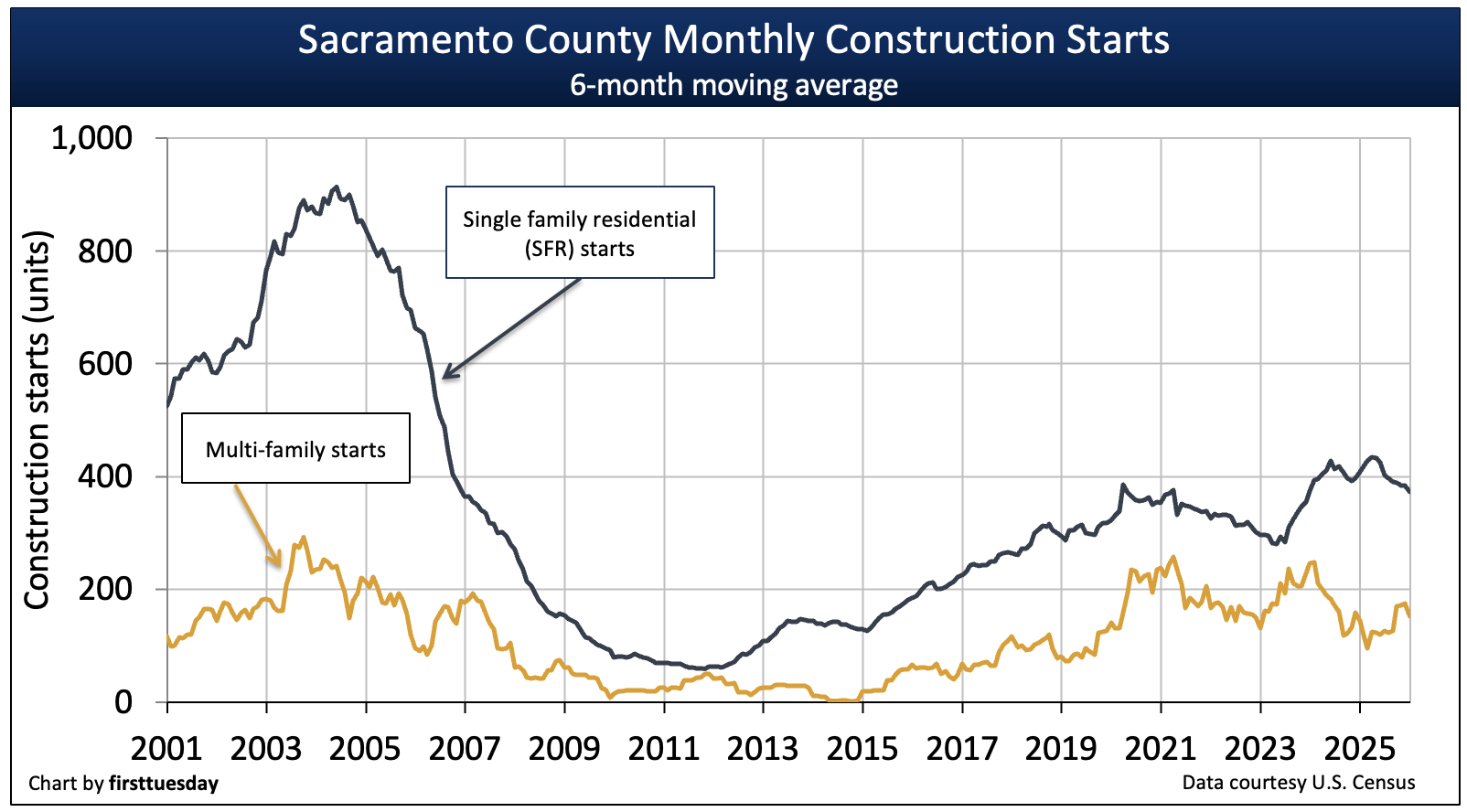
Housing supply is also an issue. The region has seen high construction rates relative to much of California — but not very high compared to the years before 2008. More housing supply can put downward pressure on housing prices, helping with affordability.
“We looked at housing production in the Sacramento region compared to the other large regions in the state,” Ballard-Rosa said. “When you adjust for population size, we found the Sacramento region had the highest per capita housing production for eight years in a row.”
Investors acting differently
With prices barely moving for the last few years, real estate investors are acting differently than they have in the past, Lundquist said. Investors are still out there, scooping up some of the cheapest homes and flipping them for a profit. But they are not buying as many properties and renting them out — a fact that could lead to higher rates of homeownership.
“I don’t think it’s a market where investors are buying and holding,” Lundquist said. “It’s hard to get the math to work.”
A high homeownership rate can be a marker of a healthy regional economy. Homeowners are able to build wealth as prices rise and they pay down their mortgage. If they have fixed-rate mortgages, they are able to lock in housing payments, potentially freeing up cash as their loans age.
Homeowners also can feel a vested interest in their communities. Areas with high homeownership rates are often wealthier, with more desirable schools and low crime rates.
The last time the homeownership rate was this high was 2006, and that didn’t end well. A plethora of bad loans led to a wave of foreclosures that severely hurt the regional economy.
This time, banks have issued mortgages with more care, so experts don’t expect a repeat of the housing bust. “It’s totally fair to say that the loans are better and less predatory,” Kadin said.
Phillip Reese is a regular contributor, writing Numbers Matter for Abridged.