
The Abridged version:
- A large body of research aligns around the idea that belonging, agency and meaning are important pillars in finding joy.
- Cultivating these pillars, which are already present in our lives, is key to maximizing the joy in our lives.
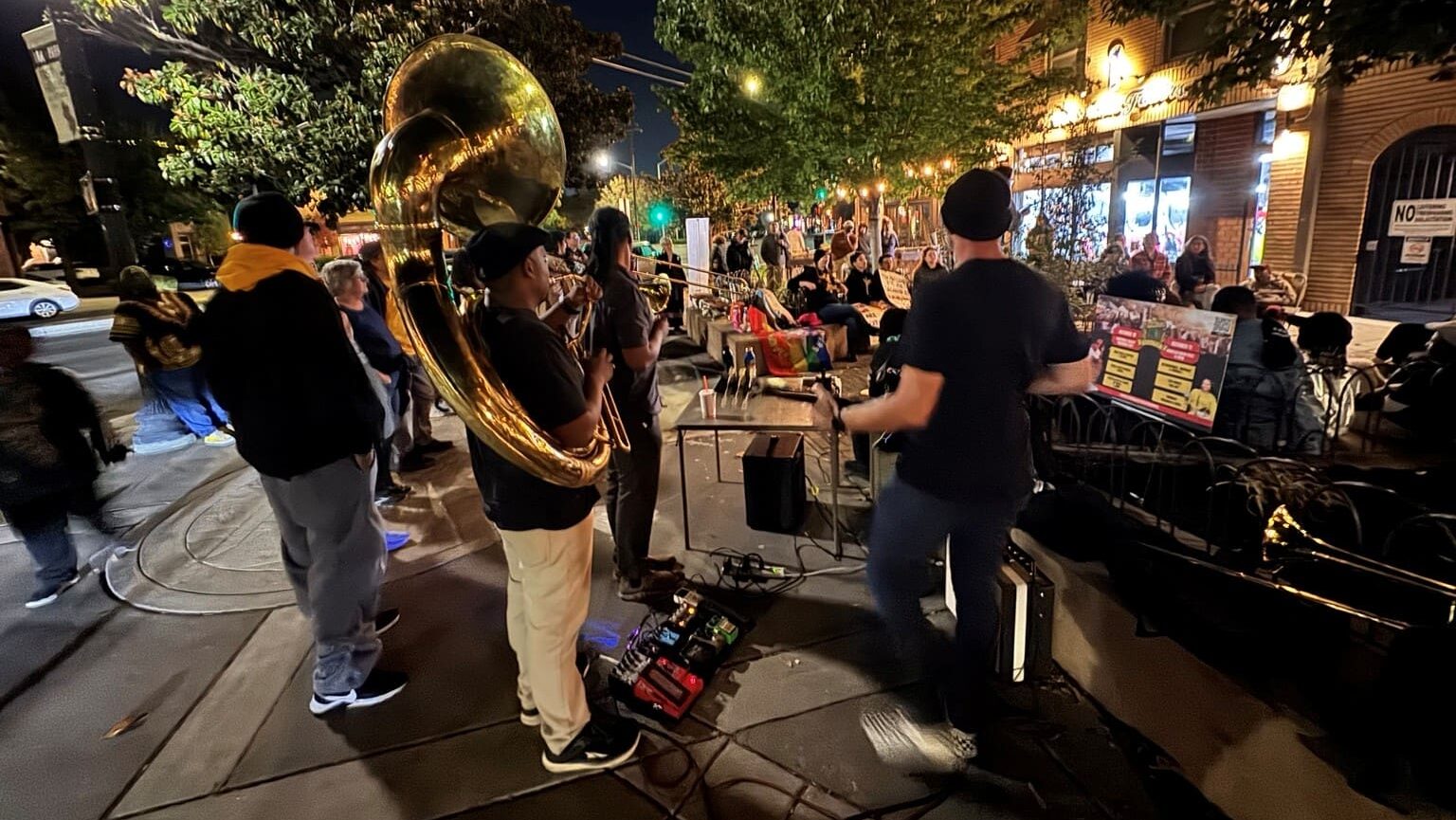
- Sacramento music therapist Tara McConnell explains that music therapy involves engaging with all three of those pillars together.
Andru Defeye served as Sacramento’s poet laureate from 2020-2024 and is the driving force behind Sacramento Poetry Week. In this regular feature, “The Great Joy Hunt,” he explores the science behind joy and shares strategies for adding more to our lives.
In our last episode, we explored queer joy and distilled one of the core ingredients down to belonging. As I was putting that article together, I described belonging as “one of the pillars of a more joyful life.” Since then I haven’t stopped thinking about the other pillars.
Over the past couple of years, the more I read about joy, happiness, neuroscience, psychology and wellbeing, the more the research began to rhyme. From the Harvard Adult Development Study, now more than 80 years old, to Ryan and Deci’s Self-Determination Theory, different fields kept circling the same ideas. The language was slightly different, but they all seemed to be saying the same things.
Belonging. Agency. Meaning.
Across nearly every area of life, from our relationship with ourselves to our families, partners, work and communities, it seems that where belonging, agency and meaning grow, joy follows.
Belonging, agency, and meaning can become powerful diagnostic tools for understanding where joy is missing from our lives. How deeply do you feel connected? Do you have a sense of control over your life? Do your days feel meaningful?
I invited Sacramento music therapist Tara McConnell to help stress test my framework about belonging, agency and meaning. She is the founder and CEO of McConnell Music Therapy, and has worked with thousands of clients with various abilities in hospitals, special education programs and psychiatric settings for the past 30 years. Her work offers an especially practical lens through which to explore these ideas.
“When you said those three things I got chills,” she explains. “Belonging has connected people from every culture in every part of the world since the beginning of time. Agency lets us choose ourselves. Meaning is what makes it all worth doing. And music is an exercise in all three at the same time.”
The joy engine
Imagine your life is an engine. If you want to move forward, you need three things. Belonging is the air. Agency is the spark. Meaning is the fuel.
Without air, the engine chokes and won’t run. Without spark, nothing starts. Without fuel the engine will sputter and die. All three are necessary to move forward. A shortage of any one of them leads to failure of the entire system.
Similarly, when belonging, agency, or meaning is lacking in a relationship or area of our lives, our joy cannot fire on all cylinders.
McConnell sees this every day through music therapy. “We are rhythm and breath and voice,” she says. “Music has the power to reach us in the spaces of our soul, shift the chemistry that shapes our mood, and help us remember what joy feels like—even if only for a moment. Make up a silly song in the shower and you’ve exercised agency. Sing a song from your childhood and you’re transported back through memory. Go to a concert and suddenly you’re singing alongside strangers in community and belonging. Share your story through a song—or even a single drumbeat—and you’re reminded that your voice matters.”
Belonging
Belonging isn’t about fitting in as much as it is about feeling safe to be your most authentic self. Brené Brown poignantly says “True belonging doesn’t require you to change who you are; it requires you to be who you are.”
Maslow, in his famous hierarchy of needs, placed love and belonging immediately after physiological and safety needs.
In their foundational paper, “The Need to Belong,” Roy Baumeister and Mark Leary argue that belonging has two components: frequent, positive interactions with others and
stable relationships in which people genuinely care for one another.
Loneliness researcher John Cacioppo viewed loneliness not simply as being alone but as the perceived absence of meaningful social connection. His work supports the idea that it’s not how many people you have in your circle, but how deep you feel your connections to them, that determines your sense of belonging or loneliness.
Belonging isn’t measured by how many people know your name. It’s measured by how deeply you feel known.
Agency
Many of us confuse agency with control, but agency often means remembering choices we have in situations we do not control. We can’t control the economy, but we can be intentional with where we spend our money. We can’t control death, but we can be intentional with how we live. We can’t control many of life’s outcomes, but we can choose how we’ll respond to them.
Albert Bandura is kind of the godfather of agency in the modern psychology world. Bandura introduced the concept of human agency and developed the theory of self-efficacy. He defined agency: “to be an agent is to intentionally make things happen by one’s actions.”
American psychologist Martin Seligman did some fascinating work on learned helplessness and demonstrated that when people experience situations where they have no control over and over again they can stop trying, even when opportunities to actually change their situation appear.
Agency isn’t about having all the power. It’s about finding the power you have. Control isn’t always possible, but agency is.
Meaning
Meaning isn’t reserved for life’s biggest moments. It’s found in mentoring a young neighbor, writing a poem, planting tomatoes, calling your grandmother, or sitting quietly beside someone who needs you.
Austrian Neurologist and Psychiatrist Viktor Frankl’s work is one of the foundations for modern thought on meaning. One helpful way to understand Frankl’s work is to see meaning as life’s “why” and purpose as its “what” or “how.” Frankl’s idea was that life asks us questions, and meaning arises from our answers.
Frankl broke meaning down into three values; creative values (giving back, creating a work, contributing to the world), experiential values (experiencing something or connecting with someone deeply), and attitudinal values (the stance you take towards unavoidable suffering).
Meaning often survives where happiness doesn’t. Anyone who’s cared for a dying parent, raised a child, or sat beside a grieving friend can attest to this.
But often when we think of meaning and life, we can drift into wildly philosophical, existential territory. Seen through Frankl’s lens, there can be meaning in making dinner on Tuesday night or choosing a particular outfit that reflects how you feel today.
We spend so much of our lives looking for the meaning of life that we forget to make meaning of our lives. Frankl reminds us that meaning isn’t something waiting for us at the end of the journey. It’s something we’re creating in the way we love, the work we do, and the stories we tell ourselves about what all of it means.
Joy may not be another ingredient at all. It may simply be what emerges when belonging, agency, and meaning work together.
The great joy hint
Use belonging, agency, and meaning as diagnostic tools for relationships and areas of your life. Unhappy at work? Feeling stuck in a relationship? Rate your belonging, agency, and meaning on a scale from 1-10 and follow the lowest score. That’s where your joy is leaking.
When we have belonging with little agency we can feel loved but trapped. Conversely, when we have agency with little belonging we can become wildly successful but lonely. Without meaning, life can feel comfortable but empty.
Pay close attention to the places where you feel you belong, where your choices matter, and where your life feels meaningful. Joy isn’t always found by chasing the highest score. Sometimes it’s found by following the lowest one.
Joy leaves clues. More often than not, they look like belonging, agency and meaning.
Andru Defeye is the former poet laureate of Sacramento and a regular contributor, writing The Great Joy Hunt for Abridged.