

The Abridged version:
- Abridged by PBS KVIE is answering your questions about Village Farms before the June 2 election. One reader asked about the potential effects on the environment and another wondered what kind of accountability measures are in place for the developer.
- We’ll continue to answer questions heading into in-person voting. If you have one, ask at the form at the end of this story.
Davis voters are making the final call on Village Farms, a housing development proposed for the northern edge of town. The project, on the June 2 primary ballot, has been in the works for years — and its specific features have gone through multiple rounds of negotiation and revision.
Abridged by PBS KVIE is answering questions from readers about the project.
We’ll be updating the list periodically and answering as many questions as we can before early in-person voting at the polls begins on May 23.
If you have something you would like us to look into, ask us here or in the form below.
Jump to:
- What about the environment? What’s there now and will it be destroyed?
- What’s there now? What about the environment? Will anything be destroyed?
Sign Up for the Yolo County Newsletter
Stay in-the-know on all things Yolo! Weekly email with stories and insights from Yolo County reporter Daniel Hennessy.
What’s there now? What about the environment? Will anything be destroyed?

What’s there now?
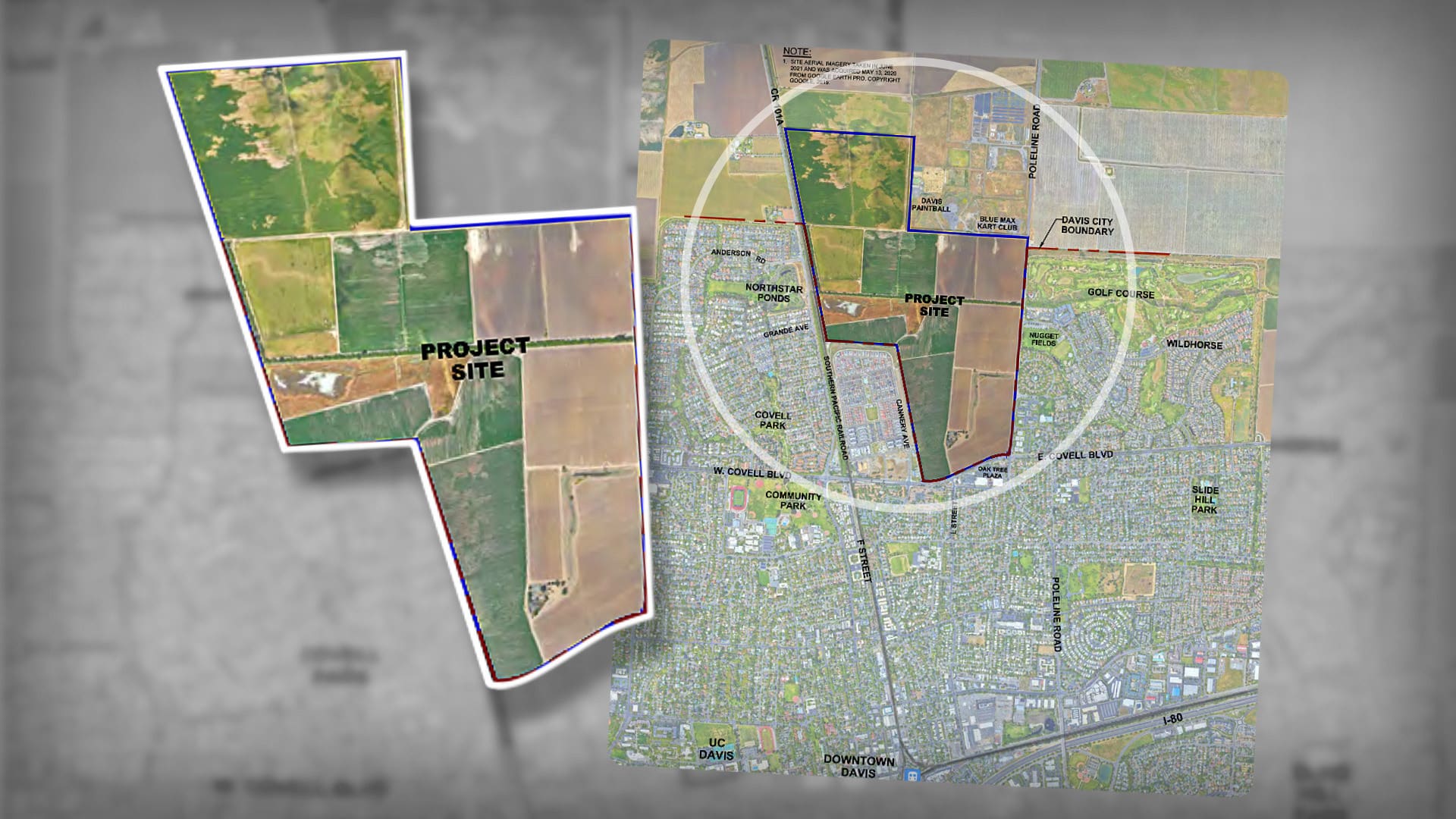
The nearly 500-acre project is proposed for a parcel of land on the northern end of Davis that is mostly used for agricultural purposes. More than 400 of the acres were previously planted with corn, wheat or tomatoes.

What about the environment?
In the approved environmental impact report, many of the issues related to environmental concerns are discussed, including the project’s impacts on soil quality, air quality, water quality, biological resources, vernal pools and agriculture. The report also includes mitigation measures that the developer will take to try to offset some of those impacts.
On just under 30 acres of the project area is a “large alkali playa/alkali wetland complex,” which is inundated with water for at least part of the year. According to a biological survey conducted by a team of biologists from Madrone Ecological Consulting, the wetland hosts a variety of unique species, including threatened vernal pool tadpole shrimp (the biological resources assessment can be found in Appendix D of this environmental impact report).
The city and developers have agreed on a development plan called the Biological Resources Preservation Alternative that would protect most of the wetland.
According to the biologists, there are nearly 10 acres of habitat on the property where vernal pool tadpole shrimp could live.
Will anything be destroyed?
Under the BRPA plan, less than a quarter of 1% of the 9.812 of identified habitat on the property would be destroyed.
Do you have questions about California elections? Where do the governor candidates stand on the issues? What does the insurance commissioner do?
Please join us on May 22 at the Mary L. Stephens-Davis Branch Library as we welcome the nonprofit statewide publication CalMatters as they break down, analyze and answer your burning questions about this year’s primary election, in a conversation centered around the latest edition of their Voter Guide.
What kind of accountability measures are in place to ensure the developers deliver on their promises?
Many of the commitments and project features are recorded in a 101-page agreement between the city of Davis and the developer. The agreement sets the guidelines for the project and establishes rules for cooperation.
Like most contracts, the agreement is enforceable by both parties and if it’s breached, they can take legal action.
Two key components of the agreement include city inspection and an affordable housing milestone.
City inspection of the project
Every year, the Davis city manager will inspect the project. If any issues are found, the city manager brings the report back to the city council with recommendations on how to move forward.
If either party falls short, a written notice detailing the specific problem and ways to fix it is required. The accused party has 60 days to address or begin addressing it. If that doesn’t happen, the agreement can be terminated or legal action can start.
The city also has the right to withhold or delay building permits in this scenario.
Affordable housing commitment
To make sure the affordable housing commitment is met, the city and developer agreed to a milestone to keep the construction of lower income units on track.
By the time 150 building permits for single-family homes are issued during the third phase of the project, construction of at least 100 lower-income affordable units must have started.
The first try on construction for the affordable units is the city’s obligation. If the city can’t get it done, it returns the land and $6 million from the housing trust fund to the developer. Then, the developer takes over this piece of the project.
If the developer doesn’t provide the units, the city can withhold permits.
What are the specifics of the affordable housing plan?
Under Davis Municipal Code, a project of this size is required to include at least 262 units of affordable housing. After multiple rounds of negotiation, the city and developer have come up with a plan to build 360 units priced for people with very low, low and moderate incomes.
- At least 190 units will be priced for people making less than about $68,000 for a household of four.
- 80 units will be priced for people making between $109,000 and $163,000 for a household of four.
- The rest of the units will be reserved for people that make less than $109,000 for a household of four.
Responsibility for the delivery of those units first falls to the city. The developer will provide the city with 16 acres of land on the project site and $6 million for construction of the affordable units. When it’s turned over, the land will have infrastructure, curbs, gutters, sidewalks, utilities, paved street access and service connections.
The city will then be responsible for finding a separate affordable housing developer to construct the physical units and manage the project.
If the city can’t get the job done, officials can pass the responsibility back to the developer, along with the land and money. The city then has the right to withhold building permits during the last phase of the project if the affordable housing isn’t built.
Opponents of the project have expressed concerns related to the timeline of the construction of affordable housing and the fact that the ability to withhold permits comes in the second half of the last phase of the project. By that time, opponents say, most of the development has already been built.
Supporters of the project say this is the largest developer commitment in Davis history and that construction of affordable units will be “prioritized” in the first phase.
Who is responsible for building the grade-separated bike and pedestrian crossings?
The baseline project features say that the developer will provide the landing sites for grade-separated bike and pedestrian crossings. According to the development agreement, the developer will also be responsible for building crossings of F Street and Pole Line Road and preparing a feasibility study for a crossing of Covell Boulevard.
Daniel Hennessy joins Abridged from the California Local News Fellowship. He’s a reporter covering Yolo County.