The Abridged version:
- AgHiRE upskills Spanish-speaking farmworkers in leadership roles, teaching them practical skills for promotions and pay raises.
- Employers provided feedback on the four focus areas needed for their employees: leadership and management, digital literacy, English language skills and ag regulations.
- M Three Ranches’ Frank Muller says he has seen improved confidence and communication in one of his employees who participated.
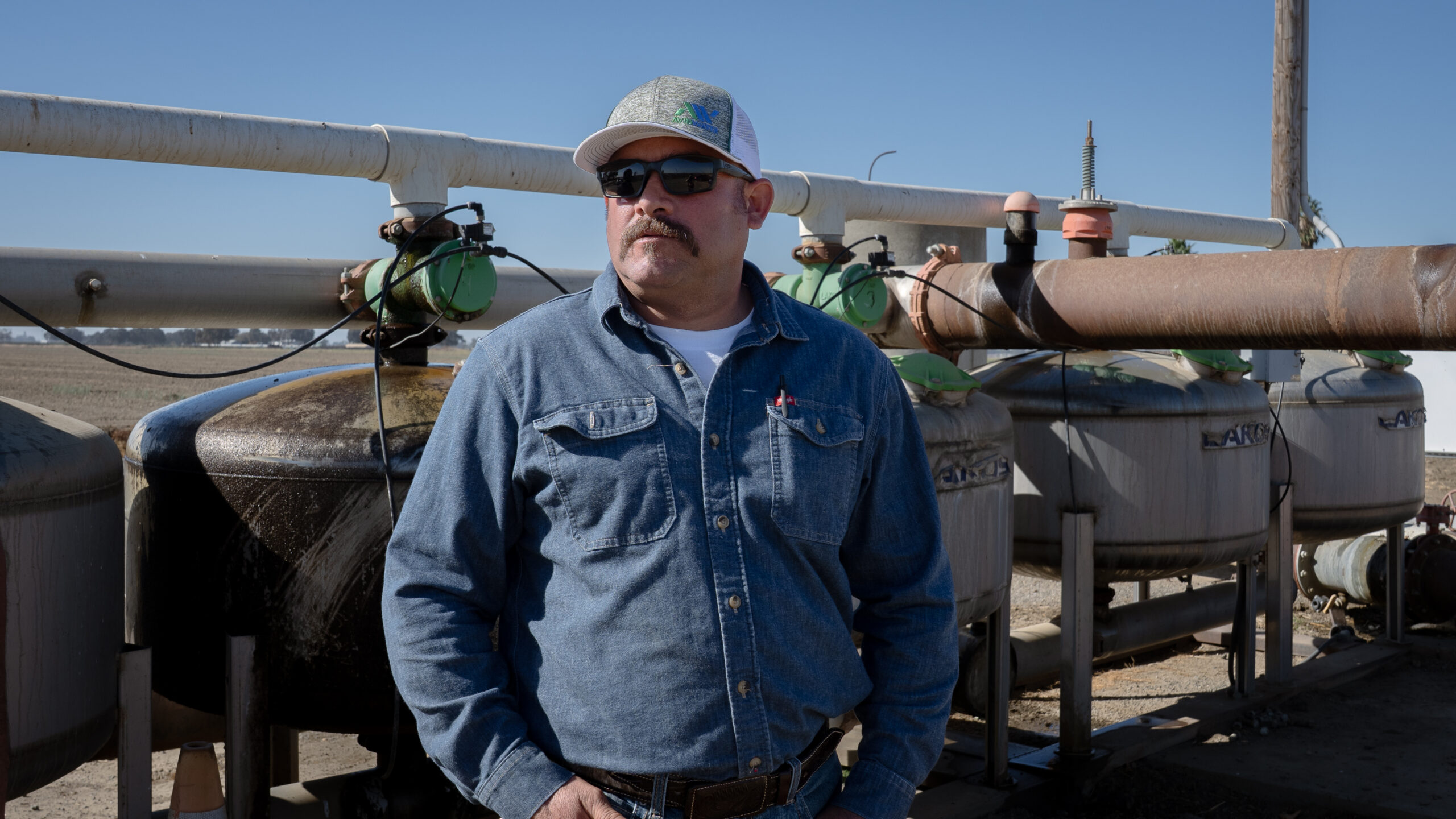
Maurilio Ayala started working with farmer Frank Muller 21 years ago, the same year his eldest of four children was born. Through the years, he gained the trust and respect of his boss, and took on more responsibilities.
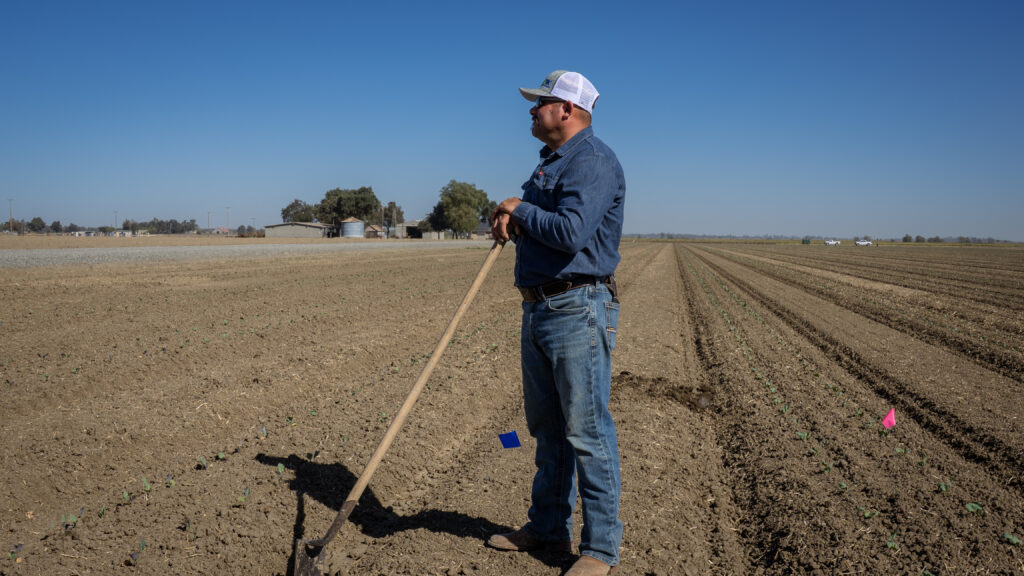
Ayala, now 41, oversees the irrigation systems of M Three Ranches, a large, diversified farming operation in Yolo, Sutter and Solano counties. Most days, Ayala travels around to different sites to ensure crops are being properly watered and to supervise folks installing irrigation systems.
On a hot morning in late September, he visits a site a few miles off Highway 113 to check on a recently planted field of broccoli.
“I have to check right now how this field is doing, that everything is getting enough water,” Ayala says through a translator. “I’m checking that everything is OK.”
Sign Up for the Morning Newsletter
The Abridged morning newsletter lands in your inbox every weekday morning with the latest news from the Sacramento region.
M Three Ranches uses sustainable practices to grow crops such as tomatoes, peppers, garlic, seeds, cucumbers, grapes, walnuts and almonds. The company prioritizes considerations like soil health, water conservation, biodiversity — and workforce training.
In 2024, Ayala, with the blessing of his boss Muller, participated in a three-month workforce development program called AgHiRE, run by Center for Land-Based Learning in Woodland.
The program upskills Spanish-speaking farmworkers already in farm management roles or headed that way, equipping participants with practical skills that improve their leadership on the job, and can result in promotions or salary increases. Many farmworkers have significant experience and knowledge, but no direct path to advancement. Employers, meanwhile, benefit from the development of a strong talent pipeline and workforce stability.
“I think it’s something good both for a supervisor and for the company we work for,” Ayala says. “They teach you more about how to talk to people … how to solve a problem.”
A bucolic setting for programs
Nearly six years ago, Center for Land-Based Learning moved to a new 5,400-square-foot office building on 30 acres of property in Woodland owned by Clark Pacific. The organization operates on a historic farm from the early 1870s, among the oldest in the area, says Mary Kimball, CEO of the nonprofit, as she points out the farm’s location along Cache Creek on the reproduction of an old map. The farm is so old that the modern-day campus of UC Davis is only known on the map as “University Farm,” opened in 1908 as a branch of UC Berkeley.
CLBL used to be on the Winters property of its founder Craig McNamara, a walnut farmer, political activist and son of former U.S. Secretary of Defense Robert McNamara. Woodland is more accessible, with more agricultural infrastructure nearby, Kimball says.
The land is under an agricultural easement with Yolo Land Trust, and CLBL pays $1 a month to Clark Collective (a subsidiary of Clark Pacific) for its 25-year lease, factors that help make its work possible.
“We want to see the long-term metrics of what we’re changing,” Kimball says, noting research into subjects such as soil health and bird populations. “We’re doing all these landscape changes. Are we going to be here?”
Hedgerows circle the farm’s edge, seducing wildlife and beneficial insects. There’s lots of narrowleaf milkweed around, the only host plant for the monarch butterfly.
“It’s not the most attractive plant,” Kimball says. “But they help support the monarch butterfly, so the more we can have, the better.”
An olive tree orchard covers five acres. CLBL works with UC Davis and an industry partner to test out various farm-related practices in the orchard and how they might translate to more acreage. Olive trees are permanent crops with low water requirements and high carbon sequestration.
Three acres of agave grow in another location, near smaller plots leased to new farmers to start their fledgling businesses in a low-risk way. The farm boasts 36 bird boxes, a couple old barns, an old blacksmith shop for welding classes and an old mill, which will soon be the site of a self-guided farm walk. Near the back of the office building, “Grandmother Oak,” a valley oak tree at least 250 years old, rises high into the sky.
Near this oak tree, through the back doors that lead into the headquarters is where the behind-the-scenes work is done for CLBL’s programs. For most of AgHiRE’s classes and events, participants go to Woodland Adult Education, where a couple dozen farmworkers will gather in early December to better their careers, and possibly their lives.
Program focuses on four key areas
Since its founding in 1993 and its designation as a nonprofit in 2001, CLBL has looked beyond the physical landscape of its work — the plants, the crops, the wildlife — to the human labor involved.
For a decade, CLBL ran a two-year apprenticeship program for aspiring farm managers. Although robust, the apprenticeship didn’t serve Spanish-speaking farmworkers, and is on pause due to lack of new funding sources.
Miguel Garcia, who oversees regenerative agriculture programs for Napa County, taught apprenticeship classes on soil health and irrigation water management. Although not involved in AgHiRE, he says he appreciates professional development for the agricultural labor force, especially ones that elevate farmworkers in leadership roles.
“These are the people that spend the most time out in the fields,” Garcia says. “These are the people that are going to be implementing the things that we’re recommending. … They already know a lot. It’s not about going there and re-teaching them or removing what they know. It’s there to enhance what they already know, put their knowledge into context and show them the why behind the how.”
CLBL spent a year soliciting industry feedback on what kind of program was actually needed, Kimball says. That led to AgHiRE, structured with a doable three-month duration. Employers nominate employees and cover their cost of participation. CLBL facilitates the curriculum with partners, including Woodland Adult Education. The smallest farm participant so far was 40 acres and the largest was 19,000 acres.
The program focuses on four areas: leadership and management; digital literacy (modern agriculture uses lots of technology); English language skills within the context of agriculture; and ag compliance in a state with significant regulation.
The first cohort in 2024 had 21 people and the second one in 2025 had 32; only one participant dropped out among those two groups. The average company tenure of the participants was 10 years. Most participants fall within the ages of 30 to 49.
CLBL Bilingual Education Coordinator Oscar Velez (who served as Ayala’s translator for an interview) says the cohort participants see each other a couple times a week, which is in itself beneficial. “You definitely get that sense of community that’s built over that time,” he says.
“This program actually has a big impact in the lives of the participants that have joined,” Velez says. “I’ve not only heard it directly from them, but we’ve seen it now over two years.”

Asking farm employers what’s needed
AgHiRE has received funding from California Workforce Development Board’s High Road Training Partnership and from We Prosper Together, a data-driven plan led by Valley Vision to build a better regional economy. AgHiRE has had participants from farms in Yolo, Yuba, Colusa, Sutter, Sacramento and San Joaquin counties.
Valley Vision worked behind the scenes to bring together industry partners and local training providers, says Liz Kilkenny, a workforce development project manager with the nonprofit.
“Valley Vision does take a little bit of a different perspective when it comes to its workforce development,” Kilkenny says. “We like to ask employers what they need first.”
Rooting the program in employers’ feedback directly contributes to AgHiRE’s success, says Caitlin Blockus, a senior project manager with Valley Vision.
“A lot of times (in) workforce development, when folks don’t do that, it’s not as effective,” Blockus says. “We all want to uplift communities. We all want to see folks thrive. But when we’re not basing it in that end goal of, how can this benefit employers or how can we bring them into the system, we wind up with disconnected programs where folks get trained towards nothing or towards something that might not be present.”
Valley Vision’s work is typically about long-term planning and what jobs will be in demand in five to 10 years — the fruit of their labor often not immediately visible.
California, as the top agricultural-producing state in the country, supports about 407,000 jobs. About 40 million acres, or 40% of the state’s land is used for agriculture, according to the Public Policy Institute of California. In 2022, the Working Lands sector in the greater Sacramento region (includes agriculture, food, wood products, logging and mining) accounted for 58,719 jobs. That region covers the counties of Colusa, El Dorado, Nevada, Placer, Sacramento, Sutter, Yolo and Yuba.
“Workforce development is very nebulous,” Kilkenny says, adding that in the case of AgHiRE, they were able to see immediate positive outputs, including participants’ reports of increased confidence in the workplace, improved communication and being able to apply lessons learned regarding regulation.
Half of the participants in the most recent cohort received a wage increase within 90 days of completing the program, with an average increase of $4.12 per hour among those who received one, according to a CLBL report.
“It’s very easy to place people into farming jobs,” Kilkenny says. “You can become a picker of some kind. You can plant, you can do something along that line. But the next stage can be very hard for workforce development to tackle.”
AgHiRE, she says, helps provide that pipeline.
“This is one of those projects that really walks the walk, where we’re not just talking about uplifting communities and what might be great, but taking this population of workers and really equipping them with skills and opportunities that can change their career and change their lives,” Blockus says. “You know, it’s a little cheesy, but one of the things that drives me in workforce development is that a good job can change a life.”

The next step in his career
When Ayala completed the AgHiRE program, his employer, Frank Muller, moved him from an hourly position to salaried. Muller says that shift had been discussed for a couple years, but “certainly the growth we saw in him from his participation gave us further incentive to move to salary.”
M Three Ranches has had four individual employees participate across both AgHiRE cohorts, and the business has currently enrolled three employees for this winter’s cohort (two are returning for their second year in the program).
“Maurilio has become more confident in his interaction with the employees that he supervises and is more confident when having a discussion with the ownership team,” Fuller says. “He has a better understanding of laws and regulations and can articulate the importance of compliance to his co-workers. Maurilio also has a better understanding of how to communicate effectively with his employees.”
Ayala says the leadership and management aspects, especially, helped boost his confidence. “I was a very, very shy person,” he says, “and in the last classes … I felt like I opened up a little more.”
Ayala, who was one of five people to participate in both years of the program, attended a graduation ceremony with his most recent cohort last spring, where participants, their family members and their bosses came together to celebrate. Muller says he was “overcome by the emotion and sense of accomplishment of the graduating classes.”
“It was very beautiful,” Ayala says, smiling on that September morning at the site of the broccoli planting in Yolo County, his sunglasses on, the heat beating down, a whole day of work still ahead of him.