

The Abridged version:
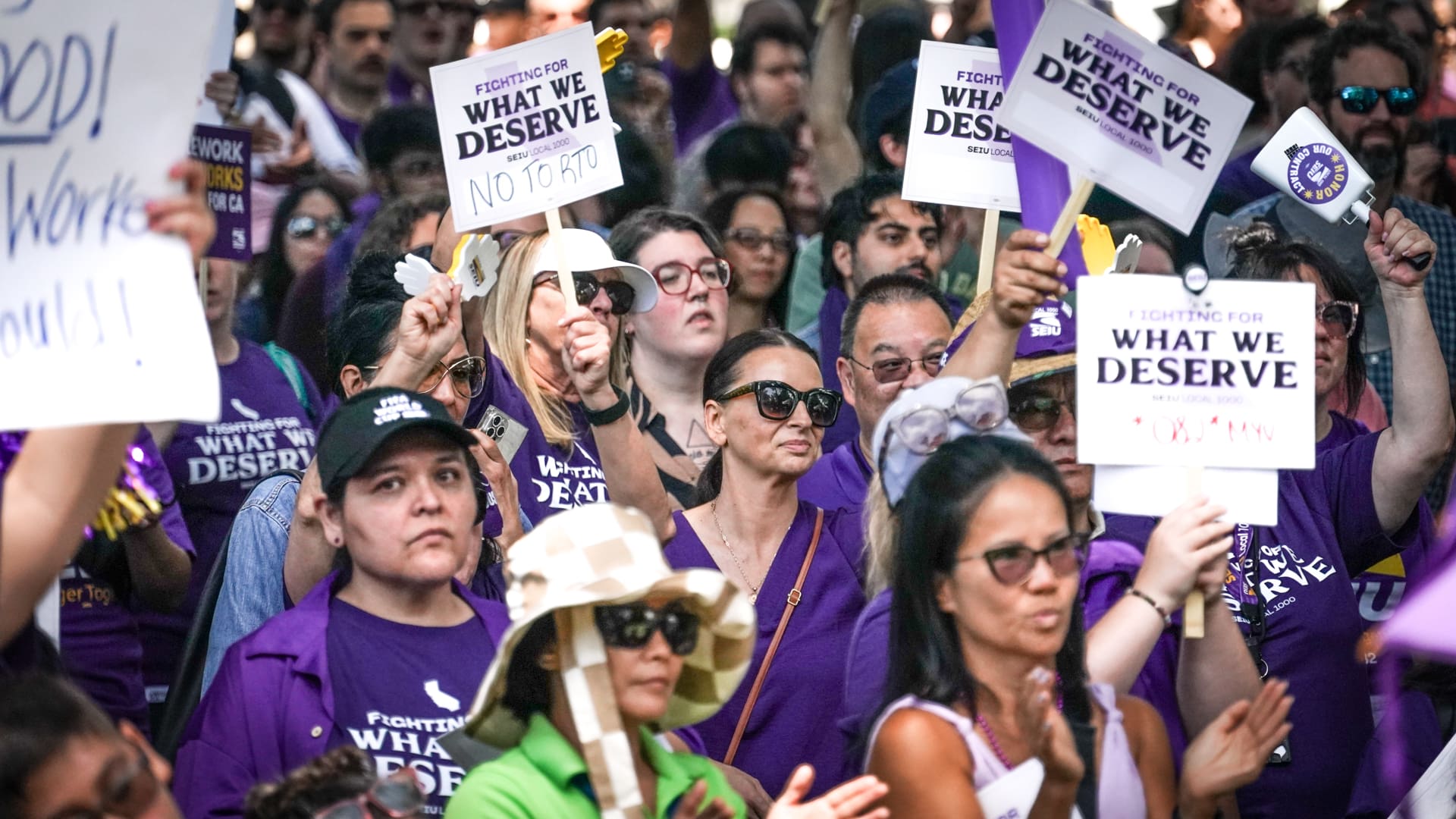
- Over 1,500 state workers arrived outside the Capitol on Wednesday afternoon to decry the scale-back of telework, after years of being able to work fully remote or only two days per week in person.
- Gov. Gavin Newsom’s executive order mandating that state workers return in person four days per week went into effect on July 1.
- The state’s largest union, SEIU Local 1000, is demanding a 20% salary increase over the next three years for its members, citing affordability concerns.
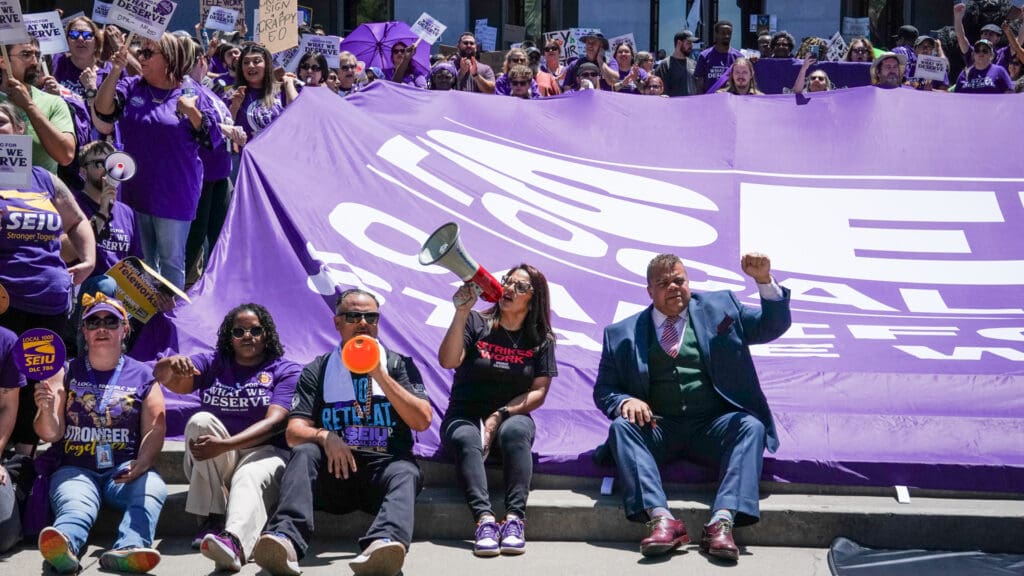
Over 1,500 state workers filled the steps of the Capitol on Wednesday afternoon, expressing their discontent with a long dreaded return-to-office mandate that officially went into effect.
July 1 marked the first day where most state workers will be required to work in person four days per week under an executive order from Gov. Gavin Newsom.
The change marks the largest shift of workers to Downtown Sacramento and other state offices since the COVID-19 pandemic began in 2020. During lockdowns, telework was broadly adopted, and state workers returned to working in offices two days per week in 2024.
Sign Up for the Morning Newsletter
The Abridged morning newsletter lands in your inbox every weekday morning with the latest news from the Sacramento region.
“This is the fight of our lives,” said Jacqueline Tkac, president of the California Association of Professional Scientists, United Auto Workers Local 1115. “This is the fight for the future of public service.”
Union leaders accused Newsom of trying to undermine the union’s collective bargaining efforts by issuing the return-to-office mandate.
Service Employees International Union Local 1000’s latest demands center on issues of affordability. July 1 also marked the expiration of the union’s contract with the state and the beginning of a new set of contract negotiations for its 96,000 members.
The union is demanding a 20% salary increase over the next three years and increased contributions toward healthcare costs.
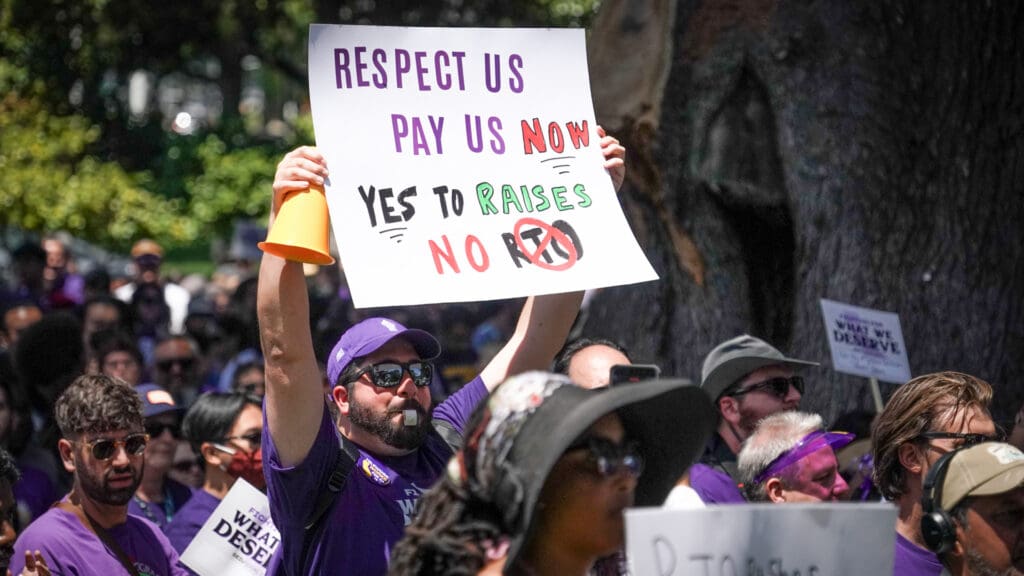
Telework also remains at center stage, as proponents urge that remote work would allow employees to avoid traffic-ridden commutes, gas costs and parking fees. The two-day-per-week schedule was also estimated to create $225 million in annual savings for the state, according to a state auditors report.
Employees worry about commute times, financial strain
Gina Galvez made an hour-and-a-half commute to the Employment Development Department on the first day of the new return-to-office mandate. When she arrived at her office, she still found herself on virtual meetings and surrounded by empty desks, as many coworkers on her immediate team work in other regions.
While Newsom has cited the benefits of building community as one reason for the mandate, Galvez questioned whether collaboration would look different.
“I feel I do my work efficiently from home. … None of my coworkers are here,” Galvez said.

Galvez added that telework previously allowed her enough time to finish her undergraduate degree while working for the state full time as well. In recent months, she had been planning on starting a small jewelry business on the side, but those plans are now on hold.
“I think it’s putting people at a disadvantage, because time is money,” Galvez.
Mathew Murillo, a longtime state worker who currently works at the Department of Motor Vehicles, worried about how transportation costs would hit his budget.
“It’s hard, it changes life completely,” Murillo said. “Financially it’s a strain, and everything is already stretched to the nines.”
Local leaders divided on telework efforts
Sacramento’s local leaders have looked to the return of office workers as one way to infuse new life into Downtown Sacramento.
In 2022, former Sacramento Mayor Darrell Steinberg said he would “shout to the rooftops to the governor” to bring state workers back downtown, KCRA 3 reported.
Mayor Kevin McCarty has continued that support for bringing state workers back, telling Abridged by PBS KVIE earlier this year that he supported the governor’s approach and that “having more people working downtown delivers tremendous economic and social benefits to Sacramento.”
Wednesday’s protest also featured the faces of some locally elected leaders. Assemblymember Maggy Krell was present at the state worker protest on Wednesday, as well as City Councilmember Caity Maple.
Others are backing an effort in the state Legislature, Assembly Bill 1729, that would require all state agencies to develop telework plans for their workers. The bill currently has 10 coauthors, including local Assemblymembers Stephanie Nguyen, D-Elk Grove, and Josh Hoover, R-Folsom.
Councilmembers Phil Pluckebaum and Mai Vang have also voiced support for AB 1729. The bill is currently awaiting a vote before the state Senate, and if passed, would eventually require a signature from the governor.
Felicia Alvarez is a reporter at Abridged covering accountability. She’s called Sacramento home since 2015 and has reported on government, health care and breaking news topics for both local and national news outlets.