The Abridged version:
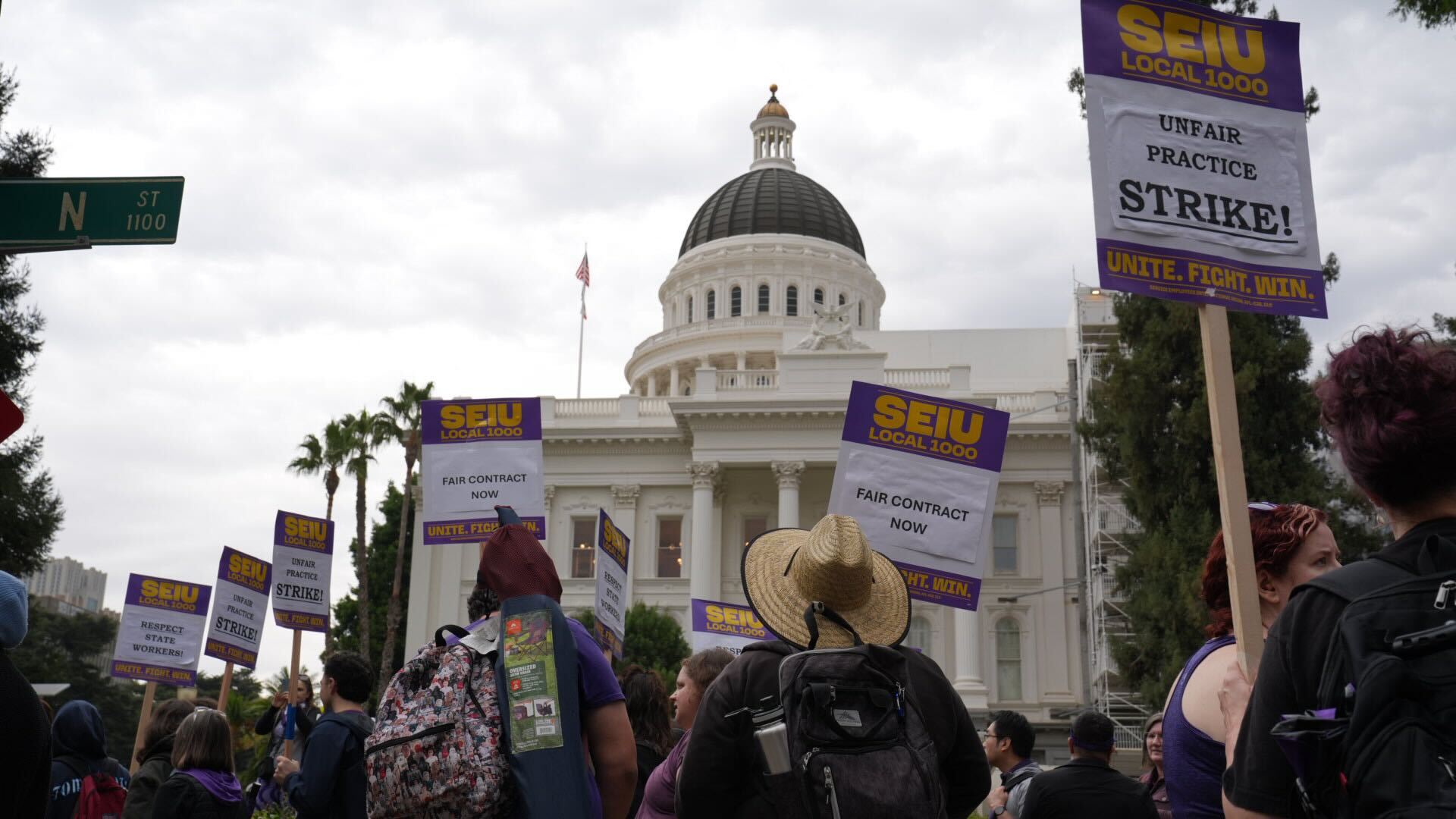
- Thousands of California state workers took part in a one-day SEIU Local 1000 strike amid a bargaining standoff between the union and the state.
- Many striking in Downtown Sacramento said they are open to walking off the job again if negotiations remain stalled. Union leaders maintain the workforce is willing to take more action.
- The union has gone without a new contract since July, and many workers on strike said higher wages and more telework flexibility are key priorities.
As thousands of California state workers concluded a one-day strike Wednesday, their union called for an escalation in labor actions amid ongoing contract talks with Gov. Gavin Newsom’s administration.
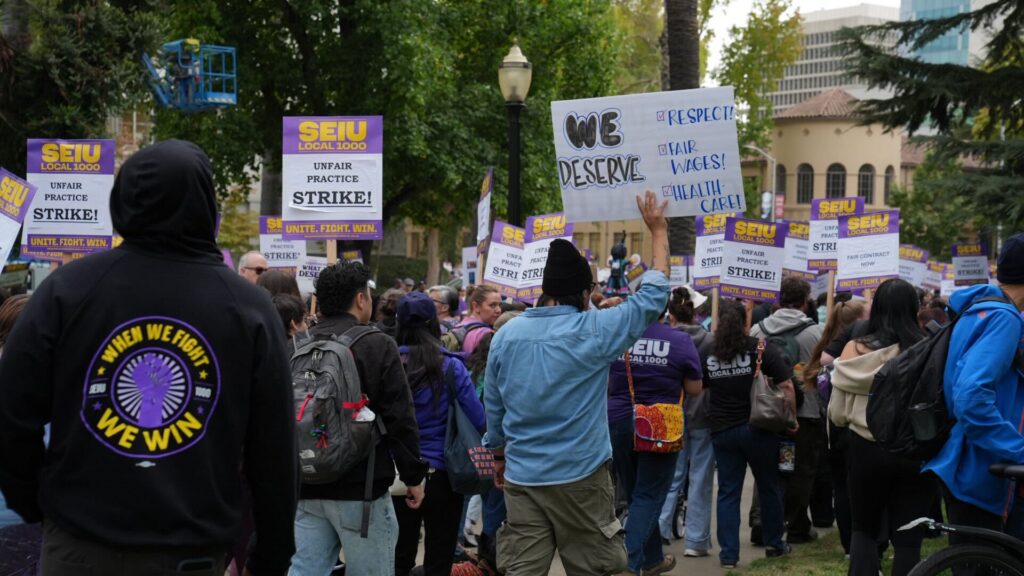
“If they continue to bargain in bad faith, we are prepared to escalate,” Service Employees International Union Local 1000 President Anica Walls told more than 1,000 state workers picketing outside a CalHR building in Downtown Sacramento.
Wednesday’s one-day strike already broke precedent as Local 1000’s first work stoppage. But a potential longer strike could push the union even further into uncharted territory.
Sign Up for the Morning Newsletter
The Abridged morning newsletter lands in your inbox every weekday morning with the latest news from the Sacramento region.
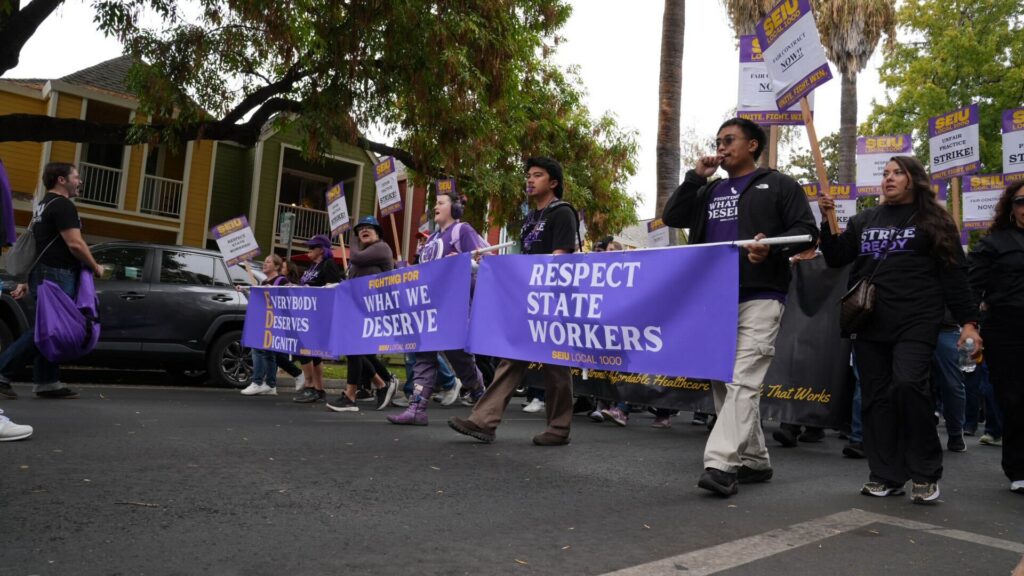
Starting before dawn, thousands of purple-clad state workers from agencies including CalSTRS, CalRecycle, the Employment Development Department and CAL FIRE flooded Downtown Sacramento picket lines.
They topped off the action with an afternoon march past the Capitol and around the O Street building housing California lawmakers’ offices.
What led to the SEIU strike
Local 1000 and the administration have been negotiating the union’s next contract since April, which state workers hope will include a 20% general salary increase over three years and more flexibility to telework, among other highlights.
Earlier this month, California’s labor board held that talks had reached an impasse. Days later, union members voted to strike — not over the impasse, but due to what Local 1000 officials say have been unfair tactics by Newsom’s side throughout negotiations.
The sides have been in mediation with a state-appointed referee since mid-October.
As the strike wrapped up, “I (would) bet what both sides are watching very closely is how many employees honor the strike,” even if they weren’t on a picket line, said Tim Yeung, a labor and employment lawyer with Sloan Sakai Yeung & Wong.
“If more than 50% of people actually showed up (to work), that’s not very effective.”
Neither Local 1000 nor CalHR — the agency that represents the administration in labor talks — said Wednesday evening how many workers they believe participated.
“We do not have an overall count of strike participation. Individual departments manage their own staffing and leave records,” Angela Musallam, CalHR’s deputy director of communications, said by email.
As for the union, spokesperson Amber Rich said, “We saw tens of thousands of state workers walk off the job across California today.”
But, “not everyone checked in at events, so we don’t have a hard number,” she said.
Tracking the strike’s turnout
Typically, public employers and unions alike keep track of strike numbers, according to Yeung.
While they might not have exact figures the day of the strike, “when I’m advising one of my (employer) clients during a strike, at each department level they’re keeping track … they’re feeding those numbers up,” he said.
“By the end of the day, it’s not going to be exact, but we’d have an idea,” he said.
As for unions, they at least often track how many people register at picket lines, Yeung said.
However many people participated Wednesday, Local 1000 worked to send a strong message that more actions may be coming.
“Today may be our strike day, but it won’t be the last time we collectively show our power,” Walls said at the picket line.
Several state workers who Abridged by PBS KVIE spoke with about further actions said they would be willing to strike for longer.
“I’m willing to come back out here again,” Morgan Rinkin, an analyst at CalSTRS, said at a picket near CalHR’s R Street office.
“I feel like today is about testing the waters and seeing what we’re capable of.”
Some were more wary.
“That’s something I’d have to discuss with my family, if we’re going to ride with the longer strike,” said Letticia Gilmore, a State Water Resources Control Board office technician, outside the California Secretary of State building.
“Some people, they may only have a one-income household, so while this strike is important,” continuing it could be difficult, she said.
Are one-day strikes effective?
In Yeung’s view, one-day strikes are not as effective in changing employers’ positions as longer work stoppages.
“The purpose of a strike is to disrupt or shut down the employer’s operations,” he said. “It’s an economic weapon.”
“A one-day strike is relatively limited in its ability to really shut down an employer. Most employers can probably get by with a day,” Yeung added.
Public worker strikes often last three or four days, he said. Whether state workers could be fired for striking for five consecutive days without leave is an open question, according to Yeung.
Under California law, “absence without leave, whether voluntary or involuntary, for five consecutive working days is an automatic resignation from state service.”
But according to Yeung, “I don’t think there’s been any court decisions on whether, if you want to strike, that would be an exception to the AWOL statute.”
Finally, some of a public labor campaign’s success comes down to whether popular opinion lies with workers.
For professions that often strike effectively, such as nurses and teachers, “they stick together, but they also get a lot of public support,” Yeung said.
As for state workers, he said, “what I can’t assess is, is the public also going to pressure the governor and CalHR to change their position?”